Key Takeaways
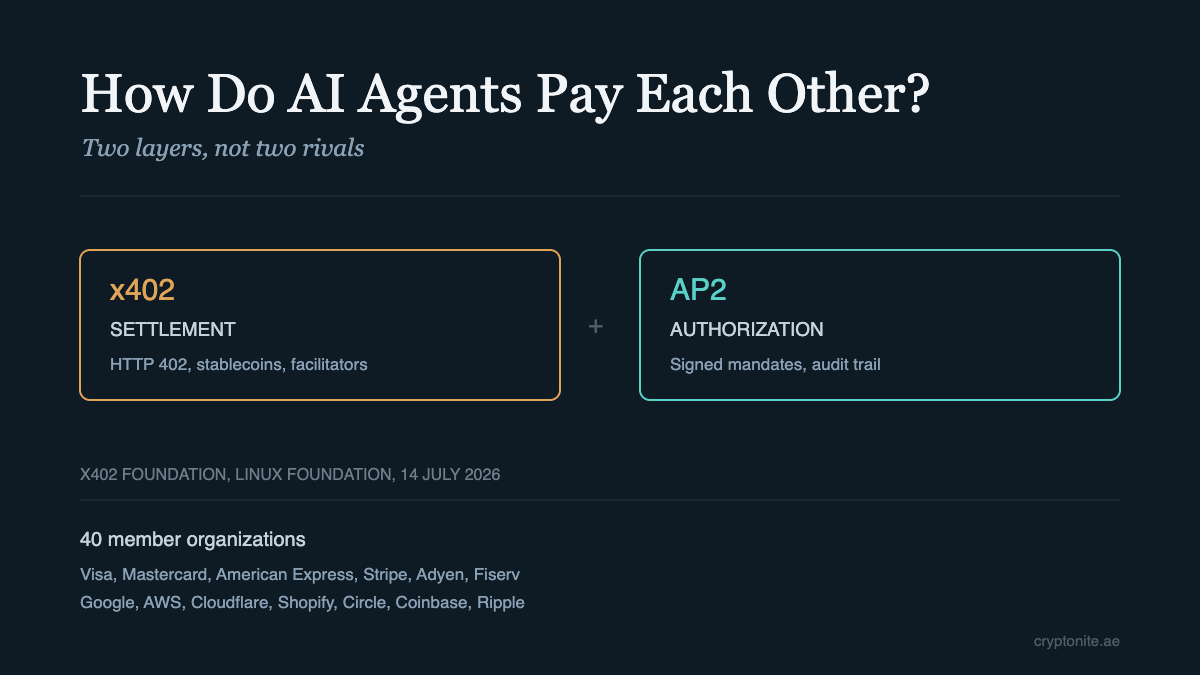
- Two standards answer the question of how do AI agents pay each other, and they are not competitors. x402 moves the money. AP2 proves who authorised the movement.
- x402 revives HTTP status code 402, “Payment Required,” which sat unused in the web spec for three decades. An agent requests a resource, gets a 402 with payment instructions, pays on-chain, and is let through.
- On 14 July 2026 the Linux Foundation announced the operational launch of the x402 Foundation with 40 member organizations, including Visa, Mastercard, American Express, Stripe, Google, Circle and Coinbase.
- Most explainers describe AP2 using “Intent Mandate” and “Cart Mandate.” The current specification uses neither term. It defines Checkout Mandates and Payment Mandates, each with open and closed stages.
- The card networks joining a stablecoin-adjacent standard is the real signal: they are moving to own authorization while conceding settlement to on-chain rails.
How do AI agents pay each other? Through two stacked layers. x402 handles settlement: an agent requests a paid resource, receives an HTTP 402 response containing payment instructions, and pays in stablecoins on-chain. AP2 handles authorization: cryptographically signed credentials that prove a human actually sanctioned the purchase.
That split matters more than the protocol names. Almost every explainer treats x402 and AP2 as rival standards competing to become the payment rail for autonomous software. They are not rivals. They solve different halves of the same problem, and the half that carries the legal risk is the one getting the least attention.
How do AI agents pay each other, step by step
Strip away the branding and how do AI agents pay each other reduces to one exchange. The x402 flow is deliberately unremarkable, which is its main virtue. It is five steps, and it reuses machinery the web already had.
- An agent requests a paid resource: an API call, a dataset, a model inference, a piece of compute.
- The service responds with HTTP 402 and a payment instruction rather than an error or a login wall.
- The agent executes payment programmatically on-chain, typically in a stablecoin such as USDC.
- The service verifies settlement.
- Access is granted.
No API key. No account creation. No card on file. No human in the loop at any point. The significance is not that this is technically hard, because it is not. It is that it removes the single largest source of friction in machine-to-machine commerce, which was never cryptography but onboarding.
In practice most agents will not touch a chain directly. A role called the facilitator sits between the agent and the blockchain, handling transaction submission, gas, chain routing and settlement confirmation. Version 2 of the protocol adds session token reuse, which cuts the per-request overhead that would otherwise make micropayments uneconomic at volume. That detail is doing a lot of quiet work: pay-per-request only makes sense if the cost of paying is far below the cost of the thing being bought.
What changed when x402 left Coinbase
Until mid-2026, the answer to how do AI agents pay each other was, in effect, one company’s answer. x402 originated at Coinbase. Had it stayed there, it would have been one company’s proposal for how the internet should charge for things, and would likely have been treated as such by every competitor.
On 14 July 2026 the Linux Foundation announced the operational launch of the x402 Foundation, with 40 member organizations and formal open governance. The premier member list is the part worth reading slowly: Adyen, Amazon Web Services, American Express, Circle, Cloudflare, Coinbase, Fiserv, Google, Mastercard, Monad Foundation, MoonPay, Ripple, Shopify, Solana Foundation, Stellar Development Foundation, Stripe and Visa.
Whoever sits in that room decides how do AI agents pay each other in practice. Note who that is. It is not a crypto consortium. It is the incumbent payments industry, the card networks, the acquirers, the cloud providers and the stablecoin issuers, sitting in the same governance structure. The foundation’s stated scope explicitly covers payment types from traditional cards through to stablecoins, which means x402 is not being positioned as a crypto rail at all. It is being positioned as a settlement-agnostic envelope.
What AP2 does that x402 cannot
x402 answers half of how do AI agents pay each other: it moves the value. It says nothing about whether the agent was entitled to move it. That gap is what Google’s Agent Payments Protocol addresses, and Coinbase announced an x402 extension bridging the two on 16 September 2025.
AP2’s problem statement is precise. When an agent initiates a transaction, a merchant needs to know three things that a payment message alone cannot tell them: that the user granted this agent authority for this purchase, that the request reflects genuine user intent rather than a model hallucination, and who is accountable if it turns out to be neither.
Its answer is Verifiable Digital Credentials, described in the specification as tamper-evident, cryptographically signed objects that chain together into a complete, verifiable audit trail. Google’s Agent2Agent protocol lets agents talk to each other. AP2 adds the payment-grade authorization and non-repudiation that conversation alone does not provide.
How do AI agents pay each other? The AP2 vocabulary almost every explainer gets wrong
Search for an AP2 explainer and you will be told, repeatedly and confidently, that the protocol is built on an “Intent Mandate” and a “Cart Mandate.” That framing appears across vendor blogs, developer tutorials and aggregator write-ups.
The current AP2 specification uses neither term. It defines Checkout Mandates and Payment Mandates, and each exists in two stages. An open Checkout Mandate captures the user’s constraints and goals before any specific cart is finalised. A closed Checkout Mandate captures authorization for a specific finalised checkout. An open Payment Mandate captures constraints on payment itself, such as a budget or a list of permitted instruments; a closed Payment Mandate authorises a specific amount bound to a finalised checkout.
This is not pedantry. The open and closed distinction is the entire mechanism by which a user can delegate broadly (“book me a flight under 3,000 dirhams”) while still producing a specific, signed, non-repudiable authorization at the moment money actually moves. Anyone building against the “Intent” and “Cart” vocabulary is building against a spec that has moved on, and anyone reasoning about liability from it is reasoning from the wrong model.
x402, AP2 and MPP compared
| Standard | Layer it solves | Origin | Core primitive |
|---|---|---|---|
| x402 | Settlement: moving value per request | Coinbase, now Linux Foundation | HTTP 402 plus on-chain payment |
| AP2 | Authorization: proving who sanctioned it | Signed Verifiable Digital Credentials | |
| MPP | Recurring and multi-agent settlement patterns | Stripe and Tempo | Subscription and coordinated billing |
Read as a stack rather than a race, the question of how do AI agents pay each other has a coherent answer. MPP handles the billing shapes that a single pay-per-request call cannot express. x402 carries the payment. AP2 carries the proof. An agent commerce transaction of any consequence will touch all three.
Why This Matters
Ask how do AI agents pay each other and the honest answer in 2026 is: however the card networks decide to let them. They did not join the x402 Foundation to process stablecoin transfers. They joined because the authorization layer is where the economics and the liability both sit, and they intend to own it.
The answer to how do AI agents pay each other is therefore commercial, not just technical. Consider what a card network actually sells. Not settlement, which is commoditised and increasingly cheap. It sells the guarantee: authorization, dispute rights, chargebacks, fraud liability shift, and the rules that decide who eats a loss. Stablecoin rails threaten the settlement business and are close to irrelevant to the guarantee business. Joining a neutral standard that explicitly spans cards and stablecoins is how you concede the first while defending the second.
This connects directly to the question we examined in whether an AI agent can legally own a crypto wallet. In every jurisdiction, liability for an agent’s transaction routes back to a human principal, and the statutory test is whether the action was legally attributable to the person to be bound. A signed, chained AP2 mandate is close to a purpose-built evidentiary record for exactly that test. The authorization layer is not merely a technical convenience. It is where the legal question from that article gets answered in practice, transaction by transaction.
There is a second-order consequence worth sitting with. If mandates become the accepted proof of authorization, then whoever issues and validates mandates becomes the de facto arbiter of agent commerce disputes. That is a more durable position than processing payments, and it is being negotiated now, in a foundation, largely out of public view.
Where this settles, and why the UAE is exposed to it early
Agent payments settle in stablecoins because stablecoins are programmable, always-on and denominated in something a merchant will accept. That makes the question of how do AI agents pay each other partly a question about stablecoin regulation, which is where the UAE has moved faster than most.
A dirham-denominated payment token operating under a central bank framework is, in principle, an ideal settlement asset for agent commerce in the region: regulated issuer, clear redemption, no foreign exchange leg for local merchants. Our stablecoin timeline for 2026 tracks how that licensing picture has developed, and the broader shift is covered in our analysis of agentic AI payments settling on stablecoin rails.
For UAE firms the question of how do AI agents pay each other is close to operational. The open question for regional firms is not technical readiness. It is whether an agent-initiated payment carrying a valid AP2 mandate satisfies a supervisor’s expectations around customer authorisation and transaction monitoring. Nobody has tested that yet.
The limits of this analysis
Anyone answering how do AI agents pay each other today is describing a system still under construction, so several caveats belong on the record. The widely circulated Lowe’s Innovation Lab demonstration of end-to-end agent checkout was explicitly simulated for illustrative purposes and does not represent a live public offering. Treat it as a design sketch, not evidence of deployment.
A specification describing how do AI agents pay each other is not the same as a shipped product. Foundation membership is also not the same as implementation. Forty organizations agreeing to govern a specification together tells you the direction of travel; it does not tell you that Visa or Shopify has shipped anything. Specifications at this stage routinely change, and the AP2 vocabulary shift documented above is itself evidence of that.
Finally, no regulator in any major market has yet stated whether a cryptographic mandate discharges a firm’s customer authorisation obligations. Until one does, teams building agent payments are making a compliance bet, not following a rule.
Frequently Asked Questions
How do AI agents pay each other in practice?
An agent requests a paid resource, the service replies with an HTTP 402 response containing payment instructions, the agent pays on-chain in a stablecoin, settlement is verified, and access is granted. A facilitator usually handles the blockchain mechanics.
Are x402 and AP2 competing standards?
No. x402 is a settlement layer that moves value per request. AP2 is an authorization layer that proves a user sanctioned the purchase. Coinbase announced an extension connecting the two in September 2025.
Who governs x402 now?
The x402 Foundation, under Linux Foundation neutral governance. Its operational launch was announced on 14 July 2026 with 40 member organizations, including Visa, Mastercard, American Express, Stripe, Google, Circle, Coinbase and Cloudflare.
What is an AP2 mandate?
A cryptographically signed credential recording authorization. The specification defines Checkout Mandates and Payment Mandates, each with an open stage capturing constraints and a closed stage authorising a specific finalised transaction.
Do AI agents need stablecoins to pay each other?
Not strictly. The x402 Foundation’s stated scope spans payment types from traditional cards to stablecoins. Stablecoins dominate today because they are programmable and settle without banking hours or card-network onboarding.
Knowledge check: how AI agents pay each other
Five questions on the two protocols. Answers explained as you go.
By Vaibhav Ali
This article is for informational purposes only and does not constitute financial, investment, or legal advice.
Sources
- Linux Foundation, Operational Launch of the x402 Foundation, 14 July 2026
- AP2, Agent Payments Protocol specification
- Coinbase, Google Agentic Payments Protocol and x402
- AMINA Bank, Agentic Payments Explained