Key Takeaways
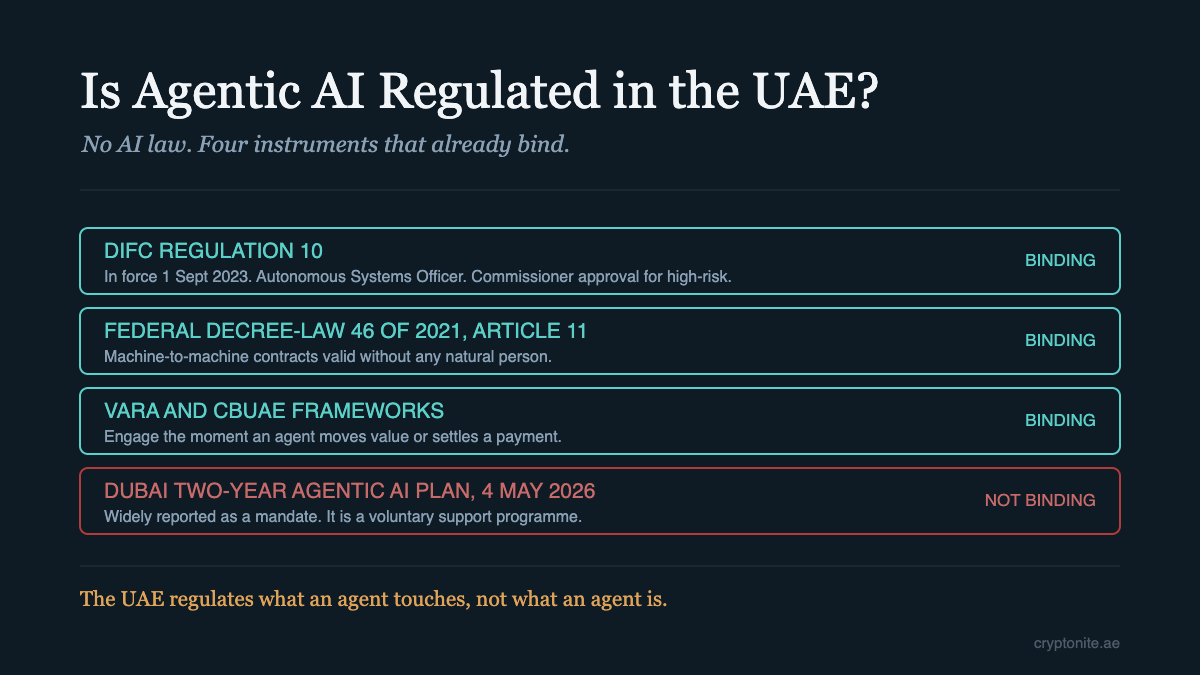
- There is no single agentic AI law in the UAE, but that does not mean agents are unregulated. Four separate instruments already bind them, and most coverage names none of them.
- DIFC Regulation 10, in force since 1 September 2023, is one of the world’s earliest binding rules for autonomous systems. It requires an appointed Autonomous Systems Officer and Commissioner approval for high-risk processing.
- Dubai’s widely reported agentic AI “mandate” is not a mandate. Announced on 4 May 2026 by Sheikh Hamdan, it is a voluntary two-year support programme delivered through the Dubai Chamber of Commerce.
- Federal Decree-Law No. 46 of 2021 already validates contracts concluded between automated systems with no human involvement.
- Agentic AI UAE regulation works functionally, not horizontally. The UAE regulates what an agent touches — personal data, money, contracts — rather than regulating “AI” as a category.
Is agentic AI regulated in the UAE? Yes, but not by a dedicated AI statute. Agentic AI UAE regulation is assembled from data protection, electronic transactions, virtual asset and payments rules that apply according to what an agent does. A firm can be fully in scope without any law named “AI” existing.
Agentic AI UAE regulation is therefore the opposite of the European approach, and the difference matters commercially. The EU regulates AI as a category and sorts systems into risk tiers. The UAE has largely left the category alone and regulated the consequences. The result is a regime that looks permissive from a distance and is considerably more specific up close.
The rule almost nobody cites: DIFC Regulation 10
The single most concrete piece of agentic AI UAE regulation, and the one almost no explainer names, came into force on 1 September 2023, well before the EU AI Act began to apply. DIFC Regulation 10 governs machine-based systems operating in an autonomous or semi-autonomous manner that process personal data, expressly including machine learning and generative systems.
As agentic AI UAE regulation goes, its obligations are unusually specific for a rule of that vintage. Operators must give clear and explicit notice describing the system’s technology, its purposes, the principles applied and the safeguards in place. Systems must be designed to be ethical, fair, transparent, secure and accountable, with mechanisms to prevent bias.
Where a system is used commercially for high-risk processing, the requirements sharpen considerably: approval from the DIFC Commissioner of Data Protection, audit compliance, human-defined purposes, and the appointment of an Autonomous Systems Officer — a named individual performing a role comparable to a Data Protection Officer, monitoring compliance and cooperating with the Commissioner.
Regulation 10 also splits responsibility in a way that anticipates the agent economy. A deployer is the accountable entity authorising the system’s use. An operator is the technical service provider. Both bear compliance obligations, and breaches attract administrative fines under the DIFC Data Protection Law, with data subjects able to complain about processing outcomes.
This is agentic AI UAE regulation with teeth. Any firm running agents that touch personal data inside the DIFC is already inside a binding autonomous-systems regime. That obligation becomes concrete after an incident: see what happens when an AI agent gets hacked. Many do not appear to know it.
The Dubai “mandate” is not a mandate
The most cited item in any discussion of agentic AI UAE regulation is also the most misreported. On 4 May 2026, Sheikh Hamdan bin Mohammed, Crown Prince of Dubai, announced a two-year plan to integrate agentic AI across the private sector. A significant amount of coverage described this as Dubai mandating adoption within two years.
It is not a mandate. Reporting by The National describes a voluntary programme delivered through training and support rather than regulatory compulsion, with the Dubai Chamber of Commerce and Industry tasked with establishing incubators and specialised training tracks. The programme components are capacity-building: executive AI leadership training, technical implementation programmes, workforce literacy, with differentiated support for enterprises, mid-market firms, SMEs and startups.
For anyone mapping agentic AI UAE regulation onto a board agenda, the distinction is not pedantic. A mandate creates a compliance deadline and a penalty for missing it. A support programme creates an opportunity and a competitive risk. Boards that treat the former as the latter will over-invest in documentation and under-invest in capability; boards that do the reverse will misread the urgency entirely. Anyone planning against a compliance clock that does not exist is planning against the wrong thing.
What agentic AI UAE regulation actually consists of
| Instrument | In force | What it binds | Trigger |
|---|---|---|---|
| DIFC Regulation 10 | 1 September 2023 | Autonomous and semi-autonomous systems processing personal data | Personal data in the DIFC |
| Federal Decree-Law No. 46 of 2021 | 2021 | Validity of contracts formed between automated systems | An agent concluding an agreement |
| VARA rules | Ongoing | Virtual asset activity, AML and transaction screening | An agent transacting in virtual assets in Dubai |
| CBUAE payments and stablecoin framework | Ongoing | Payment tokens, settlement, licensed issuers | An agent settling in dirham-denominated tokens |
| Dubai two-year agentic AI plan | 4 May 2026 | Nothing — voluntary support programme | Not binding |
Read the trigger column rather than the instrument column. That is how agentic AI UAE regulation actually reaches a business: not because it deployed “AI”, but because its agent processed a person’s data, signed something, moved a virtual asset, or settled a payment.
The contracting question was answered five years ago
A recurring question about agentic AI UAE regulation is whether an agreement an agent concluded is enforceable in the UAE. It is. Federal Decree-Law No. 46 of 2021 on Electronic Transactions and Trust Services defines an Automated Electronic Medium as a system operating automatically and independently without human intervention at the time of operation, and Article 11 provides that contracts made between such systems are valid and enforceable even absent any personal or direct interference by a natural person.
We examined the implications of that provision in detail in whether an AI agent can legally own a crypto wallet. The short version: validity is settled, personhood is refused, and liability routes to a human principal.
Where the money leg gets regulated
The sharpest edge of agentic AI UAE regulation is financial. An agent that only reasons is lightly regulated. An agent that pays is not. The moment value moves, the supervised perimeter appears: VARA for virtual asset activity in Dubai, and the central bank framework for payment tokens and settlement.
This is where agentic AI UAE regulation becomes operational rather than theoretical. Our coverage of VARA’s real-time AML screening requirements sets out how demanding that supervision already is, and the settlement picture sits in how AI agents pay each other. As we set out in why an AI agent cannot open a bank account, the identity burden does not disappear when an agent transacts on-chain. It waits at the fiat ramp.
Why This Matters
The functional approach has a consequence that the horizontal approach does not. Under a risk-tier regime, a firm can ask “is my system high-risk?” and get an answer that scopes its obligations. Under agentic AI UAE regulation, there is no single question to ask, because the obligations arrive from whichever direction the agent happens to act in.
That makes agentic AI UAE regulation harder to scope and easier to trip over. A firm can confidently conclude that no UAE AI law applies to it, and be entirely correct, while its agent is simultaneously in scope of Regulation 10 for the personal data it reads and VARA’s expectations for the transaction it settles.
The deeper pattern is worth naming. Regulation 10’s Autonomous Systems Officer is, functionally, a named human made answerable for a machine. Article 11 validates the machine’s contracts while routing liability to a person. The AML regime insists every account resolve to a natural person. Three separate instruments, drafted for different purposes, converge on the same answer: the agent acts, a human is accountable. The UAE did not need an AI law to reach that position, because every regime it already had was built on it.
For firms deploying agents in the region, that suggests a more useful compliance question than “what does the AI law say.” A related one is whether your custody design makes your vendor a custodian: see what an agentic wallet actually is, and the two ways it enforces limits. Ask instead which named individual is accountable for each agent, and whether that mapping would survive contact with a supervisor. In the DIFC, that person may already need to exist by title.
The limits of this analysis
Several caveats belong on the record, because agentic AI UAE regulation is a moving target. A federal AI instrument could change the analysis; nothing examined here suggests one is imminent, but absence of evidence is not evidence of absence.
The description of DIFC Regulation 10 above is drawn from the regulation and from legal commentary on it, not from enforcement history. As far as can be established there is no significant public body of Regulation 10 enforcement actions involving agentic systems, so how the Commissioner interprets “high-risk” in practice remains untested.
Finally, agentic AI UAE regulation is not uniform across the country. The DIFC and ADGM are separate jurisdictions with their own laws. Regulation 10 binds inside the DIFC. A firm operating onshore or in ADGM faces a different combination, and should not assume the analysis transfers.
Frequently Asked Questions
Is agentic AI regulated in the UAE?
Yes, but not by a dedicated AI statute. Agentic AI UAE regulation is assembled from data protection, electronic transactions, virtual asset and payments rules that apply according to what the agent does rather than what it is.
What is DIFC Regulation 10?
A binding rule in force since 1 September 2023 governing autonomous and semi-autonomous systems that process personal data. High-risk commercial use requires Commissioner approval and an appointed Autonomous Systems Officer.
Did Dubai mandate agentic AI adoption?
No. The two-year plan announced on 4 May 2026 by Sheikh Hamdan is a voluntary support programme delivered through the Dubai Chamber of Commerce, offering incubators and training rather than imposing a compliance deadline.
Are contracts made by AI agents enforceable in the UAE?
Yes. Article 11 of Federal Decree-Law No. 46 of 2021 provides that contracts concluded between automated electronic mediums are valid and enforceable without any personal or direct interference by a natural person.
Does agentic AI UAE regulation apply outside the DIFC?
Regulation 10 binds within the DIFC only. Onshore and ADGM firms face a different combination of federal and free-zone rules, so the analysis should not be assumed to transfer between jurisdictions.
Knowledge check: agentic AI and the UAE rulebook
Five questions on what actually binds. Answers explained as you go.
By Vaibhav Ali
This article is for informational purposes only and does not constitute financial, investment, or legal advice.
Sources
- DIFC, Regulation 10 on Personal Data Processed through Autonomous and Semi-Autonomous Systems
- The National, Dubai unveils plan to integrate agentic AI in private sector, 4 May 2026
- UAE Federal Decree-Law No. 46 of 2021 on Electronic Transactions and Trust Services
Related: Can AI agents trade DeFi autonomously, and is it legal? — the four-part test that decides whether your bot needs a licence.
Related: Do AI agents actually need stablecoins? — why the volatility argument is the weakest one, and what UAE rules actually allow.