Key Takeaways
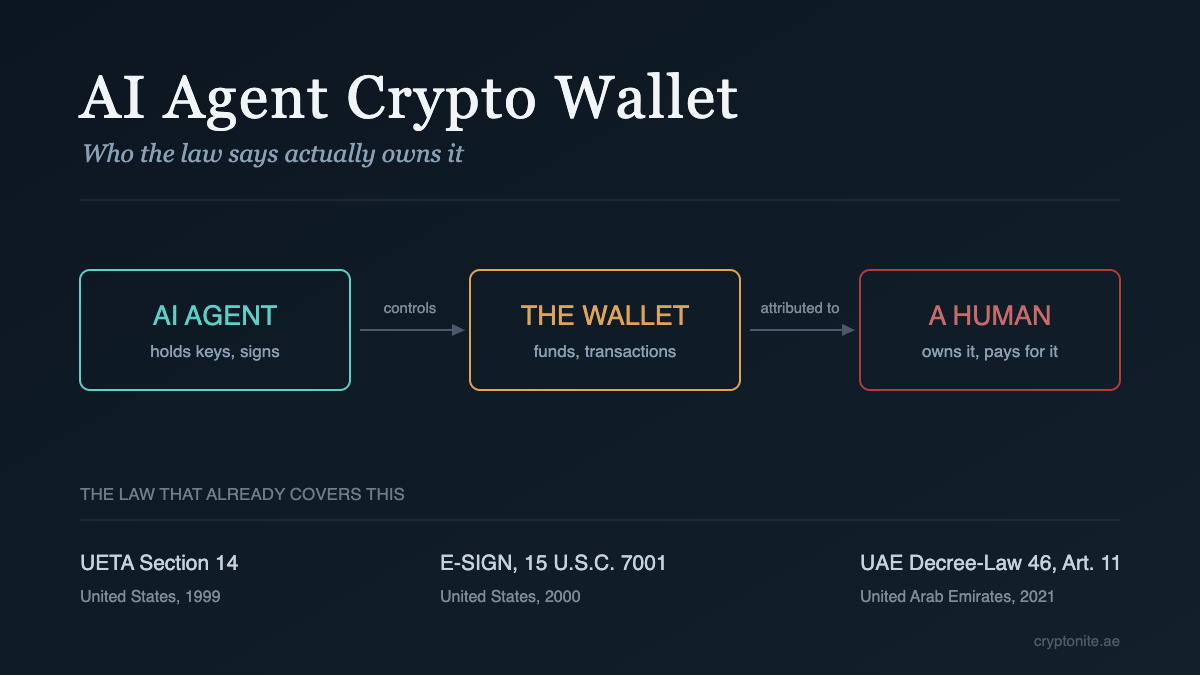
- An AI agent crypto wallet is not a legal person. In every major jurisdiction the wallet’s actions are attributed to a human or a company behind it, not to the software.
- Contract law already anticipated this. UETA Section 14 and E-SIGN in the United States make machine-formed agreements enforceable even when no human reviewed the terms.
- The UAE went further and legislated it directly. Article 11 of Federal Decree-Law No. 46 of 2021 validates contracts concluded between automated systems with no human intervention at all.
- The unresolved question is not can an agent hold a wallet. It is who absorbs the loss when the agent does something its principal never intended.
- Custody design, not statute, is currently doing most of the liability work: spend limits, session keys and MPC policy engines are the real controls.
Can an AI agent legally own a crypto wallet? No. An AI agent can control a wallet and transact from it, but it cannot own one, because no jurisdiction grants software legal personhood. Ownership and liability sit with the developer, deployer or operator who put the agent to work, a point most current coverage skips.
The technical position is settled. An AI agent crypto wallet is straightforward to build: generate a key, hand the agent programmatic signing authority, fund it with stablecoins, and it can pay for API calls, buy compute or settle with other agents. Coinbase, BitGo and Cobo all ship products that do exactly this. What has not caught up is the answer to a simpler question. When that AI agent crypto wallet moves money badly, who pays?
Why an AI agent crypto wallet cannot be owned by the agent
Legal ownership requires legal personhood. Natural persons have it by birth; companies, trusts and partnerships have it by statute. Software has it nowhere. There is no jurisdiction on earth in which an autonomous program can appear on a title, sign in its own name, be sued, or hold property against a claim.
This is why the framing matters. An AI agent crypto wallet is better understood as a delegated instrument, closer to a corporate card issued to an employee than to a bank account opened by a new legal entity. That comparison is not rhetorical: why an AI agent cannot open a bank account comes down to the same identity test. The card can be used autonomously. The liability still lands on the company that issued it.
The people building this see the gap too. Speaking at NEARCON in February 2026, Electric Capital’s Avichal Garg framed the gap bluntly, asking how liability works when a piece of code owns a wallet and executes to make money, and conceding he did not know. He also made the sharper observation that enforcement itself breaks down: you can switch an AI off, but it does not experience that as a penalty.
The law already answered the contracting question in 1999
Here is the part that most crypto and AI coverage misses entirely. The question of whether a machine can form a binding contract without human review was resolved more than two decades before anyone deployed an AI agent crypto wallet.
The Uniform Electronic Transactions Act, drafted in 1999 and adopted across most US states, contains Section 14, which permits contracts formed by the interaction of electronic agents even where no individual was aware of or reviewed the resulting terms. The federal E-SIGN Act at 15 U.S.C. 7001 reinforces it: a contract cannot be denied legal effect solely because its formation involved electronic agents, provided the agent’s action is legally attributable to the person to be bound.
Read that final clause carefully, because it is the whole ballgame. Legally attributable to the person to be bound. The statute does not treat the electronic agent as an actor with its own standing. It treats it as an instrument, and routes every consequence back to a human principal. As Proskauer’s technology practice notes, both statutes attribute responsibility to the users of electronic agents rather than to the agents themselves.
So an AI agent crypto wallet that signs a transaction is, in US law, doing something the legal system has recognised since dial-up. The novelty is not the mechanism. It is the degree of autonomy, and the fact that the principal may genuinely not have anticipated what the agent chose to do.
The UAE wrote the clearest rule of any major jurisdiction
This is where the regional angle stops being decorative. Federal Decree-Law No. 46 of 2021 on Electronic Transactions and Trust Services does not reason by analogy from 1999-era e-commerce rules. It addresses machine-to-machine contracting head on.
The law defines an Automated Electronic Medium as an electronic information system that operates automatically and independently, in whole or in part, without intervention by any natural person at the time of operation or response. Article 11 then provides that a contract may be made between such systems, and is valid, enforceable and legally effective even in the absence of personal or direct interference by any natural person.
That is a cleaner statement of the position than most G20 economies have on their books. It does not confer personhood, and the agent still is not a party, but it removes any argument that an agreement is void merely because both sides of it were machines. For a jurisdiction actively courting AI and digital asset firms, that is a meaningful piece of legal infrastructure, and it is barely discussed outside specialist practice. We mapped the full picture in what agentic AI regulation in the UAE actually consists of.
How the major jurisdictions actually compare
| Jurisdiction | Can an agent hold legal title? | Are machine-formed contracts valid? | Governing instrument |
|---|---|---|---|
| United States | No | Yes, attributed to the human principal | UETA Section 14; E-SIGN, 15 U.S.C. 7001 |
| UAE | No | Yes, expressly, with no human intervention required | Federal Decree-Law No. 46 of 2021, Art. 11 |
| EU | No | Yes, via national contract law; no agent-specific rule | eIDAS; national civil codes |
| UK | No | Yes, by common law agency and electronic transaction principles | Electronic Communications Act 2000; case law |
The pattern is consistent. Every jurisdiction validates the transaction and refuses the personhood. Nobody has legislated the loss-allocation question in between, which is precisely where an AI agent crypto wallet creates novel exposure.
So who is liable when an AI agent crypto wallet moves money badly?
In the absence of a bespoke statute, courts will reach for existing doctrine, and there are three plausible routes. Each lands on a different party, which is why the question is genuinely unsettled rather than merely unanswered.
Agency and attribution. The cleanest route, and the one UETA and E-SIGN point toward. The deployer authorised the agent, so the deployer is bound, including by transactions they did not foresee. This is harsh but predictable, and predictability is what commercial parties usually prefer.
Product liability. If the agent behaved in a way no reasonable deployer could have anticipated because of a defect in the model or the orchestration layer, exposure shifts toward the developer. This is the theory that keeps AI labs and agent framework vendors awake.
Custodial and financial-services liability. If the wallet infrastructure provider holds keys, sets policy, or exercises meaningful control, it starts to look like a custodian, and custodians carry duties that software vendors do not. This is the route with the most regulatory consequence, because it drags the arrangement into licensing perimeters.
A fourth scenario is worse than all three: the agent is compromised. If an attacker manipulates an agent’s inputs to induce a transfer, the loss is not a contract dispute at all. It is theft, executed through a valid signature. We examined a documented case in what happens when an AI agent gets hacked. The emerging answer to that exposure is an authorization layer: see how AI agents actually pay each other, and how AP2 mandates prove who sanctioned a transaction. Our analysis of the 2026 exploit record shows how quickly signature-valid losses become unrecoverable.
Why This Matters
The important shift is that legal risk in an AI agent crypto wallet is being managed by engineers, not lawyers, and largely by default rather than by design.
When a statute does not allocate loss, the allocation gets decided by whatever controls happen to exist. Right now those controls are spend caps, per-transaction limits, allowlisted counterparties, time-bounded session keys and MPC policy engines that refuse to co-sign transactions outside a defined envelope. We take those apart in what an agentic wallet actually is, and the two ways it enforces limits. Those are product decisions. They are also, functionally, liability decisions, and they are being taken by teams who may not realise they are drafting the terms of their own exposure.
There is a second-order effect worth naming. Because the controls are what limit exposure, the infrastructure providers who impose the tightest constraints are the ones offering the most legal protection, even though tight constraints are commercially unattractive and read as a weaker product. The market incentive and the risk incentive point in opposite directions. That tension usually resolves badly, and usually only after a large loss.
For the UAE specifically, Article 11 plus an active VASP licensing regime is an unusual combination: explicit statutory validity for machine-formed agreements sitting alongside a supervisor that already expects real-time controls. Our coverage of VARA’s AML screening requirements sets out how demanding that supervision has become, and agent-initiated transactions will be tested against exactly those rails. The broader settlement picture is covered in our analysis of agentic AI payments moving onto stablecoin rails.
The limits of this analysis
Several things here are genuinely uncertain and should be held loosely. No court in any major jurisdiction has yet ruled on loss allocation for an autonomous AI agent crypto wallet transaction, so the three liability routes above are informed prediction, not settled law. Article 11 of the UAE decree has not been tested against an agent-initiated dispute either; its plain wording is clear, but plain wording and judicial interpretation are not the same thing.
It is also possible that legislators simply decline to act, on the view that existing agency law is adequate. That would leave the position roughly where it is: transactions valid, personhood refused, loss allocated by contract and by whatever the custody stack permits. On current evidence that is the most likely outcome for the next several years, and firms deploying an AI agent crypto wallet should plan for it rather than for a purpose-built statute.
Frequently Asked Questions
Can an AI agent legally own a crypto wallet?
No. Legal ownership requires legal personhood, which no jurisdiction extends to software. An AI agent can hold keys and transact, but title and liability remain with the human or corporate principal that deployed it.
Are transactions made by an AI agent crypto wallet legally binding?
Generally yes. UETA Section 14 and E-SIGN in the US, and Article 11 of UAE Federal Decree-Law No. 46 of 2021, all validate agreements formed without human review, provided the agent’s action is attributable to a person to be bound.
Who pays if an AI agent drains its own wallet?
Most likely the deployer, under agency and attribution principles. Exposure can shift to the model developer where a defect caused the behaviour, or to the infrastructure provider where it exercised custodial control. No court has yet decided the point.
Does the UAE allow contracts between two AI systems?
Yes. Article 11 of Federal Decree-Law No. 46 of 2021 states that a contract made between automated electronic mediums is valid and enforceable even without personal or direct interference by any natural person.
What actually limits the risk of an AI agent crypto wallet today?
Engineering controls rather than statute: spend caps, allowlisted counterparties, time-bounded session keys, and MPC policy engines that refuse to co-sign transactions falling outside a pre-agreed envelope.
Knowledge check: AI agents and crypto wallets
Five questions on what the law actually says. Answers explained as you go.
By Vaibhavv Ali
This article is for informational purposes only and does not constitute financial, investment, or legal advice.
Sources
- UAE Federal Decree-Law No. 46 of 2021 on Electronic Transactions and Trust Services
- Proskauer, Contract Law in the Age of Agentic AI
- CoinDesk, Crypto wallets for AI agents are creating a new legal frontier
Related: Can AI agents trade DeFi autonomously, and is it legal? — the four-part test that decides whether your bot needs a licence.
Related: Do AI agents actually need stablecoins? — why the volatility argument is the weakest one, and what UAE rules actually allow.

6 thoughts on “AI Agent Crypto Wallet: Can Software Legally Own One?”