Key Takeaways
- An AI agent bank account is not blocked by technology or by bank conservatism. It is blocked by the anti-money-laundering standard that requires every account to resolve to an identified natural person.
- A crypto wallet imposes no such test. Generating a keypair requires no identity, no permission and no counterparty. That asymmetry, not any judgement about which rail is better, is why agents ended up on-chain.
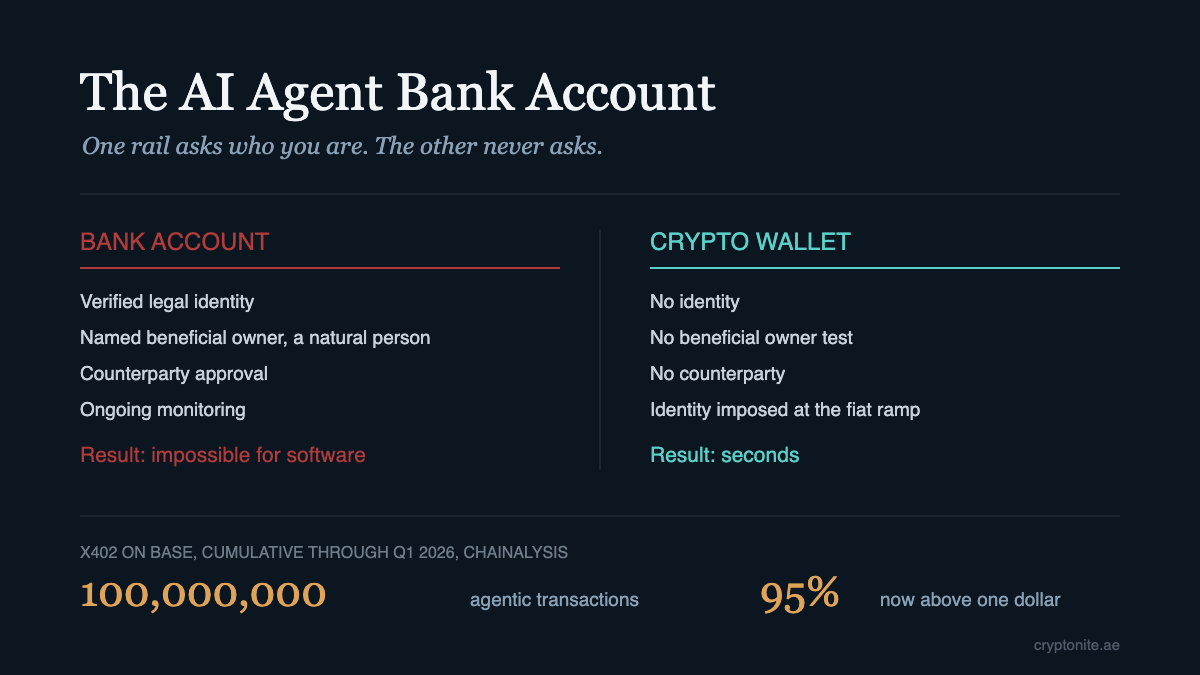
- Chainalysis recorded 100 million cumulative x402 transactions on Base through Q1 2026, with payments above one dollar rising from 49% to 95% of volume.
- Services now exist that let agents complete KYC paperwork, but completing the forms is not the same as becoming the account holder. Liability still lands on a person.
- Expect agent banking to arrive as sub-accounts under a human principal, never as accounts an agent owns. The identity requirement is load-bearing for the whole regime and cannot be patched away.
Why can’t an AI agent open a bank account? Because opening one requires a verified legal identity and a named beneficial owner who is a natural person. Software has neither. A crypto wallet asks for neither, so an AI agent bank account remains impossible while an agent-controlled wallet takes seconds.
Ask why there is no AI agent bank account and the comparison gets framed as banks being slow and crypto being permissive. That framing is wrong, and it obscures the actual mechanism. Banks are not refusing agents out of caution. They are structurally incapable of onboarding one, because the global AML framework they operate inside has a natural person at the centre of every account by design.
What an AI agent bank account would actually require
To see why an AI agent bank account fails at the first step, look at what the first step is. Customer due diligence under the FATF standard is not a form. It is a chain of assertions a bank must be able to defend to its supervisor: identify the customer, verify that identity against reliable independent documents, identify the beneficial owner, and take reasonable measures to verify that person too. Ongoing monitoring then runs against that established identity for the life of the relationship.
Every link in that chain terminates at a human being, and that is what an AI agent bank account cannot supply. Beneficial ownership, in particular, exists precisely to prevent an opaque entity from being the end of the trail. A company can hold an account, but only because the regime forces you to look through it to the natural persons who control it.
An autonomous agent offers nothing to look through to. It has no birth certificate, no passport, no residency, no tax identity, and no capacity to be sanctioned or prosecuted. Ask what an AI agent bank account would be verified against and the question has no answer that satisfies a supervisor.
This is why the objection is not solvable by better paperwork. Some services now automate KYC submission on an agent’s behalf. As Forbes reported in June 2026, automating the paperwork is not the same as becoming the account holder — the liability still attaches to a named person. What those services really produce is a human-owned account an agent is permitted to operate. Useful, but not an AI agent bank account.
What a crypto wallet requires instead: nothing
Set the AI agent bank account aside and look at the alternative. A wallet is a keypair. Generating one is a local mathematical operation. There is no application, no counterparty, no approval, and nobody to refuse you. The network does not know or care whether the entity holding the private key is a person, a company, a script or a model.
That is the whole asymmetry between a wallet and an AI agent bank account. Banking is permissioned at the point of entry; a public chain is not permissioned at all at the base layer. Identity in crypto is imposed at the edges — exchanges, custodians, fiat on-ramps and licensed VASPs — rather than at the protocol. An agent that never touches those edges never meets an identity check.
The practical demonstration is blunt. A Redwood Research experiment gave an AI agent five thousand dollars and four days to make money. It was stopped at a CAPTCHA and an identity check. Not by a lack of capability, but by gates designed to establish that a human is present.
Bank account versus crypto wallet, compared honestly
| Requirement | Bank account | Crypto wallet |
|---|---|---|
| Verified legal identity | Mandatory | None at protocol layer |
| Named beneficial owner | Mandatory, natural person | Not applicable |
| Counterparty approval | Required | None |
| Time to open | Days, subject to review | Milliseconds |
| Who bears liability | The named account holder | Unallocated by default |
| Where identity is enforced | At onboarding | At exchanges and fiat ramps |
Read down the AI agent bank account column and the obstacle is obvious; read the wallet column and so is the appeal. Read the last row and so is the catch. The wallet does not remove the identity requirement from the agent economy. Nor does it remove the attack surface: see what happens when an AI agent gets hacked. It relocates it to the moment value tries to leave the chain. The controls that hold an agent inside its envelope are covered in what an agentic wallet actually is, and the two ways it enforces limits.
The volume is real, and the shape of it is informative
The migration away from the AI agent bank account is not theoretical. Chainalysis measured 100 million cumulative transactions through the x402 protocol on Base through the first quarter of 2026, from a near-zero base in mid-2025.
The composition matters more than the headline. Payments above one dollar rose from 49% of volume in early 2025 to 95% by Q1 2026, while the ten-cent-to-one-dollar band collapsed from 46% to 4%. That is the signature of activity moving from dust-level testing toward transactions with actual economic content.
Two counterweights belong here, because the same dataset supplies them. Weekly wallet retention peaked at 87% during an October 2025 token spike and then fell to 5%, so engagement is volatile rather than compounding. And x402 wallets look unusual: average wallet age of 197 days against 423 for Base overall, holding 26 tokens against four. That is a speculative cohort, not a settled commercial user base. Growth is real; maturity is not established.
Why This Matters
The instinct in most coverage is that an AI agent bank account is simply a product banks will eventually catch up and offer once product teams get around to it. That misreads what is in the way.
The natural-person requirement standing between agents and an AI agent bank account is not a feature banks chose. It is the mechanism that makes sanctions enforceable, makes account freezing meaningful, and gives a supervisor somebody to hold responsible. Remove it and you do not get a modernised bank account; you get an instrument that cannot be policed. No regulator is going to concede that, and no bank is going to ask.
So the realistic destination for the AI agent bank account is not an account the agent owns. It is agent-operated sub-accounts sitting underneath an identified principal, with programmatic limits, delegated authority and a full audit trail — which is precisely the structure we described in whether an AI agent can legally own a crypto wallet. The law never gave the agent standing; it treated it as an instrument of a human. Banking will land in the same place, because it is answering the same question with stricter tools.
There is a second-order effect worth naming. If identity cannot attach to the agent, it has to attach to the authorization instead — which is exactly the gap the mandate layer fills, as we set out in how AI agents pay each other. A signed mandate does not tell you who the agent is. It tells you who authorised it, which turns out to be the only question the regime actually needs answered. That is a quiet but significant reframing: the agent economy may not need agent identity at all, only verifiable human authorisation.
The UAE angle: identity at the ramp, not at the wallet
For the region the AI agent bank account question is less abstract than it sounds. The UAE has built a licence-first regime in which supervised entities — exchanges, custodians, brokers — carry the identity burden. That perimeter is one of four instruments covered in what agentic AI regulation in the UAE actually consists of. An agent operating purely on-chain never encounters that perimeter. The moment it wants dirhams, it does.
That makes the fiat ramp the real control point for agent activity, and it is where supervisory attention will concentrate. Our coverage of VARA’s AML screening requirements shows how demanding that perimeter already is, and the broader settlement picture sits in our analysis of agentic AI payments on stablecoin rails. A firm whose agents transact on-chain but settle to a UAE bank account has not escaped customer due diligence. It has deferred it.
The limits of this analysis
Some of this is directional rather than settled. No supervisor has ruled on the AI agent bank account question directly. No jurisdiction has published a rule specifically addressing whether an agent-operated sub-account satisfies customer due diligence, so the sub-account model described above is the most probable path, not an announced one.
The transaction data also deserves care. One hundred million transactions on one protocol on one chain is a meaningful signal, but it is a single measurement of a young system, and the retention figures in the same dataset argue against treating it as evidence of durable commercial adoption. Anyone citing the number without the retention caveat is telling half the story.
Finally, a legislature could in principle create a limited legal personality for autonomous systems, as has occasionally been floated for DAOs. Nothing suggests that is imminent, and it would require rebuilding the liability model rather than extending it. Until then, the answer to whether an AI agent bank account is possible stays no.
Frequently Asked Questions
Why can’t an AI agent open a bank account?
Because customer due diligence requires a verified legal identity and a beneficial owner who is a natural person. An autonomous agent has neither, so no bank can complete the checks its supervisor requires.
Can an AI agent open a crypto wallet instead?
Yes. A wallet is a locally generated keypair requiring no identity, approval or counterparty. The network cannot distinguish an agent from a person, which is why agent activity concentrated on-chain rather than in banking.
Do services that automate KYC give agents real bank accounts?
No. They automate the submission of paperwork, but the account holder remains a named person or company who carries the liability. The agent is an operator of that account, not its owner.
How much are AI agents actually transacting on-chain?
Chainalysis recorded 100 million cumulative x402 transactions on Base through Q1 2026, with payments above one dollar rising from 49% to 95% of volume. Wallet retention, however, remains volatile.
Will banks ever offer an AI agent bank account?
Most likely as an agent-operated sub-account under an identified human or corporate principal, with spending limits and an audit trail, rather than an account the agent owns in its own name.
Knowledge check: agents, banks and wallets
Five questions on why one rail is closed and the other is open. Answers explained as you go.
By Vaibhavv Ali
This article is for informational purposes only and does not constitute financial, investment, or legal advice.
Sources
- Chainalysis, Inside x402: 100M Agentic Payments on Base
- Forbes, An AI Agent Can’t Open A Bank Account, So It Opens A Crypto Wallet
- FATF, International Standards on Combating Money Laundering, Recommendation 10
Related: Can AI agents trade DeFi autonomously, and is it legal? — the four-part test that decides whether your bot needs a licence.
Related: Do AI agents actually need stablecoins? — why the volatility argument is the weakest one, and what UAE rules actually allow.