
The Bitcoin Suisse ADGM licence granted to the Swiss firm’s Middle East subsidiary is a small regulatory notice with an outsized signal attached: Abu Dhabi has now assembled enough of an institutional custody stack that a long-established European crypto bank considers it a home market rather than a sales office.
Key takeaways
- BTCS (Middle East) Ltd. received a full Financial Services Permission from ADGM’s Financial Services Regulatory Authority on 7 July 2026.
- The permission covers regulated digital asset services for institutional and professional clients, including custody, trading of approved virtual assets, and risk management and hedging.
- The UAE becomes Bitcoin Suisse’s fourth regulated jurisdiction, alongside Switzerland, Liechtenstein and Bermuda.
- Abu Dhabi now hosts Binance and Kraken under the same regulator, concentrating institutional venue, custody and settlement in one jurisdiction.
- The competitive pressure this creates falls on Zurich and Singapore, not on Dubai.
In short: Bitcoin Suisse’s Middle East arm has been authorised by ADGM’s FSRA to offer regulated digital asset custody and trading to institutional clients in the UAE. It is the firm’s fourth licensed jurisdiction and adds another established European custodian to Abu Dhabi’s growing roster of regulated virtual asset service providers.
What the Bitcoin Suisse ADGM licence actually permits
A Financial Services Permission is ADGM’s core authorisation instrument, not a provisional or in-principle approval. According to ADGM’s own announcement, BTCS (Middle East) Ltd. completed a multi-stage authorisation process before the FSRA issued the permission on 7 July 2026.
The scope is deliberately institutional. Bitcoin Suisse’s statement describes a suite of regulated digital asset services for institutional and professional clients — custody, trading of approved virtual assets, and risk management and hedging being the load-bearing pieces. There is no retail component, which matters for how the licence should be read.
Two caveats are worth stating plainly. First, an FSP defines what a firm may do, not what it has built; operational scale in the UAE still has to be demonstrated. Second, ADGM’s approved-token list is narrower than the tradable universe on offshore venues, so “approved virtual assets” is a real constraint rather than boilerplate.
Why a fourth jurisdiction is the interesting number
Bitcoin Suisse has spent a decade operating from jurisdictions chosen for regulatory durability rather than volume: Switzerland, Liechtenstein and Bermuda. Each is small, conservative and slow to grant permissions. Adding the UAE to that list is a statement about where the firm expects institutional demand to originate over the next cycle.
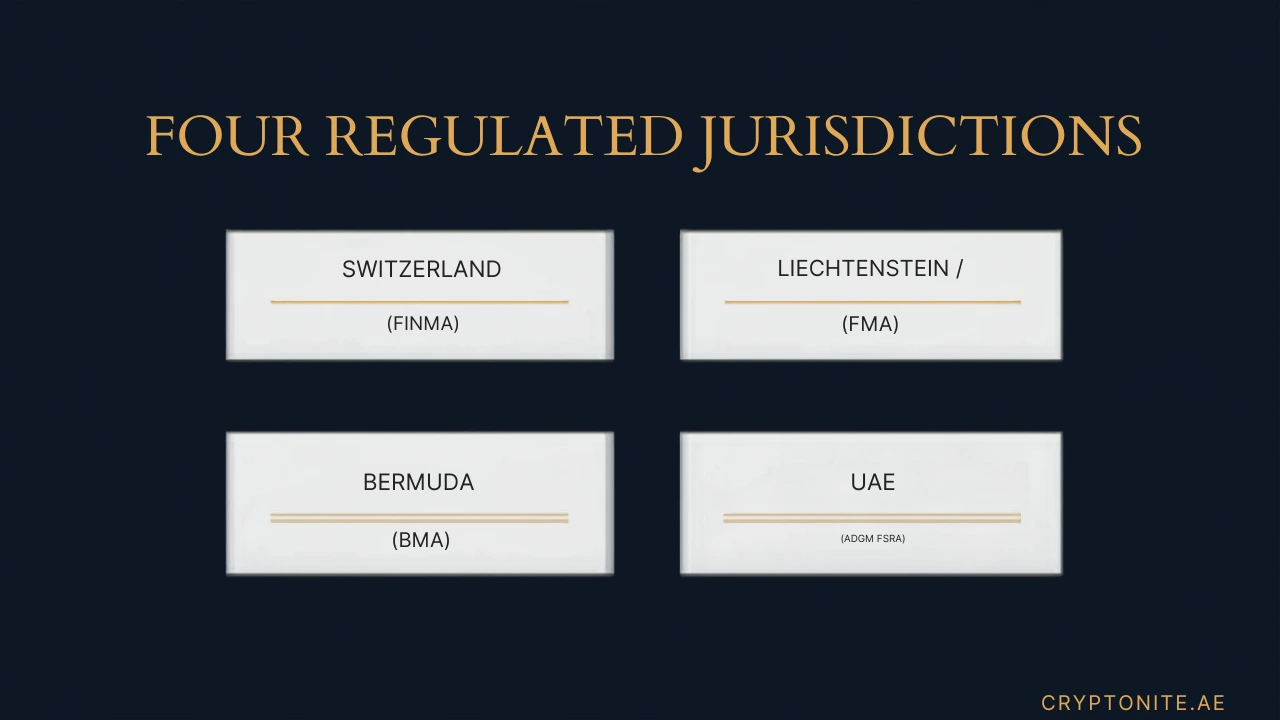
| Jurisdiction | Regulator | Primary role for Bitcoin Suisse |
|---|---|---|
| Switzerland | FINMA | Home market, core custody and brokerage |
| Liechtenstein | FMA | EEA-adjacent access |
| Bermuda | BMA | Offshore institutional structures |
| UAE (Abu Dhabi) | ADGM FSRA | Gulf institutional custody and trading |
Gulf capital has historically accessed digital assets through offshore vehicles or European custodians. A locally licensed entity changes the operational calculus for regional family offices, sovereign-linked investors and treasury desks that face internal mandates requiring a domestically regulated counterparty.
How does this change Abu Dhabi’s position against Dubai?
Less than the framing suggests. The two jurisdictions have drifted into complementary rather than competing roles. Dubai’s VARA regime has attracted a broad base of exchanges, brokers and consumer-facing platforms — the licensing volume is visible in our UAE VASP licence tracker. ADGM has accumulated a narrower, heavier set: institutional custodians, prime venues and, more recently, regulated commodity derivatives.
The genuine competitive pressure lands elsewhere. When a Swiss custodian can serve Gulf institutions from Abu Dhabi under a common-law regime with English-language documentation and no time-zone penalty, the marginal reason to book that relationship in Zurich or Singapore weakens. That is a slow reallocation, not a dramatic one, but it is the direction of travel.
What this means

The observation most coverage will skip is that custody licences are infrastructure for other people’s products. Tokenised funds, dirham-denominated settlement and institutional lending all require a regulated entity willing to hold the assets. Each additional licensed custodian in ADGM lowers the counterparty-concentration problem that has quietly constrained UAE tokenisation deals — issuers have often had one realistic custody option, which is a hard conversation with an investment committee.
Read that way, the Bitcoin Suisse ADGM licence is less a headline about one firm and more a marginal improvement in the plumbing that regional tokenisation has been waiting on. Whether it converts into flow depends on pricing, asset coverage and how quickly BTCS ME staffs up locally — none of which is knowable yet.
Frequently asked questions
What is a Financial Services Permission in ADGM?
A Financial Services Permission is the authorisation issued by ADGM’s Financial Services Regulatory Authority that allows a firm to conduct specified regulated activities from Abu Dhabi Global Market. It follows a multi-stage review and defines the exact activities and client types a firm may serve.
Can retail investors in the UAE use Bitcoin Suisse under this licence?
No. The permission covers institutional and professional clients. Retail-facing virtual asset services in the UAE fall under different regimes, including Dubai’s VARA framework and Central Bank of the UAE rules for payment-related activity.
Which other major crypto firms are licensed in ADGM?
Binance and Kraken both hold ADGM authorisations, and Bitcoin Suisse joins them as the jurisdiction builds out institutional-grade venue, custody and settlement capacity in a single regulatory perimeter.
This article is for informational purposes only and does not constitute financial, investment, or legal advice.
By Vaibhavv Ali

1 thought on “Bitcoin Suisse ADGM Licence Unlocks a 4th Crypto Hub”