Most crypto payment companies want to issue the token. Augustus wants to be the boring institution underneath it. The company has raised $180m at a $1bn valuation to build a stablecoin clearing bank designed for machine-speed settlement — and, notably, it has no plans to launch a stablecoin of its own.
Key takeaways
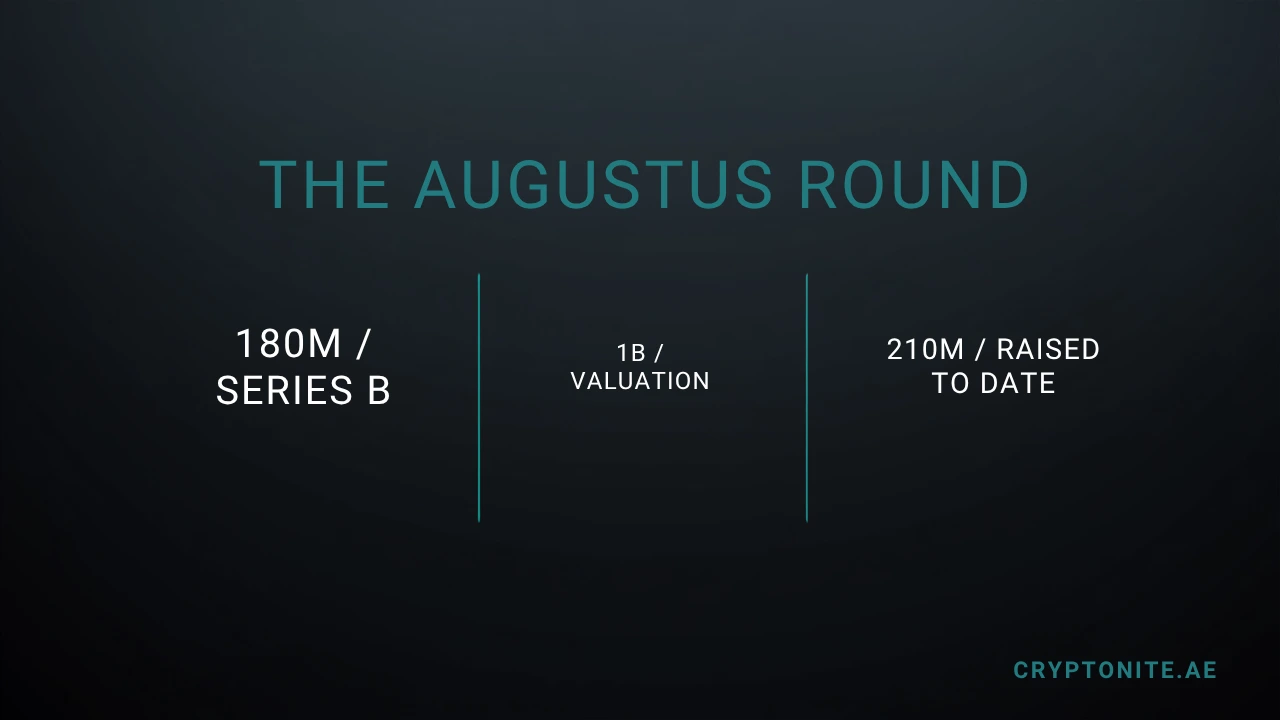
- Augustus raised a $180m Series B at a $1bn valuation led by Tiger Global, with QED Investors, Hummingbird and the founders of Nubank, Ramp, Circle and Deel participating.
- The company is building an AI-native, federally chartered clearing bank for stablecoin and programmable-money settlement.
- It received conditional approval from the OCC for a US national bank charter in May 2026 — reportedly only the eighth such conditional approval since 2010.
- CoinDesk reports the company already processes billions of euros annually through a regulated Finnish entity and counts Kraken among its customers.
- Stated expansion targets include Latin America, Southeast Asia, the Middle East and Africa.
In short: Augustus is building regulated infrastructure that moves dollars across both traditional banking rails and blockchain networks with always-on, programmable settlement. Rather than issuing a stablecoin, it aims to be the clearing layer that fintechs, banks and payment firms plug into for continuous dollar access.
What a stablecoin clearing bank actually does
Clearing is the unglamorous step between a payment instruction and money actually being where it should be. In the traditional system it runs on banking hours, correspondent relationships and batch windows. Stablecoins settle continuously on-chain, which creates an awkward seam: the token moves in seconds, the fiat leg behind it does not.

Augustus is positioning at that seam. According to CoinDesk, the company is pursuing a federally chartered clearing bank rather than issuing its own token — infrastructure for other people’s stablecoins rather than a competitor to them. The company’s own announcement frames the goal as giving international fintechs and banks direct access to the US dollar.
The charter is the crux. Conditional OCC approval arrived in May 2026; final approval would let Augustus clear dollars directly rather than through a sponsor bank. That distinction determines whether it is genuinely infrastructure or another intermediary with a dependency of its own. Conditional approval is not final approval, and that gap is the single largest execution risk in the story.
Why does AI keep appearing in payments funding rounds?
“AI-native” is doing real work here, not just marketing. Autonomous software agents that transact create a settlement profile traditional banking was never designed for: very high volume, very small values, unpredictable timing, and no tolerance for a batch window.
| Attribute | Traditional clearing | Agent-driven settlement |
|---|---|---|
| Availability | Banking hours, batch cycles | Continuous |
| Typical value | Large, low frequency | Small, very high frequency |
| Authorisation | Human-initiated | Programmatic, policy-bound |
| Compliance model | Periodic review | Real-time screening |
Whether agent-driven payment volume materialises at the scale investors are pricing in remains an open question. The infrastructure is being built ahead of demonstrated demand — a reasonable bet given how long bank charters take, but a bet nonetheless. We have written previously on how AI agents pay each other and the stablecoin rails emerging beneath agentic payments.
What this means
The detail worth isolating is the refusal to issue a token. Stablecoin issuance is the visible, high-margin, reserve-income business — and it is becoming crowded, with banks, consortiums and sovereign-backed projects all entering. Clearing is the opposite: capital-intensive, licence-gated, low-margin per transaction, and extremely difficult to displace once embedded. Augustus is choosing the harder moat.
That has a specific consequence for the Gulf. The UAE has moved quickly on issuance — dirham-backed tokens now exist with central bank authorisation — but issuance without deep, always-on dollar clearing still leaves cross-border flows dependent on correspondent banking. A licensed clearing layer that treats blockchain and traditional rails as equivalent is arguably the more strategically valuable piece for a regional financial hub, and it is the piece nobody in the region has yet built at scale.
Augustus lists the Middle East among its expansion targets. Whether that becomes a licensed local presence or simply a sales motion is unknown, and the company has not said. But the structural gap it is aiming at is real, and it is one a stablecoin clearing bank is better suited to close than another issuer.
Frequently asked questions
Is Augustus launching its own stablecoin?
No. The company has said it is building clearing and settlement infrastructure rather than issuing a stablecoin, positioning itself as a neutral layer that existing stablecoins and fintechs can settle through.
Does Augustus have a US banking licence?
Not yet in final form. It received conditional approval from the Office of the Comptroller of the Currency for a US national bank charter in May 2026. Final approval would be required before it can clear US dollars directly, and conditional approval does not guarantee that outcome.
Who invested in the $180m round?
Tiger Global led the round, joined by QED Investors and Hummingbird, alongside founders and executives from Nubank, Ramp, Circle and Deel. The company reports roughly $210m raised in total to date.
This article is for informational purposes only and does not constitute financial, investment, or legal advice.
By Vaibhavv Ali