A crypto ETF rotation is reshaping how institutional money is positioned in digital assets this July. Rather than pouring uniformly into the biggest names, capital is flowing out of spot Bitcoin and Ether exchange-traded funds and into alternatives — XRP, Solana and even Hyperliquid‘s HYPE — alongside a new generation of yield-bearing products. The takeaway is not that institutions are leaving crypto; it is that this crypto ETF rotation shows them becoming more selective about where, and how, they take exposure.
Below we break down where the money is moving, the role of BlackRock’s staked Ethereum ETF, why the rotation is happening now, and what it signals for the second half of 2026. This is market analysis, not investment advice.
Inside the crypto ETF rotation
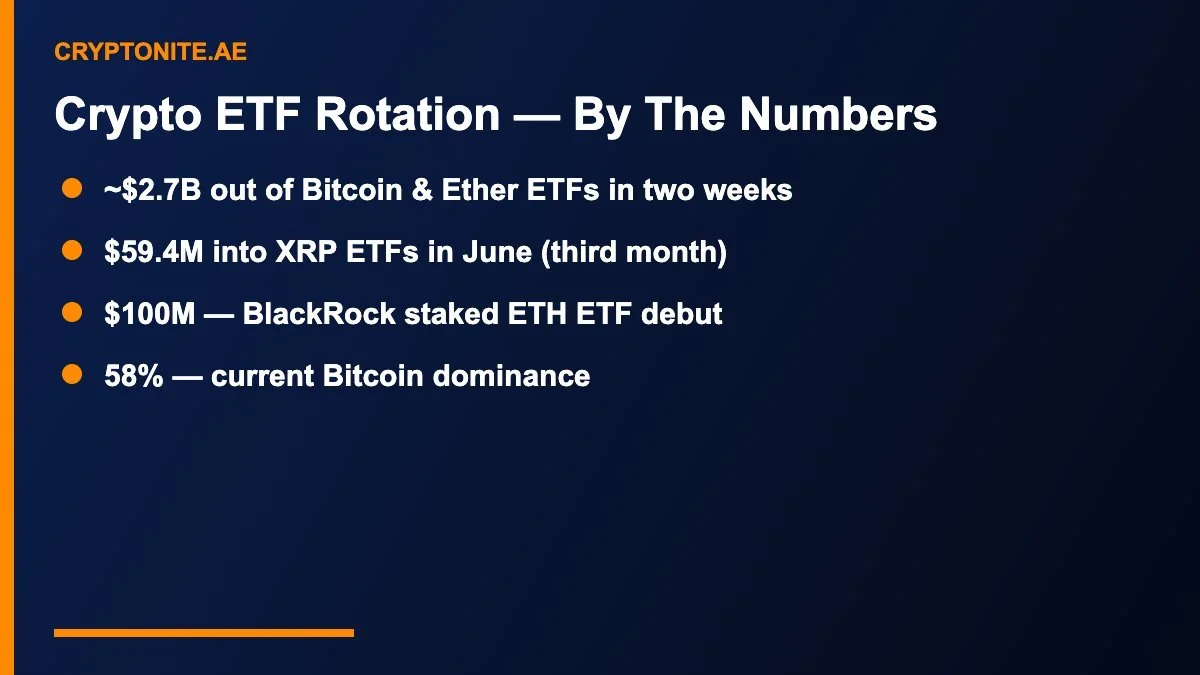
The headline numbers tell the story. Over a recent two-week stretch, spot Bitcoin and Ethereum ETFs saw combined outflows approaching $2.7 billion, with earlier weeks featuring some of the largest single-day Bitcoin ETF redemptions on record. On their own, those figures might read as a retreat from crypto. But the money has not left the asset class — it has moved sideways into other vehicles.
That is the essence of a crypto ETF rotation: net outflows from the majors coincide with net inflows into alternatives. XRP-linked funds, Solana products and HYPE-based vehicles have absorbed capital even as BTC and ETH funds bled. When flows behave this way, it usually reflects a change in conviction about relative value rather than a wholesale exit.
XRP, Solana and HYPE funds attract the inflows
XRP has been the standout. XRP-linked ETFs added roughly $59.4 million in June, marking a third consecutive month of net inflows — a notable streak at a time when the largest funds were shrinking. XRP began July trading near $1.04, with buyers repeatedly defending the psychologically important $1.00 level.
Solana products have benefited from the network’s surging real-world-asset and tokenized-equity activity, giving allocators a growth story distinct from Bitcoin’s store-of-value thesis. HYPE, the token tied to the Hyperliquid ecosystem, has drawn attention as one of the year’s brighter spots for fund flows. Together, these inflows illustrate the rotation’s logic: investors are hunting for differentiated exposure and yield rather than doubling down on the incumbents.
BlackRock’s staked Ethereum ETF and the yield trade
A key driver of the crypto ETF rotation is the arrival of yield. BlackRock launched its iShares Staked Ethereum Trust ETF (ticker ETHB) on 12 March 2026, seeded with roughly $100 million, and it changed what a crypto ETF could offer. Under normal conditions, ETHB stakes between 70% and 95% of its ether holdings via Coinbase Prime, passing approximately 82% of gross staking rewards to investors while BlackRock retains about 18%.
The significance is strategic. A plain spot ETH ETF gives price exposure; a staked product adds an income stream, making Ether more competitive with yield-bearing assets that treasuries and allocators already understand. For investors weighing where to place ETH exposure, the choice between a non-yielding fund and one that captures staking rewards is exactly the kind of decision that fuels rotation between products.
Why the crypto ETF rotation is happening now
Several forces are converging. Macro uncertainty and shifting interest-rate expectations have cooled the broad ETF hype that defined earlier in the cycle, prompting investors to trim their largest positions. Bitcoin dominance sitting around 58% signals a market where capital concentrates in Bitcoin during risk-off phases and rotates into alternatives when appetite returns — and the current crypto ETF rotation looks like selective risk-taking at the margins.
There is also a structural element. The menu of crypto ETFs has expanded rapidly, from single-asset spot funds to staked products and altcoin vehicles. More choice naturally produces more movement between products as allocators fine-tune exposure. Encouragingly, Bitcoin ETFs recently snapped a ten-day outflow streak, a reminder that these flows ebb and reverse rather than moving in one direction forever.
The bigger picture behind the crypto ETF rotation
To read the crypto ETF rotation correctly, it helps to zoom out from the weekly flow figures. The first generation of crypto ETFs was a single trade: buy spot Bitcoin exposure in a familiar wrapper. That simplicity drove record inflows and made products like BlackRock’s flagship Bitcoin fund some of the fastest-growing ETFs in history. But a single-asset market eventually matures into a multi-asset one, and that is precisely the transition the current rotation reflects.
As issuers launched Ether funds, staked-yield products and altcoin vehicles, investors gained the ability to express more nuanced views. The crypto ETF rotation is the visible result: rather than treating “crypto exposure” as one monolithic bet, allocators now shift between assets and structures based on relative value, yield and narrative. That is a sign of a deepening market, and it mirrors how flows behave across sectors in traditional equity and bond ETFs.
What staked ETH ETFs mean for the yield trade
The arrival of yield is arguably the most consequential structural change of 2026, and it sits at the heart of the crypto ETF rotation. A conventional spot Ether ETF offers price exposure and nothing more. A staked product, by contrast, puts the underlying ether to work securing the network and captures a share of the resulting rewards. BlackRock’s iShares Staked Ethereum Trust ETF (ETHB) stakes the majority of its holdings via Coinbase Prime and passes the bulk of gross rewards to investors.
For allocators who think in terms of total return, that distinction is decisive. A yield-bearing crypto product competes with income assets they already understand, and it changes the calculus of holding ether versus bitcoin, which does not natively generate yield. As more staked and income-oriented products launch, expect the crypto ETF rotation to increasingly favor structures that pay investors to hold, not just to speculate on price.
XRP’s institutional moment
XRP has been the clearest beneficiary of the rotation. XRP-linked ETFs recorded a third consecutive month of net inflows, adding roughly $59.4 million in June even as the largest funds shrank. That persistence matters: one month of inflows can be noise, but three in a row suggests a genuine shift in institutional appetite toward the asset. With XRP defending the psychologically important $1.00 level into July, the fund flows and the spot market have been telling a broadly consistent story.
Part of the appeal is differentiation. XRP offers a distinct thesis centered on cross-border settlement and payments, giving allocators exposure that is not simply a proxy for Bitcoin’s price. In a crypto ETF rotation defined by the hunt for differentiated returns, an asset with its own narrative and its own catalysts is well positioned to attract flows.
Bitcoin dominance and the risk-on, risk-off cycle
Bitcoin dominance hovering around 58% is an important backdrop to the crypto ETF rotation. Dominance measures Bitcoin’s share of total crypto market value, and elevated readings typically indicate a cautious market where capital shelters in the largest, most liquid asset. When confidence returns, some of that capital rotates into higher-beta alternatives in search of outperformance.
That cyclical pattern helps explain why money can flow out of Bitcoin ETFs while simultaneously flowing into XRP, Solana and HYPE products. It is not a contradiction; it is the market fine-tuning risk. Encouragingly, the recent snapping of a ten-day Bitcoin ETF outflow streak is a reminder that these tides reverse, and that a rotation out of an asset today can become a rotation back in tomorrow. Reading flows as cycles rather than one-way verdicts is the key discipline.
How allocators are reading the crypto ETF rotation
For professional allocators, the crypto ETF rotation is less a warning sign than a menu. The proliferation of products lets them build more deliberate crypto sleeves: a core Bitcoin position for store-of-value exposure, an Ether or staked-Ether allocation for smart-contract and yield exposure, and satellite positions in XRP, Solana or thematic tokens for differentiated upside. Rebalancing between these naturally generates the flow patterns now visible in the data.
The practical lesson is to avoid over-interpreting short-term moves. Two weeks of outflows from a category can reflect tactical rebalancing rather than a change in long-term conviction. Sophisticated investors watch flows over quarters, weigh them against price and positioning, and treat any single data point with appropriate skepticism. That measured approach is the antidote to the whiplash that headline flow numbers can induce.
The Gulf and UAE institutional angle
For readers in the UAE and wider Gulf, the crypto ETF rotation is instructive even where these specific US products are not directly accessible. It demonstrates how institutional crypto adoption evolves once wrappers exist: demand does not stay concentrated in one asset but spreads across a spectrum of exposures and structures. As regional regulators and institutions build out their own digital-asset frameworks, the maturation visible in US ETF flows offers a preview of how local demand may develop.
It also underscores the growing importance of yield and differentiation. Gulf allocators accustomed to income-generating assets are likely to gravitate toward staked and yield-bearing crypto products, and toward assets with distinct theses rather than undifferentiated beta. The crypto ETF rotation, in that sense, is a useful map of where sophisticated capital tends to travel as the market matures.
A short history of the crypto ETF era
The current crypto ETF rotation is only comprehensible against the backdrop of how quickly this market appeared. Spot Bitcoin ETFs arrived and almost immediately became some of the most successful fund launches in history, channeling tens of billions of dollars into crypto through a wrapper that pensions, advisors and retail brokerages could all use. Ether funds followed, extending the same accessibility to the second-largest asset. In a remarkably short span, crypto went from a market accessed mainly through specialized exchanges to one available in ordinary brokerage accounts.
That accessibility is precisely what makes flows so informative now. Because these products sit inside mainstream portfolios, their inflows and outflows offer a real-time read on how traditional investors feel about crypto. The crypto ETF rotation is, in effect, institutional sentiment made visible — and right now that sentiment is nuanced rather than uniformly bullish or bearish.
Risks and caveats in reading fund flows
Flow data is powerful but easy to misread, and a few caveats are worth stating plainly. Daily and weekly figures are volatile, and a large redemption can reflect a single institution rebalancing rather than a broad change in conviction. Creations and redemptions can also be driven by arbitrage and hedging activity that has little to do with directional views. Treating any one day’s number as a verdict on the market is a common and costly mistake.
There is also survivorship and composition bias: as new products launch, flows naturally spread across more vehicles, which can make any single fund’s numbers look weaker even as total crypto exposure grows. The disciplined way to read the crypto ETF rotation is to aggregate across products, smooth the data over weeks or months, and cross-check flows against price and on-chain activity before drawing conclusions.
Solana funds and the tokenization crossover
Solana’s inclusion in the crypto ETF rotation is notable because it ties fund flows to a powerful underlying narrative. The network has become the dominant venue for tokenized stocks and real-world assets, giving Solana-linked products a growth story rooted in genuine on-chain usage rather than speculation alone. For allocators seeking exposure to the tokenization theme through a familiar wrapper, Solana funds offer a natural entry point.
That linkage between a network’s fundamental adoption and its fund flows is a healthy sign of maturation. It suggests investors are increasingly differentiating assets by what they actually do, not merely by momentum. As tokenization expands, expect the crypto ETF rotation to keep rewarding networks and assets with demonstrable real-world traction.
The bottom line on the crypto ETF rotation
Stepping back, the crypto ETF rotation tells a constructive story about a maturing asset class. Capital is not fleeing crypto; it is becoming more discerning, spreading across assets and structures and increasingly favoring products that offer yield or a differentiated thesis. That is exactly how a young market grows up, and it mirrors the way flows behave across established sectors in traditional finance.
The prudent takeaway for any investor is to watch the trend rather than the ticker: follow flows over months, weigh them against fundamentals, and resist the urge to react to every headline number. The crypto ETF rotation is a map of where sophisticated money is traveling, not a set of instructions. As always, this coverage is information rather than financial advice, and readers should do their own research before acting.
What to watch next in the crypto ETF rotation
Several developments will shape the next chapter of the crypto ETF rotation. The first is the pace of new product launches: as issuers roll out additional staked, altcoin and thematic funds, the menu of exposures will widen and give allocators even more room to rotate. Each new structure is a fresh channel through which capital can flow, and the breadth of products will increasingly define how the market behaves.
The second is the direction of macro policy. Interest-rate expectations and broader risk appetite exert a strong pull on crypto fund flows, and a decisive shift in either could accelerate or reverse the current rotation. Watching how BTC and ETH funds respond to macro catalysts will reveal whether the recent outflows were tactical or the start of something more durable. The recent end of a ten-day Bitcoin ETF outflow streak hints that sentiment can turn quickly.
The third is the interplay between fund flows and on-chain fundamentals. As products tied to Solana, XRP and staked Ether gain traction, the assets with the strongest real-world usage and clearest yield stories are likely to attract the most durable inflows. That alignment between fundamentals and flows would mark a healthy evolution beyond momentum-driven trading. For investors, the enduring lesson of the crypto ETF rotation is to track these structural signals over time rather than chasing the noise of any single week, and to treat this analysis as information rather than investment advice.
What it means
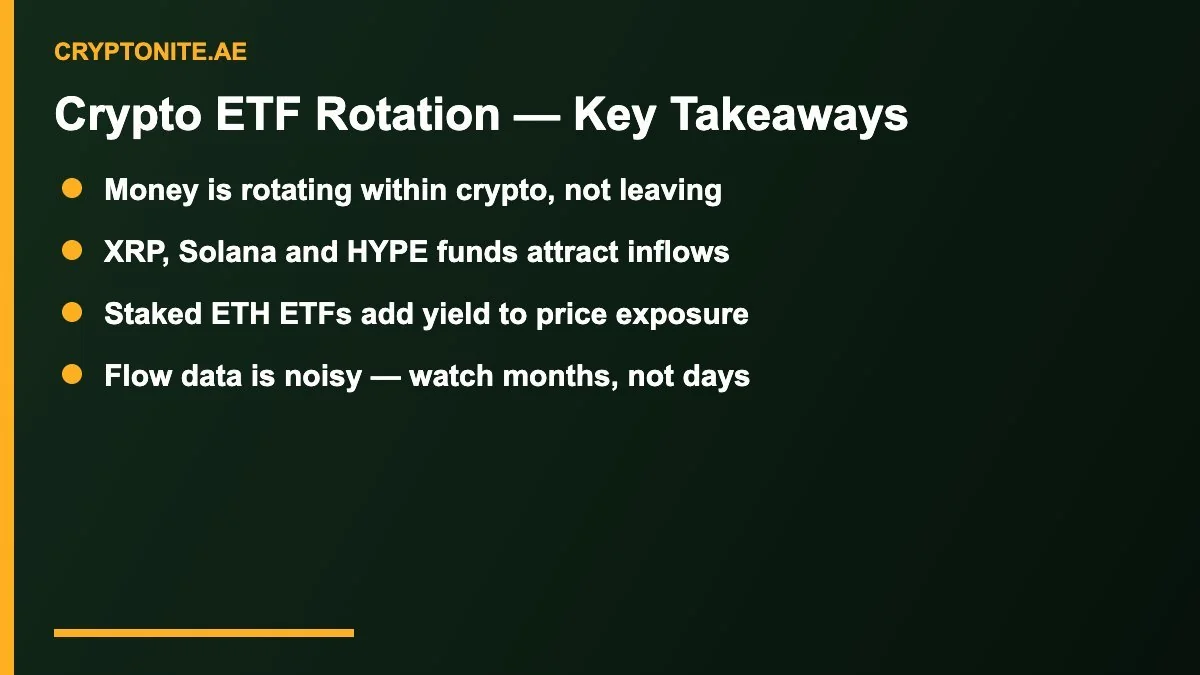
The crypto ETF rotation is a sign of a maturing market, not a fading one. When money moves from Bitcoin and Ether into XRP, Solana, HYPE and staked-yield products, it reflects investors treating crypto as a diversified asset class with distinct sub-narratives — store of value, high-performance settlement, real-world assets and yield — rather than a single trade. For issuers, it is validation that product breadth matters; for allocators, it is an invitation to be deliberate about which exposure they want.
The caution is that flow data is noisy and reverses quickly, and short-term movements should not be mistaken for permanent trends. Anyone acting on these signals should look at flows over months, not days, and remember that this is information, not financial advice.
Related on Cryptonite: our Bitcoin ETF inflow coverage, XRP outlook and UAE Ethereum staking guide.
Sources: CoinDesk, Forbes, DL News.
More trending on Cryptonite: Pi Network v25 upgrade goes live July 22 · Solana tokenized stocks overtake memecoins · CLARITY Act stalls near 40% odds.
What is the crypto ETF rotation?
It refers to institutional capital flowing out of spot Bitcoin and Ether ETFs and into alternatives such as XRP, Solana and HYPE funds, plus yield-bearing products like staked Ethereum ETFs, reflecting more selective positioning rather than an exit from crypto.
How does BlackRock’s staked Ethereum ETF work?
BlackRock’s iShares Staked Ethereum Trust ETF (ETHB), launched in March 2026, stakes 70-95% of its ether via Coinbase Prime and passes roughly 82% of gross staking rewards to investors, adding yield on top of price exposure.

6 thoughts on “Crypto ETF Rotation: Billions Leave Bitcoin and Ether for XRP and Solana”