

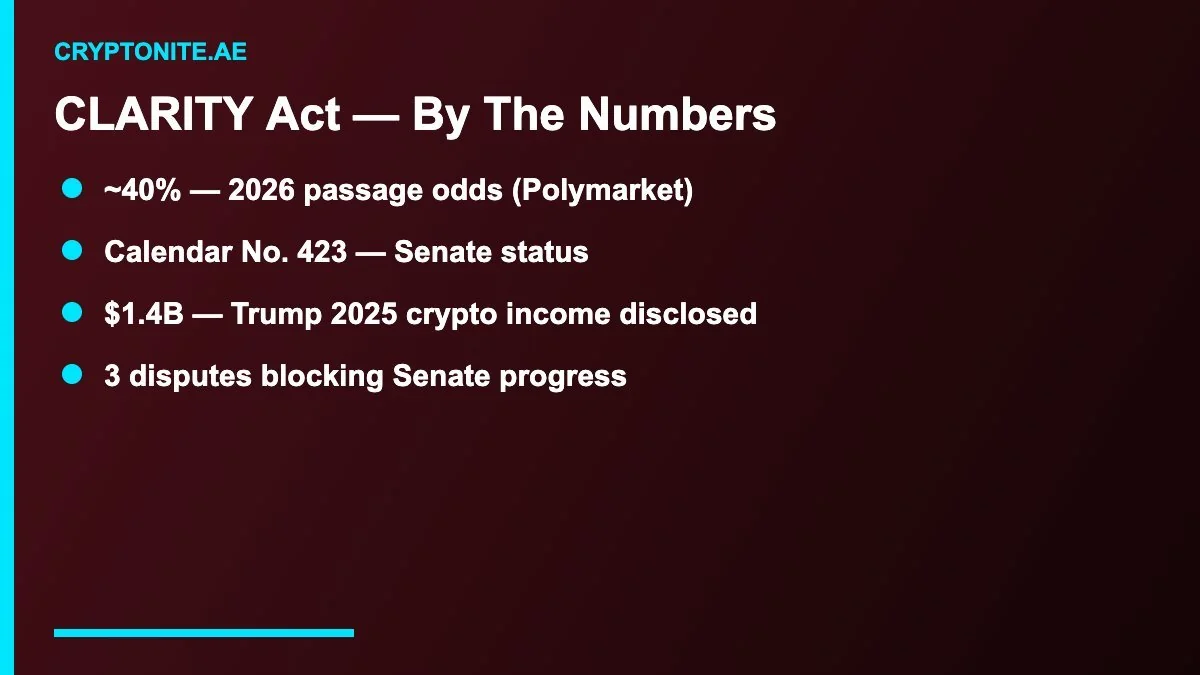
The CLARITY Act — formally the Digital Asset Market Clarity Act — has become the single most important piece of unfinished business in US crypto policy, and as of late July 2026 its fate is genuinely uncertain. Prediction markets put the odds of the CLARITY Act being signed into law this year somewhere in the high-30s to low-40s percent, a range that captures both real momentum and real obstacles. The bill would settle long-running questions about how digital assets are regulated in the United States, but it remains stuck in the Senate with time running short.
This article explains what the CLARITY Act would do, why it stalled, how a dispute over ethics and disclosure became central, and what the realistic timeline looks like. It is a factual overview, not political advocacy or investment advice.
What the CLARITY Act would do
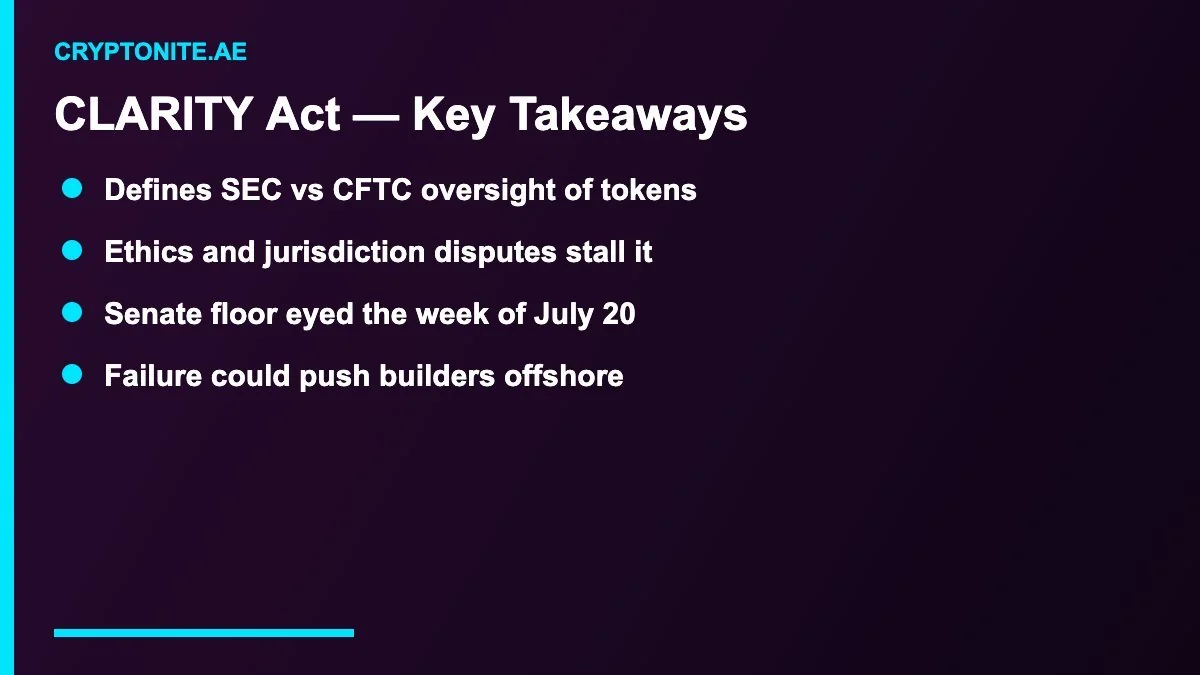
The CLARITY Act is a market-structure bill: its purpose is to define which US regulator oversees which digital assets and under what rules. In broad terms, it seeks to draw clearer lines between tokens that behave like securities — falling under the Securities and Exchange Commission — and those that function more like commodities, overseen by the Commodity Futures Trading Commission. It also aims to establish registration pathways, consumer protections and disclosure requirements tailored to digital assets.
For an industry that has spent years complaining about “regulation by enforcement,” that clarity is the entire point. Businesses building exchanges, tokens and custody services want to know, in advance, which rulebook applies. Supporters argue the CLARITY Act would unlock institutional participation by removing legal ambiguity; that is why the bill commands close attention across the market.
Why the CLARITY Act stalled in the Senate
The CLARITY Act cleared earlier hurdles but has bogged down in the Senate. As America’s 250th birthday passed on 4 July 2026, the bill sat at Calendar No. 423 with no floor vote scheduled and no cloture motion filed. Reporting has pointed to three interlocking disputes blocking progress, spanning ethics and disclosure, the precise boundaries of regulatory jurisdiction, and provisions affecting decentralized finance.
Legislative mechanics make the timing tight. Even once a revised draft appears, advancing it requires floor time, cloture and reconciliation between chambers — a process that can consume the limited days left on the calendar. That is why the same bill can look both close to passage and at risk of missing its window, depending on which obstacle you weigh most heavily.
Trump’s $1.4 billion crypto income and the ethics fight
One dispute has drawn outsized attention. On 1 July 2026, the Office of Government Ethics released a 927-page financial disclosure showing that President Donald Trump reported approximately $1.4 billion in cryptocurrency-related income during 2025. That figure sharpened an existing debate about conflicts of interest and whether a market-structure bill should include stronger safeguards against public officials profiting from assets they help regulate.
Critics contend the CLARITY Act needs firmer insider-trading and ethics provisions to prevent conflicts of interest; supporters counter that such concerns should not derail a technical framework the industry has awaited for years, and that ethics rules can be addressed separately. Both positions are being argued in good faith by their proponents, and the disagreement is as much about process and precedent as about any single individual. The result, for now, is gridlock on this specific point.
The odds, the timeline and what’s next
Prediction-market pricing has been volatile. Polymarket odds of the CLARITY Act becoming law in 2026 fell to around 39% on 1 July and have swung within roughly a 36–44% band since, reflecting how sensitive the outcome is to each procedural development. A newer draft of the bill was expected to surface in mid-July, and its advocates hoped to bring it to the Senate floor as soon as the week of 20 July — though even supporters acknowledge the runway is short.
The base case, then, is a genuine coin-flip. A revised text that resolves the ethics and jurisdiction disputes could move quickly given bipartisan interest; continued deadlock could push the effort into 2027. Markets are watching cloture motions and floor scheduling as the clearest signals of momentum.
The regulatory backdrop: why the CLARITY Act exists
To understand the stakes, it helps to remember the problem the CLARITY Act is meant to solve. For years, US crypto companies have operated without a clear federal framework defining which regulator governs which asset. That vacuum produced a patchwork of enforcement actions, court rulings and state-level regimes, leaving businesses guessing about the rules and, in some cases, relocating abroad. The CLARITY Act is Congress’s attempt to replace that ambiguity with statute.
The bill emerged from years of debate over whether existing securities and commodities laws, written long before blockchains existed, could sensibly be applied to digital assets. Industry advocates argued they could not, and that a purpose-built framework was needed. The CLARITY Act reflects that view, seeking to create tailored categories, registration paths and disclosure standards suited to how digital assets actually function.
SEC versus CFTC: the jurisdictional core of the CLARITY Act
At the heart of the CLARITY Act is a deceptively simple question: is a given token a security or a commodity? The answer determines whether it falls under the Securities and Exchange Commission or the Commodity Futures Trading Commission, two agencies with very different mandates, rulebooks and enforcement styles. The bill attempts to draw workable lines between the two, with mechanisms for assets to move between categories as they decentralize over time.
This jurisdictional split is more than bureaucratic housekeeping. It shapes how tokens are issued, traded and custodied, and which disclosures projects must make. Getting the boundaries right is essential; getting them wrong could either stifle legitimate projects with heavy securities requirements or leave investors underprotected. The precise wording of these provisions is one of the disputes that has slowed the CLARITY Act in the Senate, because small definitional choices carry large practical consequences.
The DeFi and decentralization debate
A second cluster of disputes centers on decentralized finance. DeFi protocols, which run on autonomous smart contracts rather than being operated by an identifiable company, do not fit neatly into frameworks designed for intermediaries. Lawmakers have wrestled with how the CLARITY Act should treat genuinely decentralized systems versus those that merely claim decentralization while remaining under effective control of a founding team.
Get this balance wrong in either direction and there are costs: overly broad rules could sweep in software developers and open-source contributors, while overly lax rules could create a loophole for bad actors to evade oversight by asserting decentralization. Crafting language that distinguishes the two is genuinely hard, and it is one reason the bill has proven difficult to finalize even among legislators who broadly support it.
What passage of the CLARITY Act would mean for crypto businesses
If the CLARITY Act becomes law, the most immediate effect would be certainty. Exchanges, token issuers, custodians and DeFi projects would gain a clearer map of their obligations, reducing the legal risk that has pushed some firms offshore. Many industry participants believe that clarity would unlock a wave of institutional participation, as banks, asset managers and payment companies that have stayed on the sidelines gain the regulatory comfort they require.
Clarity would also likely accelerate product development. When the rules are known in advance, companies can build compliant products rather than litigating after the fact. For a US market that has watched tokenization and trading activity migrate to jurisdictions with clearer frameworks, the CLARITY Act could help repatriate some of that innovation. None of this is guaranteed, and the details of the final text would determine how business-friendly the outcome proves to be.
What failure of the CLARITY Act would mean
The counterfactual matters just as much. If the CLARITY Act stalls and dies this session, the status quo of regulation-by-enforcement would persist, with agencies and courts continuing to define the rules case by case. For businesses, that means ongoing uncertainty, higher legal costs and the continued temptation to build in friendlier jurisdictions. Momentum lost this year could be difficult to regain, particularly if the political calendar shifts.
Failure would also send a signal internationally. Jurisdictions competing to attract crypto businesses would likely point to continued US gridlock as a reason to base operations elsewhere. In that sense, the CLARITY Act is not only about domestic rules but about the United States’ competitive position in a global industry that is increasingly mobile.
The global contrast: UAE, EU and beyond
The debate over the CLARITY Act throws the global regulatory landscape into sharp relief. While Washington deliberates, other jurisdictions have moved decisively. The European Union implemented its Markets in Crypto-Assets framework, and Gulf regulators such as Dubai’s VARA and Abu Dhabi’s FSRA have built detailed, operational regimes that have attracted exchanges, custodians and tokenization platforms. For firms weighing where to build, clarity elsewhere is a powerful magnet.
This contrast is precisely why the CLARITY Act carries such weight. Supporters argue that without a competitive federal framework, the United States risks ceding leadership in a strategically important technology. Whatever one’s view of the specific provisions, the global direction of travel toward clear digital-asset rules is unmistakable, and the CLARITY Act is America’s attempt not to be left behind.
What to watch next on the CLARITY Act
Several signals will indicate where the CLARITY Act is heading. The most important is procedural: whether a revised draft is introduced, whether a cloture motion is filed, and whether Senate leadership schedules floor time. These mechanical steps, more than public statements, reveal genuine momentum. Prediction-market odds will continue to move with each development and offer a real-time gauge of sentiment, even if they are not forecasts to be relied upon.
Observers should also watch how the ethics and jurisdiction disputes are resolved, since compromise language on those points is the likeliest path to passage. Whether the CLARITY Act ultimately becomes law in 2026 or slips into a future session, the underlying push for a clear US framework is unlikely to disappear. For readers, the sensible approach is to track the procedural signals, treat the odds as a live barometer, and remember that this coverage is factual analysis rather than legal or investment advice.
A brief timeline of how the bill reached the Senate
The road to the current standoff has been long. The effort to pass a comprehensive US digital-asset framework spans multiple congressional sessions, with earlier attempts foundering on disagreements between committees, chambers and the two main financial regulators. What distinguishes the present moment is that a market-structure framework advanced further than in previous years, clearing key committee hurdles and reaching the Senate calendar rather than dying quietly in a subcommittee.
That progress reflects a broader shift in the political conversation around crypto, which has moved from the fringes toward the mainstream of financial policy. Lawmakers on both sides of the aisle have come to accept that digital assets are not going away and that a regulatory framework of some kind is preferable to continued ambiguity. The disagreement now is over the details and the guardrails, not over whether legislation should exist at all — a meaningful evolution from the outright skepticism of just a few years ago.
Even so, the legislative calendar is unforgiving. Bills that miss their window can languish for months or require reintroduction in a new session, losing momentum each time. That is why supporters have pressed so hard to bring the measure to a vote while the political will exists, and why each procedural delay carries outsized significance for the bill’s ultimate prospects.
Provisions that often get overlooked
Much of the public debate focuses on the headline question of SEC versus CFTC jurisdiction, but the legislation contains a range of less-discussed provisions that could prove just as consequential. These include rules on custody and the safekeeping of customer assets, disclosure obligations for token issuers, and standards for how trading platforms manage conflicts of interest between their various business lines. For everyday users, these consumer-protection elements may matter more than the abstract classification debates.
There are also provisions addressing stablecoins’ interaction with the broader framework, the treatment of tokenized real-world assets, and the obligations of intermediaries that serve retail customers. Each of these touches a fast-growing part of the market, and the precise wording will shape how products can be offered in the United States. Observers focused solely on the jurisdictional fight risk missing how these operational rules could reshape day-to-day compliance for exchanges, issuers and custodians alike.
Finally, the framework includes transition and grandfathering mechanisms that determine how existing projects come into compliance. These technical details rarely make headlines, but they can decide whether the shift to a new regime is smooth or disruptive. Reading beyond the political drama to these substantive provisions gives a fuller picture of what the legislation would actually do, and why so many stakeholders are invested in getting the language right rather than merely getting something passed.
The bottom line for readers watching the CLARITY Act
For anyone trying to make sense of the noise, a few grounded conclusions stand out. The CLARITY Act represents the most serious attempt yet to give the United States a coherent digital-asset framework, and it has advanced further than any predecessor. At the same time, its passage in 2026 is genuinely uncertain, with prediction markets treating it as close to a coin flip and real disputes still unresolved in the Senate. Both things are true at once, which is why confident predictions in either direction should be treated with caution.
What is clear is the direction of travel. Whether or not this specific bill becomes law this year, the pressure for regulatory clarity in the United States is not going away, and the global backdrop of maturing frameworks only intensifies it. Markets, businesses and investors would all benefit from certainty, and the political conversation has shifted decisively toward providing some version of it. The open question is timing and detail, not whether clarity eventually arrives.
For readers in the Gulf and beyond, the most useful posture is to watch the procedural signals, weigh the competing arguments fairly, and avoid staking decisions on any single headline or odds movement. Regulatory processes are messy and non-linear, and this one is no exception. As always, this article is intended as factual analysis rather than legal or investment advice, and the situation may evolve quickly in the days and weeks ahead.
What it means for crypto markets
For crypto businesses, the CLARITY Act represents the difference between operating under clear federal rules and continuing to navigate a patchwork of enforcement actions and state regimes. Passage would likely be read as a green light for deeper institutional involvement in US digital-asset markets; failure would prolong the uncertainty that has pushed some builders toward friendlier jurisdictions, including the UAE, Singapore and Switzerland.
For readers in the Gulf, the contrast is instructive: while Washington debates, regulators such as Dubai’s VARA and Abu Dhabi’s FSRA have already built detailed frameworks. Whatever Congress decides, the direction of travel globally is toward clearer digital-asset rules. As always, this is analysis rather than legal or investment advice, and the situation may change rapidly — verify the latest status before acting.
Related on Cryptonite: our CLARITY Act explained, sheriffs and the CLARITY Act and the UAE and global regulation guide.
Sources: CoinDesk, Latham & Watkins policy tracker, Forbes.
More trending on Cryptonite: Pi Network v25 upgrade goes live July 22 · Solana tokenized stocks overtake memecoins · Crypto ETF rotation into XRP and Solana.
What is the CLARITY Act?
The CLARITY Act, or Digital Asset Market Clarity Act, is a US market-structure bill that would define whether the SEC or CFTC regulates a given digital asset and establish registration, disclosure and consumer-protection rules for the industry.
What are the CLARITY Act’s chances of passing in 2026?
Prediction markets have priced the odds of the CLARITY Act becoming law in 2026 in roughly the 36-44% range, with progress blocked in the Senate by disputes over ethics disclosure, regulatory jurisdiction and DeFi provisions.
Related: New CLARITY Act Draft Reaches Senate as Crypto Market-Structure Deadline Looms

1 thought on “CLARITY Act Stalls in the Senate as Passing Odds Hover Near 40%”