Solana tokenized stocks have quietly pulled off one of the most important narrative shifts of 2026: for the first time, on-chain trading of tokenized equities on Solana has overtaken the network’s famous memecoin activity. On 24 June, daily tokenized-stock volume hit a record $644 million and surpassed memecoins as a share of Solana spot volume — a milestone that reframes Solana from a casino of speculative tokens into serious infrastructure for real-world assets. Solana tokenized stocks are no longer a side experiment; they are becoming the network’s flagship use case.
This article unpacks the data behind the shift, the platforms powering it, why Solana captured the category, and the risks that still hang over tokenized equities. It is analysis, not investment advice.
Solana tokenized stocks overtake memecoins
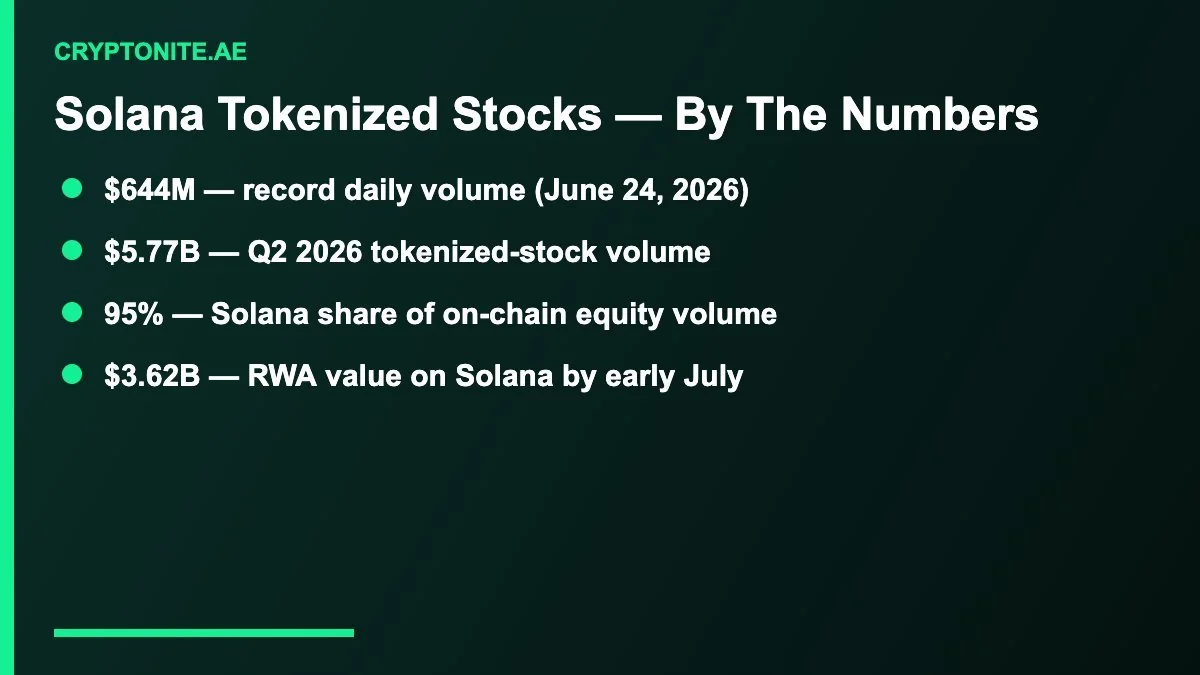
For years, Solana’s identity was tied to memecoins. The network’s speed and low fees made it the natural home for fast-moving speculative tokens, and at times memecoins accounted for the majority of its spot activity. That is now changing. Solana tokenized stocks posted roughly $5.77 billion in trading volume during the second quarter of 2026 — a single-quarter figure that exceeded the entire prior year’s second-half total by more than seven times.
The June 24 record of $644 million in daily tokenized-equity volume was the moment the crossover became undeniable. Investors rotating away from purely speculative meme assets toward instruments with tangible underlying value — shares of real companies — found Solana already had the rails in place. The broader market backdrop helped: 2026 has seen capital pivot toward real-world assets, institutional partnerships and utility-driven narratives, and tokenized equities sit squarely in that theme.
xStocks, Kraken and the platforms driving the boom
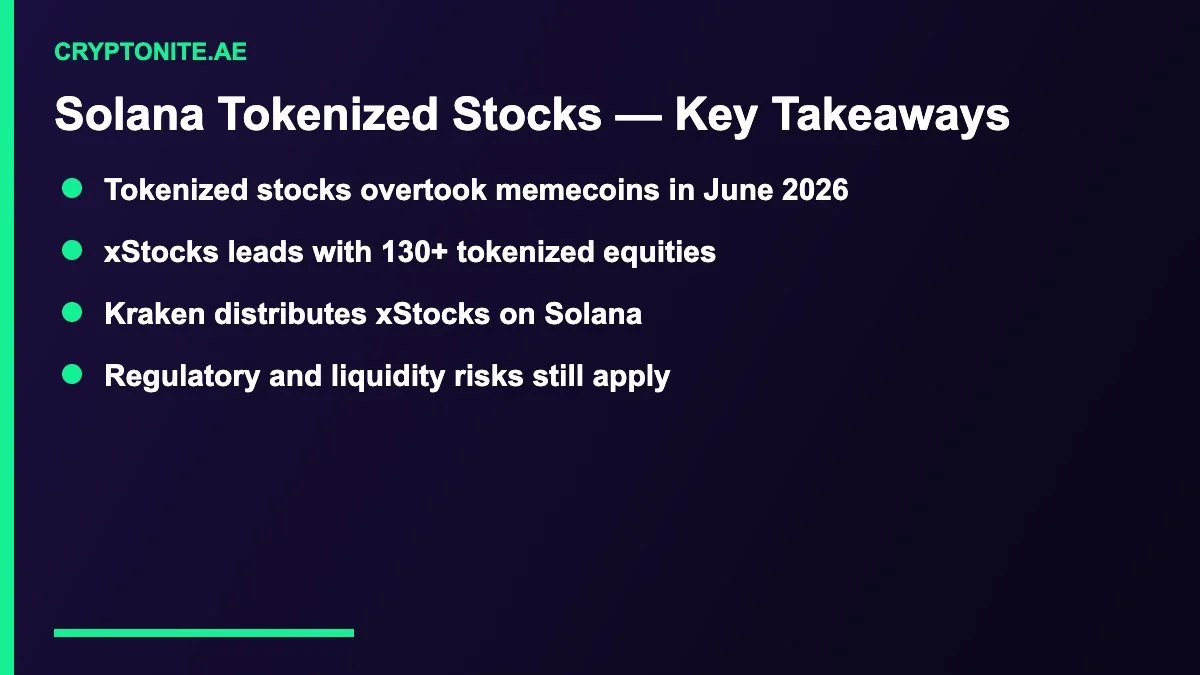
The engine behind Solana tokenized stocks is Backed Finance’s xStocks platform. xStocks now offers more than 130 tokenized stocks, has surpassed $3 billion in cumulative on-chain trading volume and attracted over 57,000 unique holders. Each xStock is designed to track a real equity, giving on-chain users price exposure to names they previously could only trade through a traditional brokerage.
Distribution matters as much as issuance, and here Kraken has been pivotal. The exchange rolled out xStocks on Solana, with an initial line-up of around 60 tokenized assets, bringing tokenized equities to a large, established user base. As more venues list the same tokens, liquidity deepens and spreads tighten — a virtuous cycle that has helped Solana tokenized stocks scale quickly. The tokenization of high-profile private names, including buzz around a tokenized SpaceX exposure, added further attention to the category.
The numbers behind Solana tokenized stocks
The growth shows up across every relevant metric. Real-world asset value on Solana climbed from about $1.4 billion in January to roughly $3.62 billion by early July — close to a fourfold increase in half a year. On the equities side specifically, Solana now processes an estimated 95% of all on-chain tokenized-stock trading volume, an extraordinary concentration for a single chain.
Tooling has matured alongside the market. Analytics provider rwa.xyz launched a dedicated dashboard tracking more than 2,600 tokenized stocks worth around $1.85 billion, giving traders and institutions transparent, real-time visibility into a segment that barely existed a year earlier. When independent data providers build infrastructure to measure a category, it is usually a sign the category has arrived.
Why Solana won tokenized equities
Several factors explain Solana’s dominance in tokenized stocks. Speed and cost are the obvious ones: settling equity trades on-chain only makes sense if fees are negligible and confirmation is near-instant, and Solana’s architecture delivers both. Just as important is the ecosystem already built around it — wallets, exchanges, market makers and DeFi protocols that can plug tokenized equities into lending, collateral and trading strategies.
There is also a first-mover advantage. By hosting xStocks early and attracting the liquidity that followed, Solana built a network effect that is hard for rival chains to dislodge. Liquidity begets liquidity: traders go where the volume is, and issuers list where the traders are. That feedback loop is why 95% of the category now runs on one network.
Risks and regulatory questions
None of this is without caveats. Tokenized stocks raise thorny questions about legal ownership, dividend rights and how on-chain tokens map to the underlying shares held by an issuer. Regulatory treatment varies by jurisdiction — some structures rely on Swiss DLT frameworks, others on US exemptions — and the rules are still evolving. Liquidity, while growing, remains far smaller than traditional equity markets, meaning large orders can move prices.
For institutional readers, the due-diligence checklist is familiar: who issues the token, what backs it, where redemption rights sit, and which regulator oversees the structure. The upside of Solana tokenized stocks is real, but so is the need to understand the plumbing before relying on it.
The wider RWA context for Solana tokenized stocks
The surge in Solana tokenized stocks does not exist in isolation; it is the sharpest expression of a much larger real-world-asset trend sweeping through crypto in 2026. Tokenized US Treasuries and private credit led the first wave of institutional tokenization, proving that regulated, yield-bearing instruments could live on public blockchains. Tokenized equities are the natural next step, because stocks are the most widely held and most actively traded assets on earth. When that demand found a fast, cheap settlement layer, Solana tokenized stocks were the result.
Total real-world-asset value on Solana climbing from roughly $1.4 billion in January to about $3.62 billion by early July shows how quickly capital has followed. Crucially, this growth is happening alongside, not instead of, the network’s stablecoin and payments activity, giving Solana a diversified base of on-chain economic activity. For a network once dismissed as a venue for speculative tokens, hosting billions in tokenized real-world assets is a profound repositioning.
How tokenized stocks actually work on Solana
Understanding the mechanics helps explain both the appeal and the caveats. A tokenized stock is a blockchain token designed to track the price of a real share. An issuer such as Backed Finance holds or references the underlying equity and mints on-chain tokens that mirror its value, which then trade on Solana and can be integrated into DeFi protocols. Because settlement happens on-chain, trades clear in seconds at negligible cost, and the tokens can be used as collateral or building blocks in ways traditional shares cannot.
That programmability is the real unlock. A tokenized equity can be lent, borrowed against, bundled into structured products or traded 24/7, blurring the line between equities and DeFi. It is why Solana tokenized stocks have grown into more than a novelty: they let on-chain users access familiar assets through the composable machinery of decentralized finance. The trade-off is that token holders rely on the issuer’s structure and jurisdiction for their economic rights, which is why due diligence matters.
Institutional interest and the UAE angle
The institutional implications of Solana tokenized stocks are significant, and they resonate strongly in the Gulf. As sovereign wealth funds, family offices and asset managers in the UAE explore tokenization, a liquid on-chain market for equities offers a template for how other assets — real estate, funds, commodities — might trade. Dubai and Abu Dhabi have built regulatory frameworks explicitly welcoming tokenization, and the rapid maturation of Solana tokenized stocks provides a live example of what deep, liquid tokenized markets can look like.
For institutions, the appeal is efficiency: faster settlement, fractional ownership, round-the-clock trading and programmable compliance. The caution is that regulatory recognition of tokenized equities varies widely by jurisdiction, and the instruments that trade freely on-chain may not carry identical legal rights to the shares they track. Serious allocators will treat Solana tokenized stocks as a promising frontier that still requires careful legal and operational review.
Can rival chains catch Solana tokenized stocks?
With Solana processing an estimated 95% of on-chain tokenized-equity volume, the obvious question is whether competitors can close the gap. Ethereum and its layer-2 networks, along with other high-performance chains, all covet the tokenization narrative, and issuers may eventually deploy the same tokenized stocks across multiple networks to widen distribution. Multi-chain issuance would dilute Solana’s dominance over time.
Yet network effects are powerful. Liquidity concentrates where trading already happens, and the ecosystem of exchanges, market makers and DeFi protocols that has formed around Solana tokenized stocks is difficult to replicate quickly. For now, Solana’s early lead, low costs and deep liquidity make it the default venue, and rivals will need more than comparable technology to pull volume away. The most likely outcome is a multi-chain market in which Solana remains the center of gravity for the foreseeable future.
What to watch next for Solana tokenized stocks
Several signals will show whether the boom is durable. The first is breadth of listings: as issuers expand beyond the largest names into a wider universe of equities and even private companies, the addressable market grows. The second is regulatory clarity, both in the jurisdictions where issuers are domiciled and in the major markets whose stocks are being tokenized. The third is the depth of secondary-market liquidity, since thin order books can produce prices that stray from the underlying shares.
Interoperability with traditional finance is the longer-term prize. If tokenized equities can eventually settle against regulated venues and connect to established custody and clearing, Solana tokenized stocks could evolve from a crypto-native curiosity into genuine market infrastructure. That is a multi-year journey, but the trajectory established in 2026 is unmistakable. As always, this is analysis rather than investment advice, and readers should verify the latest figures and legal structures before acting.
From memecoins to tokenized equities: a six-year journey
The rise of Solana tokenized stocks is best appreciated against the backdrop of the network’s own evolution. Solana launched with a promise of speed and scale, and for much of its history that capacity was most visibly used for high-frequency trading and, later, memecoins. The memecoin era brought enormous volume and attention, but also a reputation for speculation that some institutions found off-putting. The pivot toward tokenized equities is, in effect, Solana channeling the same technical strengths — throughput and low fees — toward assets with real-world backing.
That shift matters because it changes who shows up. Memecoin volume is dominated by retail speculation; Solana tokenized stocks attract a different mix that includes investors seeking familiar exposure and, increasingly, institutions evaluating on-chain settlement. When the June crossover saw tokenized-stock volume overtake memecoins for the first time, it was more than a statistical curiosity — it signaled a maturing of demand on the network toward utility-driven activity.
Data, dashboards and the transparency advantage
One underappreciated driver of Solana tokenized stocks is transparency. Because these instruments live on a public blockchain, every trade, holder and transfer is visible and auditable in real time. The launch of dedicated analytics — including an rwa.xyz dashboard tracking more than 2,600 tokenized stocks worth roughly $1.85 billion — gives traders and institutions a level of on-chain visibility that traditional equity markets, with their fragmented data and delayed reporting, rarely match.
This transparency is a feature, not a footnote. Institutions considering tokenized assets want reliable, independent data on liquidity, concentration and flows before they commit capital. As measurement infrastructure matures around Solana tokenized stocks, it lowers the perceived risk of the category and makes it easier for larger players to participate. Good data begets confidence, and confidence begets volume.
The bottom line for Solana tokenized stocks
Pulling the threads together, Solana tokenized stocks represent one of the clearest signs that tokenization is moving from theory into practice at scale. The category has grown from negligible to billions in quarterly volume in a matter of quarters, overtaken the network’s memecoin activity, and attracted purpose-built infrastructure and analytics. That is not the profile of a passing fad; it is the profile of an emerging market finding its feet.
The honest counterweight is that early-stage markets are volatile and legally complex, and the rights attached to a tokenized share depend heavily on the issuer and jurisdiction. Liquidity, while growing quickly, is still a fraction of traditional equity markets. None of that negates the trend, but it does argue for measured expectations. For readers weighing the significance of Solana tokenized stocks, the sensible posture is to recognize a genuine structural shift while respecting the risks that come with any young market. This article is information, not investment advice.
Solana tokenized stocks and the future of on-chain markets
Looking further out, the significance of Solana tokenized stocks may lie less in the specific tokens trading today and more in what they prove is possible. For years, sceptics argued that public blockchains were too slow, too expensive or too lightly regulated to host serious financial instruments. A liquid, transparent market in tokenized equities settling in seconds at negligible cost is a direct rebuttal to that view, and it is happening in production rather than in a whitepaper.
If the model holds, the same rails that carry Solana tokenized stocks could carry tokenized bonds, funds, commodities and real estate, knitting together a broad on-chain capital market. That is the vision institutional tokenization advocates have described for years, and Solana has become an unlikely proving ground for it. Each new asset class that migrates on-chain adds to the network effect and makes the next one easier.
There are also second-order effects worth noting. As tokenized equities become collateral within DeFi, they blur the boundary between traditional markets and decentralized finance, potentially channeling real-world value into on-chain lending and structured products. That composability is powerful, but it also concentrates risk if the underlying instruments or issuers falter, which is why prudent design and clear regulation will determine how safely the category scales.
For now, Solana tokenized stocks stand as one of 2026’s defining crypto stories: a concrete, measurable example of tokenization delivering real volume and real utility. The trajectory from here will depend on regulation, liquidity and interoperability, but the direction is set. Readers should keep watching the data, weigh the risks with clear eyes, and remember that this coverage is intended as information rather than investment advice.
What it means
The rise of Solana tokenized stocks is a genuine inflection point for real-world assets on-chain. It shows that tokenization is moving beyond Treasuries and private credit into the most liquid, most recognisable assets of all — public equities — and that retail and institutional demand can coexist on the same rails. For a network long defined by memecoins, becoming the default venue for tokenized equities is a striking reinvention.
The story is far from finished. Regulatory clarity, deeper liquidity and interoperability with traditional venues will determine whether this is a durable shift or an early-cycle surge. But the direction is clear, and the data is hard to argue with. As ever, verify the latest figures and treat this as information rather than investment advice.
Related on Cryptonite: DTCC tokenized securities go live on Wall Street, our what is RWA tokenization guide and Ondo vs Mantra comparison.
Sources: Solana / xStocks case study, rwa.xyz, Crypto Briefing.
More trending on Cryptonite: Pi Network v25 upgrade goes live July 22 · Crypto ETF rotation into XRP and Solana · CLARITY Act stalls near 40% odds.
Have Solana tokenized stocks really overtaken memecoins?
Yes. On 24 June 2026, daily tokenized-stock volume on Solana hit a record $644 million and surpassed memecoins as a share of Solana spot volume for the first time, with Q2 volume reaching about $5.77 billion.
Which platforms power Solana tokenized stocks?
Backed Finance’s xStocks is the leading issuer with 130+ tokenized stocks and over $3 billion in cumulative volume, while Kraken has distributed xStocks on Solana. Solana processes about 95% of on-chain tokenized-equity volume.

3 thoughts on “Solana Tokenized Stocks Overtake Memecoins as Q2 Volume Hits $5.77B”