UAE Crypto Regulation 2026- In 2026, regulatory compliance has transitioned from a future checklist item into an absolute prerequisite for survival in the global Web3 ecosystem.
UAE Crypto Regulation 2026- The international regulatory landscape is executing a synchronized tightening:
- The European Union has completed its transitional grandfathering phase under the Markets in Crypto-Assets (MiCA) regulation, enforcing a hard authorization cutoff on July 1, 2026.
- The United States established historic clarity with a monumental joint SEC and CFTC ruling on March 17, 2026, officially classifying 16 major cryptocurrencies, including Bitcoin ($BTC) and Ethereum ($ETH), as digital commodities.
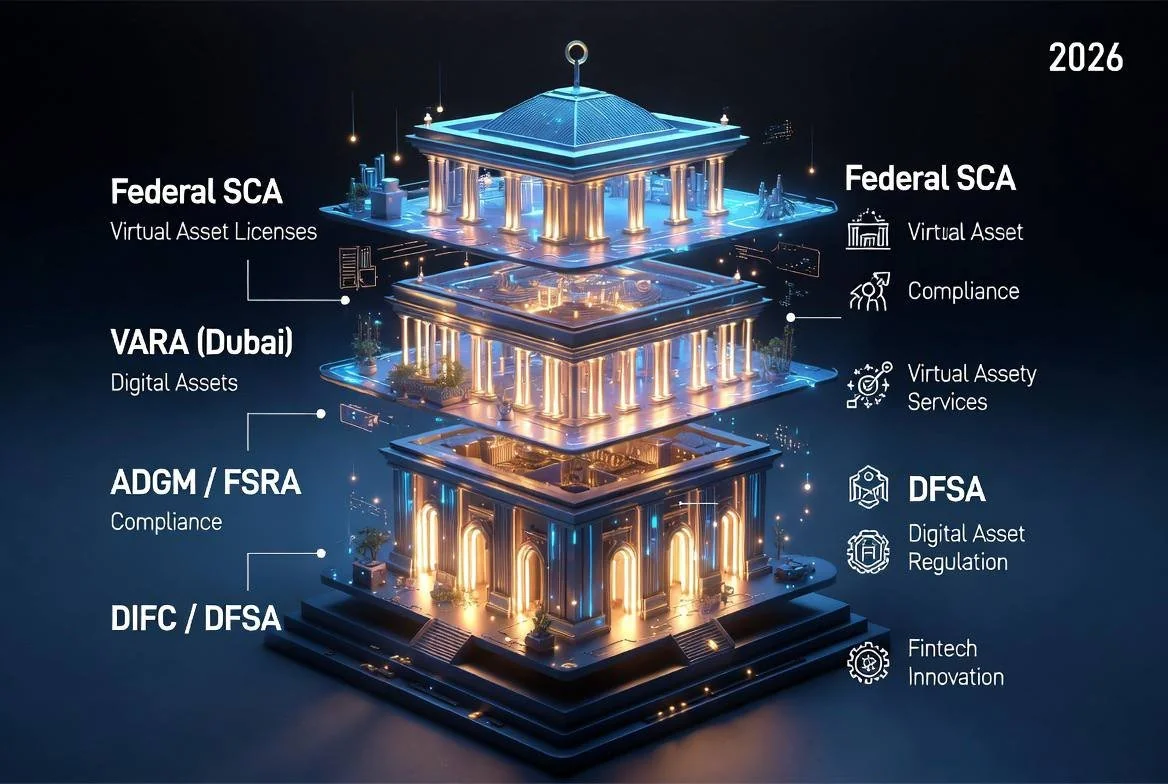
- The United Arab Emirates (UAE) has solidified its position as the world’s premier regulatory oasis. By operating a specialized, multilayered framework across mainland Dubai (VARA), Abu Dhabi (ADGM), and the DIFC (DFSA), the UAE offers bespoke, institution-ready licensing pathways that balance robust compliance with explosive growth.
The 2026 Global Paradigm Shift: US and EU Diverge
As capital flows globally, understanding the two largest regulatory pillars outside of the Middle East is vital for cross-border strategy:
The EU: MiCA’s July 1, 2026 Hard Line
The grandfathering period under the EU’s landmark MiCA framework officially expired on July 1, 2026. Any Crypto-Asset Service Provider (CASP) serving EU clients without full MiCA authorization must halt operations immediately or face severe enforcement actions.
- Key Requirements: CASPs must maintain minimum capital reserves (ranging from €50,000 to €150,000), issue audited whitepapers for asset issuances, and implement institutional-grade AML protocols.
The US: The Digital Commodity Breakthrough
The long-standing regulatory turf war between the SEC and the CFTC saw a massive breakthrough on March 17, 2026. The joint agency ruling classifying major assets as digital commodities has significantly reduced operating uncertainty. However, yield-bearing projects, staking programs, and centralized stablecoins remain under strict security-focused scrutiny.
The UAE’s Multilayered Regulatory Framework
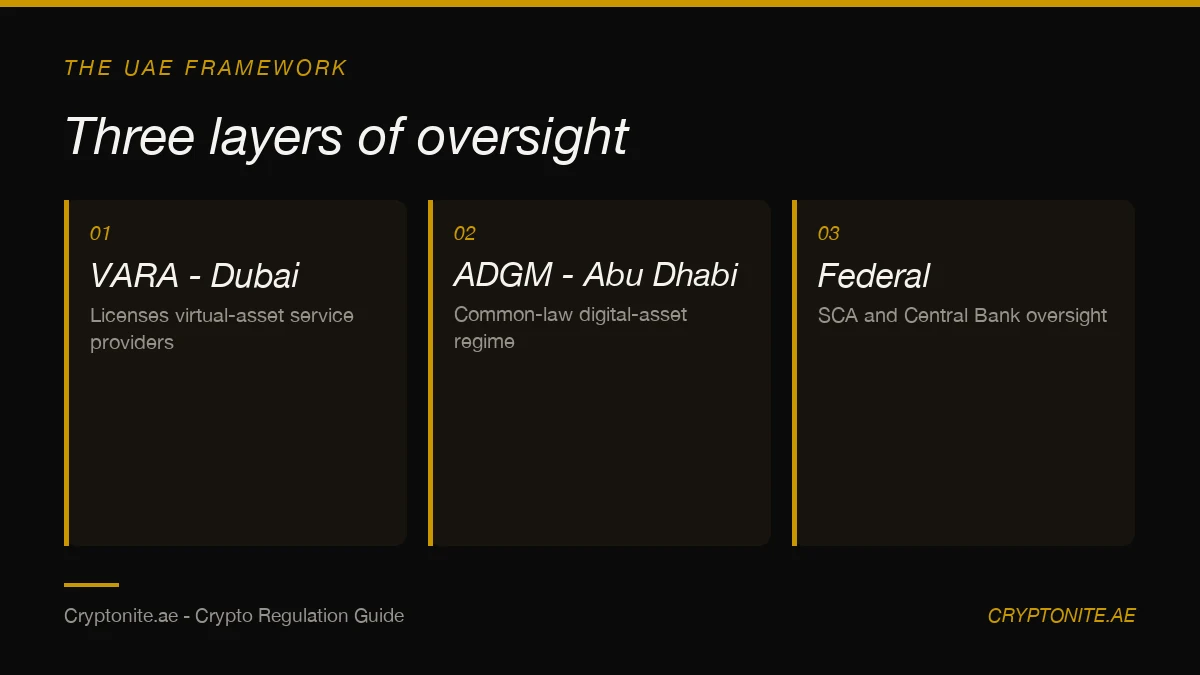
Unlike nations that rely on a single, monolithic regulatory entity, the UAE’s regulatory framework is deliberately layered, enabling different emirates and free zones to specialize in distinct market sectors.
                                [UAE Federal Level]
                        SCA (Securities & Tokenized RWAs)
                         CBUAE (Overarching AML & Fiat)
                                        │
             ┌──────────────────────────┼──────────────────────────┐
             ▼                          ▼                          ▼
      [Dubai Mainland]          [Abu Dhabi (ADGM)]         [Dubai (DIFC)]
         VARA (Retail,               FSRA (Common Law,          DFSA (Wholesale,
       Exchanges, Web3)            Institutional, DeFi)        Structured Finance)
At the federal level, the Securities and Commodities Authority (SCA) establishes baseline standards, while the Central Bank of the UAE (CBUAE) mandates rigorous AML/CFT rules. From there, the framework splits into three world-class jurisdictions:

1. Dubai Mainland: VARA
The Virtual Assets Regulatory Authority (VARA) remains the world’s only independent, built-for-purpose virtual asset regulator. VARA oversees everything in Dubai (excluding the DIFC financial free zone).
2. Abu Dhabi: ADGM (FSRA)
Operating under English Common Law, Abu Dhabi Global Market’s Financial Services Regulatory Authority (FSRA) is a pioneer in digital asset policy. In early 2026, the FSRA further expanded its framework to introduce enhanced rules covering decentralized finance (DeFi) protocols and staking operations.
3. Dubai Financial Free Zone: DIFC (DFSA)
The Dubai Financial Services Authority (DFSA) regulates the DIFC. In January 2026, the DFSA transitioned from its strict “Recognised Crypto Token” (RCT) structure to a more flexible “Suitable Crypto Token” framework, making it a hotspot for institutional structured finance and tokenized funds.
VARA vs. ADGM vs. DFSA: Choosing Your Jurisdiction
| Metric | VARA (Dubai Mainland) | FSRA (ADGM – Abu Dhabi) | DFSA (DIFC – Dubai) |
| Primary Target Market | Retail Consumers & Web3 Startups | Institutional Funds & DeFi | Wholesale Banking & Tokenized Assets |
| Legal Basis | UAE Civil & Commercial Law | English Common Law | English Common Law |
| Key 2026 Milestone | Released Exchange-Traded Derivatives (ETD) guidelines | Expanded rules for DeFi protocol operators | Implemented “Suitable Crypto Token” framework |
| Minimum Capital (Exchange) | AED 4,000,000 | Assessed based on FSP profile | Assessed on retail/wholesale scope |
Anti-Money Laundering (AML) & The FATF Travel Rule in the UAE
Since the enforcement of Federal Decree-Law No. 10 of 2025, virtual asset compliance in the UAE carries the exact same legal weight as traditional tier-1 banking.
- The Travel Rule Threshold: Under CBUAE and VARA directives, any virtual asset transfer equal to or exceeding AED 3,500 (approx. $1,000 USD) requires immediate, automated transmission of verified originator and beneficiary details.
- Zero Anonymity: Anonymity-enhancing “privacy tokens” (like Monero or Dash) are banned outright by VARA and federal regulators.
- Unhosted Wallets: Interaction with self-hosted (non-custodial) wallets is permitted, but triggers mandatory Enhanced Due Diligence (EDD) to verify the source of funds and the wallet owner’s identity.
Interactive Readiness Checklist: Is Your VASP Ready for 2026?
If your project is aiming to set up operations in the UAE this year, you must possess the technical infrastructure to meet these regulatory standards:
- [ ] Travel Rule Automation: Do you have active integrations with protocols like VerifyVASP or Notabene to automatically transmit counterparty details?
- [ ] goAML Portal Registration: Is your compliance officer registered and trained to report suspicious transactions directly to the UAE Financial Intelligence Unit (FIU)?
- [ ] 95% Cold Storage Custody: Can your technical architecture guarantee that at least 95% of client virtual assets remain in air-gapped cold storage?
- [ ] Local Substance Requirement: Do you have the resources to secure physical office space and hire resident senior management (SEO, MLRO, Compliance Officer) in your target emirate?
About the Author
Sarah Fathima Ahmed
Co-Founder of Cryptonite.ae
Sarah Fathima Ahmed is an institutional Web3 strategist and the co-founder of Cryptonite.ae, the Middle East’s premier digital media and intelligence platform tracking emerging regulatory frameworks and institutional digital asset flows. With deep expertise in blockchain compliance, sovereign tokenization initiatives, and market microstructures, Sarah bridges the gap between traditional corporate finance and decentralized protocols.

26 thoughts on “UAE Crypto Regulation 2026: VARA, ADGM and the Global Rulebook”