
The Revolut VARA approval announced on July 15 marks one of the most consequential licensing steps in Dubai’s virtual asset market this year. The Virtual Assets Regulatory Authority (VARA) granted the London-based fintech in-principle approval to provide broker-dealer, exchange, and management and investment services in the UAE, according to The National and a company statement carried by Zawya. For a platform serving more than 75 million customers globally, the Revolut VARA approval positions Dubai as the launchpad for one of the largest retail fintechs to enter the Gulf’s regulated crypto market.
This article breaks down what the Revolut VARA approval actually authorises, how the licensing pathway works from here, and why the decision matters for Dubai’s competitive landscape, for regional expansion strategy, and for the institutions watching the UAE consolidate its position as the most comprehensively regulated virtual asset hub in the world.
What the Revolut VARA Approval Covers
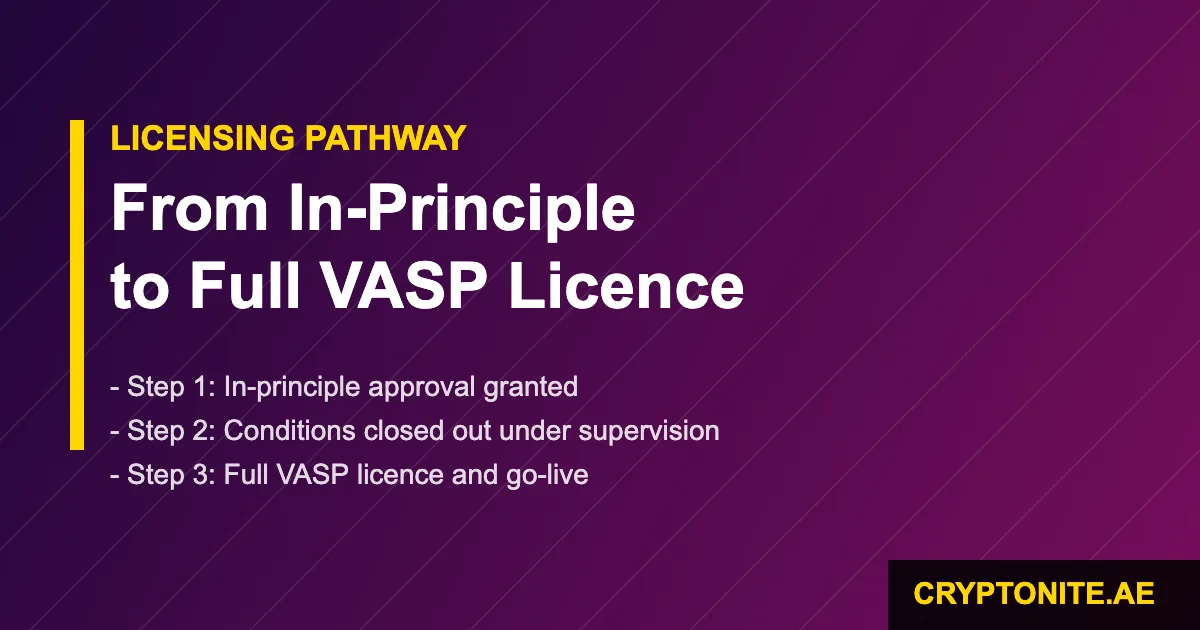
In-principle approval is VARA’s signal that it is satisfied with an applicant’s business model, governance arrangements and risk controls. It is not yet an operating licence, and it comes with defined conditions the applicant must close out under the regulator’s supervision before going live. Revolut must satisfy those remaining conditions before the Revolut VARA approval converts into a full Virtual Asset Service Provider (VASP) licence, and it cannot onboard UAE crypto customers until that conversion is complete.
The scope granted is notably broad. Broker-dealer services allow the firm to execute customer orders against external venues. Exchange services permit it to operate its own matching engine for UAE clients. Management and investment services open the door to portfolio-style crypto products down the line. Taken together, the Revolut VARA approval suggests the company intends to offer trading through its main retail app and its dedicated Revolut X platform once licensed, rather than a minimal single-product entry.
How the Revolut VARA Approval Process Works From Here
VARA’s licensing framework runs in stages. First comes the initial disclosure questionnaire and application review. Then the regulator issues in-principle approval, the stage Revolut has now reached, which freezes the perimeter of permitted activities and sets out the conditions to be satisfied. Finally, once capital requirements, local staffing, compliance infrastructure and technology audits are evidenced, VARA converts the approval into an operating licence.
Historically, the gap between in-principle approval and full licence has ranged from a few months to more than a year, depending on the complexity of the activities sought. Because the Revolut VARA approval covers three distinct service categories, the conditions list is likely to be longer than for a single-activity applicant. The company has not published a target go-live date, and VARA does not comment on individual applications in progress.
The supervision-first posture VARA adopted through 2025 and 2026 matters here. The regulator has shifted emphasis from licensing volume to governance, capital discipline, operational resilience and ongoing compliance. In practice, that means the conditions attached to the Revolut VARA approval will be enforced line by line rather than waived to accelerate a marquee name’s launch, a point the regulator has made repeatedly in public guidance.
Building on Central Bank Licences Secured in June
The crypto clearance does not stand alone. Revolut obtained stored value facilities and retail payment services licences from the Central Bank of the UAE in June, giving it the payments backbone a retail super-app requires. The sequencing, payments first, virtual assets second, mirrors the playbook other global platforms have used to enter the Emirates, and it means the firm could arrive in the market with a full-stack offering rather than a standalone crypto product.
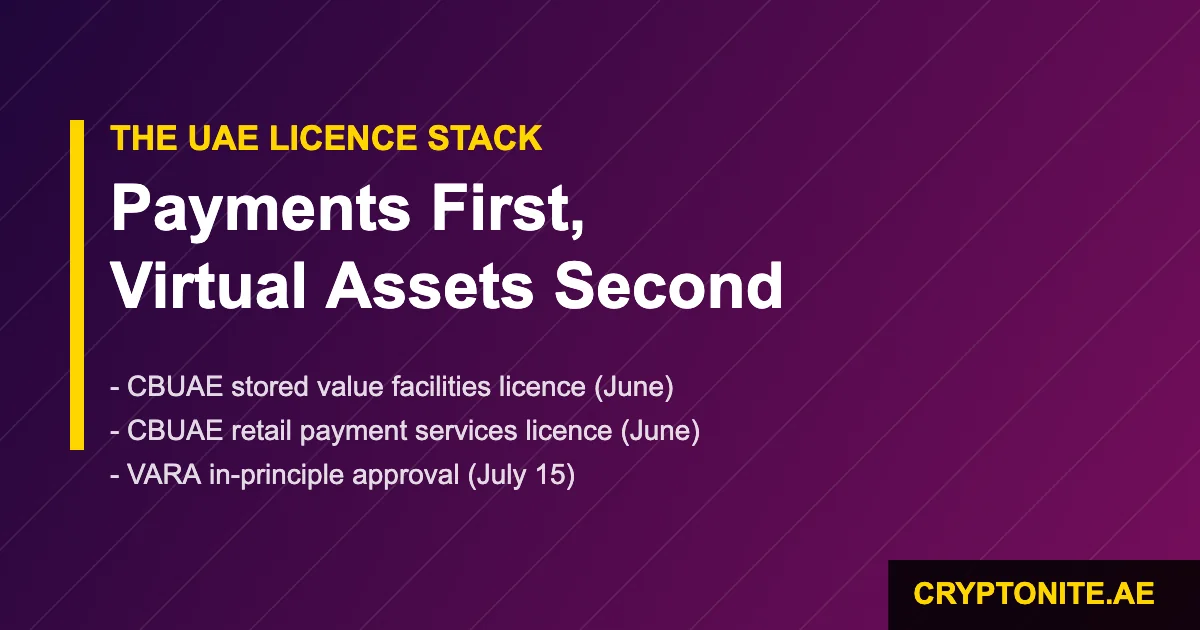
That combination is rare. Most licensed VASPs in Dubai are crypto-native firms without payments licences, while most licensed payments firms have no virtual asset permissions. A company holding both can move customer funds between fiat and crypto inside its own regulated perimeter, reducing dependency on third-party on-ramps and giving compliance teams a single view of the customer. The Revolut VARA approval is therefore best read as the second half of a deliberate two-regulator strategy.
Dubai’s Licensing Landscape in 2026
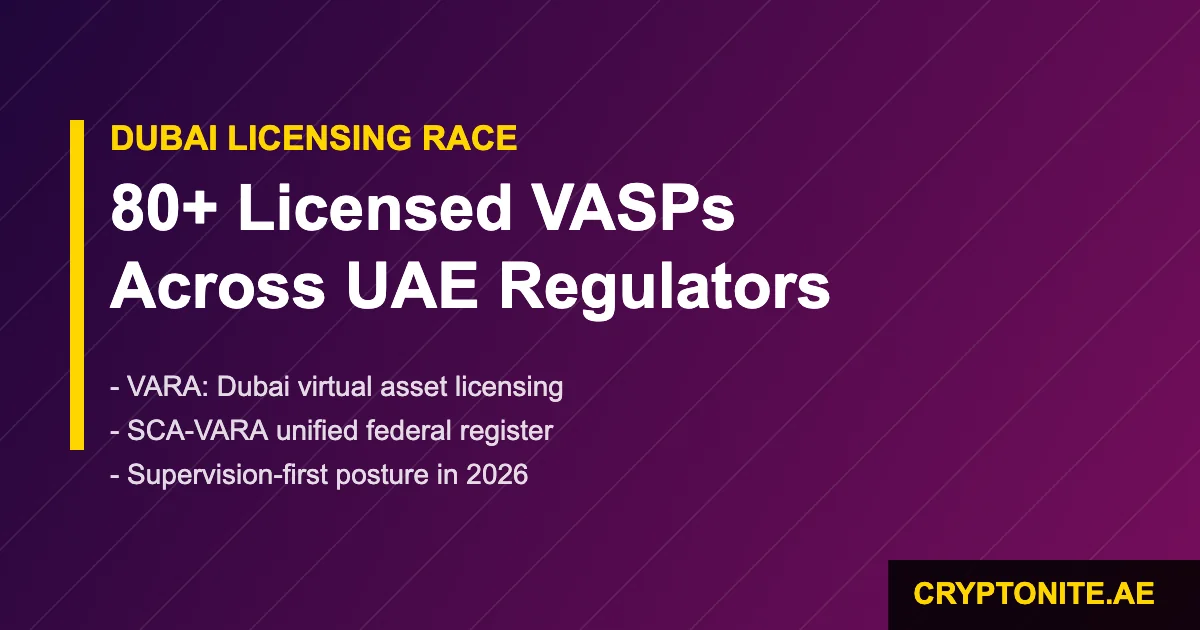
More than 80 VASPs are now licensed across the UAE’s regulators, spanning VARA in Dubai, the SCA federally, and the financial free zones of ADGM and DIFC under their own frameworks. The SCA and VARA now operate a unified register, so a Dubai licence is visible federally, simplifying cross-emirate operations. Penalties for unlicensed activity have escalated sharply, with fines reaching into the millions of dirhams.
Against that backdrop, the Revolut VARA approval is a signal about the market’s maturity rather than an outlier. The first wave of Dubai licences went to exchanges and brokers built for crypto-native users. The second wave, now underway, is bringing in mainstream consumer platforms whose core business is banking-adjacent. Each conversion of a household fintech name tells traditional finance that the rulebook is workable at consumer scale.
Institutional readers tracking the emirate’s trajectory can revisit our coverage of MENA Blockchain Week 2026 in Dubai and the growth of regulated Ethereum staking in the UAE for context on how quickly this market has institutionalised.
What the Revolut VARA Approval Means for Competitors
For incumbent exchanges serving UAE retail customers, the arrival of a super-app that bundles payments, cards, remittances and crypto trading raises the competitive bar on pricing and user experience. Revolut’s model historically undercuts standalone brokers on headline fees and wins on convenience, since the customer never leaves the app to move money.
The counterargument is depth. Crypto-native venues offer wider token selections, derivatives where permitted, and institutional-grade order books that a retail super-app is unlikely to match at launch. The most probable outcome is segmentation: casual and first-time buyers consolidating toward the super-app, while active traders remain on specialist venues. Either way, the Revolut VARA approval forces every retail-facing competitor in the market to sharpen its proposition before the firm goes live.
There is also a talent dimension. Each major licence brings hiring in compliance, risk and product roles based in Dubai, deepening the local ecosystem’s bench. That in turn reduces the cost and friction for the next applicant, a network effect regulators openly encourage.
The UAE as a GCC Beachhead
Revolut’s regional ambition is wider than one emirate. The UAE offers a wealthy, crypto-forward customer base, a large expatriate population already familiar with the brand from home markets, and a regulatory home base from which to pursue the rest of the Gulf. Saudi Arabia, the region’s largest consumer market, has no comparable retail crypto licensing regime yet, which makes a UAE hub the practical staging ground.

The Revolut VARA approval also matters for the UAE’s own positioning contest with other hubs. Singapore and Hong Kong compete for the same global platforms, and each high-profile approval is marketing for the jurisdiction that granted it. Dubai’s pitch, a dedicated virtual asset regulator with a complete rulebook, gains credibility every time a firm of this scale chooses it as the entry point.
Timeline: What Comes Next
The near-term milestones are procedural but meaningful. Revolut must evidence satisfaction of VARA’s conditions, complete any required technology and financial audits, and stand up local governance. Only then does the Revolut VARA approval convert to a full VASP licence, after which a phased customer rollout would be expected, typically starting with a waitlist and limited asset selection.
Watch for three signals. First, senior UAE-based appointments in compliance and money-laundering reporting roles, which are licence conditions in practice. Second, the appearance of Revolut’s UAE entity on VARA’s public register with active status. Third, product disclosures indicating which assets and services will be available at launch. None of these have been announced yet, and the company has not disclosed which assets it will list at debut.
Inside VARA’s Rulebook: What Licensees Must Prove
To understand why the Revolut VARA approval is only a waypoint, it helps to see what full licensing demands. VARA’s rulebooks cover company structure, governance, compliance and risk management, technology, and market conduct. Applicants must evidence UAE-based senior management, a designated compliance officer and money-laundering reporting officer, and paid-up capital scaled to the activities sought.
Technology requirements are equally specific: penetration testing, wallet and key-management standards, business continuity plans, and independent audits. Consumer-facing firms also face marketing rules, Dubai regulates crypto advertising tightly, and disclosure obligations covering fees, risks and complaint handling. Every one of these must be signed off before the Revolut VARA approval becomes an operating licence.
The practical effect is that an in-principle approval functions as a project plan. The regulator has told the firm exactly what remains; the timetable now depends on how quickly Revolut can evidence each item to VARA’s satisfaction.
How the UAE Compares With Singapore, Hong Kong and London
Global fintechs weighing crypto expansion typically shortlist the same jurisdictions, and the contrasts are instructive. Singapore licenses digital payment token services under the MAS, but has deliberately cooled retail crypto marketing. Hong Kong’s SFC regime permits retail trading on licensed venues yet maintains a conservative token-approval list. The UK, Revolut’s home market, still runs crypto registration through the FCA with a narrower activity scope.
Dubai’s difference is institutional: VARA is a dedicated virtual-asset regulator with a purpose-built rulebook, rather than a securities or payments authority adapting legacy rules. For a firm seeking broker-dealer, exchange and investment permissions in one application, that single-window design is precisely what made the Revolut VARA approval achievable in this form. It is also why several global platforms have chosen Dubai as their first fully-licensed retail market rather than their last.
None of this makes the UAE a soft option. It means the rules are legible, and legibility is what large consumer businesses need before committing brand and balance sheet to a new asset class.
Lessons From Earlier Dubai Licences
The Revolut VARA approval follows a pattern visible in earlier licensing rounds. Exchange groups that received in-principle approvals in past years typically took six to eighteen months to convert, launched with a limited asset menu, and expanded permissions iteratively. Firms that attempted to compress the conditions phase generally found the regulator immovable on staffing and audit evidence.
The lesson for observers is to track register status rather than press releases. VARA’s public register is the authoritative record of what any firm may actually do in Dubai at a given moment, and its entries change only when conditions are genuinely satisfied. When the Revolut VARA approval converts, the register will say so before any marketing campaign does.
Data Points Institutional Readers Should Track
Three metrics will reveal how much the Revolut VARA approval ultimately matters. First, licensed VASP count and composition: if more payments-first platforms follow, Dubai’s market shifts from crypto-native to mainstream distribution. Second, retail volume share: a super-app entry should be visible within quarters in exchange market-share data. Third, regional expansion filings: a successful UAE launch would likely precede applications elsewhere in the Gulf.
For the UAE’s policymakers, the relevant metric is simpler, whether flagship approvals convert into operating businesses that employ, comply and grow. That is the test every headline licence eventually faces, and the one that will define whether the Revolut VARA approval is remembered as a turning point or a footnote. The next two quarters of register updates, hiring announcements and product disclosures will tell the market which of those outcomes is taking shape, and how quickly.
The Consumer Protection Dimension
Retail scale changes the stakes of supervision, and the Revolut VARA approval will test how Dubai’s consumer-protection architecture performs when millions of mainstream users, rather than crypto natives, enter the market. VARA’s conduct rules require clear risk disclosures at onboarding, segregation of client assets from corporate funds, and complaint-handling procedures with defined response times.
Marketing restrictions matter just as much. Dubai requires crypto promotions to carry prominent risk warnings and prohibits presenting virtual assets as guaranteed investments. For a brand as visible as Revolut, every in-app banner and billboard will sit inside that perimeter. The company’s experience navigating similar advertising regimes in the UK and EU is arguably one of the operational strengths it brings to the conditions phase of the Revolut VARA approval.
Custody arrangements will draw particular scrutiny. Retail platforms typically combine omnibus hot wallets for liquidity with cold storage for reserves, and VARA’s technology rulebook sets standards for key management, third-party custodians and incident reporting. How these arrangements are evidenced, and audited, will shape both the launch timeline and the trust the product ultimately earns.
There is also a financial-literacy angle that regulators in the region increasingly emphasise. A super-app that introduces first-time buyers to digital assets inside the same interface they use for salaries and savings blurs the psychological line between banking and speculation. Expect disclosure design, cooling-off prompts and exposure limits to feature in how the final licence conditions are written, because the regulator has signalled repeatedly that mainstream distribution must not mean mainstream mis-selling.
None of these requirements are unique to one firm. They are the standing terms of doing consumer crypto business in Dubai, and they are the reason the emirate’s licensing decisions increasingly function as a global reference point. When the Revolut VARA approval completes its journey to a full licence, the resulting compliance blueprint, disclosures, custody, marketing, complaints, will be studied by every consumer fintech weighing the same move, in the Gulf and well beyond it.
What It Means
For the UAE, the Revolut VARA approval reinforces a deliberate strategy: attract globally recognised consumer brands under strict supervision rather than lightly regulated volume. For Revolut, the UAE offers growth in a market where crypto adoption is among the highest in the world. For incumbents, it compresses the window to differentiate. And for institutions assessing the Gulf, it is another data point that the region’s regulatory experiment is producing exactly the outcomes it was designed for.
The practical caveat remains timing. In-principle approvals have historically taken months to convert, and VARA’s supervision-first posture in 2026 means conditions are enforced, not waived. A launch window has not been announced. Nothing in this article constitutes investment advice.
FAQ
Can UAE residents trade crypto on Revolut today?
No. The Revolut VARA approval must first convert into a full VASP licence. Until then, eligible customers cannot buy, sell or hold digital assets through the app in the UAE.
Which services did VARA approve in principle?
Broker-dealer services, exchange services, and management and investment services, one of the broader scopes granted to a consumer fintech in Dubai to date.
How long does conversion to a full licence usually take?
There is no fixed statutory period. Comparable conversions have taken several months to over a year depending on the complexity of conditions attached to the approval.
Does the approval cover the whole UAE?
VARA licences cover Dubai (excluding DIFC). However, the SCA-VARA unified register means the Revolut VARA approval is visible federally, and passporting arrangements continue to expand across the Emirates.
Sources: The National, Zawya, Finance Magnates, VARA.

6 thoughts on “Revolut Secures VARA In-Principle Approval for UAE Crypto Services”