The UK digital gilt has a platform, a timeline and a place in history: HM Treasury has selected HSBC’s Orion blockchain to issue the Digital Gilt Instrument (DIGIT) by early 2027, making the United Kingdom the first G7 nation to put sovereign debt on a distributed ledger, as reported by CoinDesk and confirmed in an HSBC media release. Chancellor Rachel Reeves announced the timeline in her Mansion House speech, framing the UK digital gilt as a test of whether tokenization can cut settlement times and issuance costs for one of the world’s most liquid asset classes.
This analysis explains how the UK digital gilt will work, why central bank collateral eligibility is the detail that matters most, what the selection of HSBC Orion says about the platform race, and what a G7 sovereign going on-chain means for the broader real-world asset market, including the Gulf jurisdictions that pioneered dedicated tokenization rulebooks.
How the UK Digital Gilt Will Work
DIGIT will be a sterling-denominated government bond issued natively on HSBC Orion and operated inside the Digital Securities Sandbox run jointly by the Bank of England and the Financial Conduct Authority. The sandbox structure matters: it lets the Debt Management Office test on-chain issuance, settlement and lifecycle management under modified rules without amending primary legislation first.
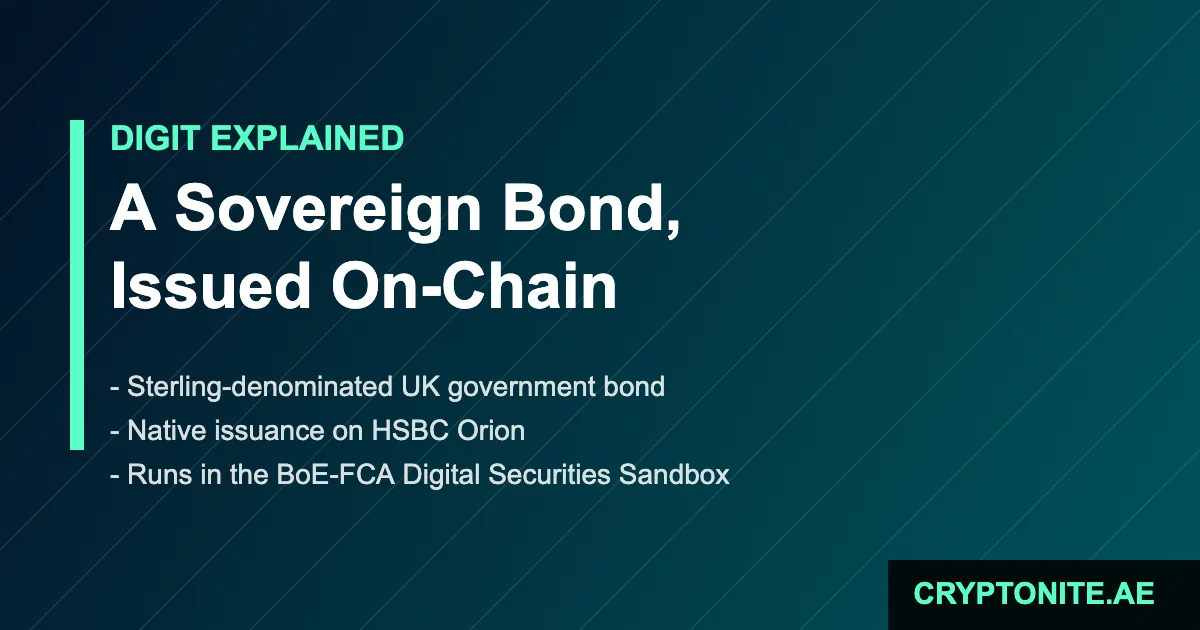
Native issuance is the key design choice. Many earlier tokenized bonds were mirrored instruments, a conventional security wrapped in a digital twin, which duplicates infrastructure instead of replacing it. The UK digital gilt will instead exist on the ledger as the primary record, so settlement, coupon payments and redemptions can be executed programmatically. That is where the promised efficiency gains, shorter settlement cycles and lower issuance costs, actually come from.
The pilot’s explicit objectives are measurable: reduce settlement time, cut issuance and servicing costs, and demonstrate programmable lifecycle events such as automated coupons. The Treasury has said it will evaluate those metrics before deciding whether tokenized issuance becomes a permanent feature of the gilt programme.
Tender, Timeline and Why HSBC Orion Won
The procurement ran through a public tender launched in October 2025, following an industry consultation, with HSBC’s Orion platform appointed in February 2026. Orion arrived with a track record: more than $3.5 billion in digital bonds already issued, including landmark transactions for the European Investment Bank and the Hong Kong Monetary Authority. For a systemically cautious issuer like the UK, demonstrated throughput beat architectural novelty.
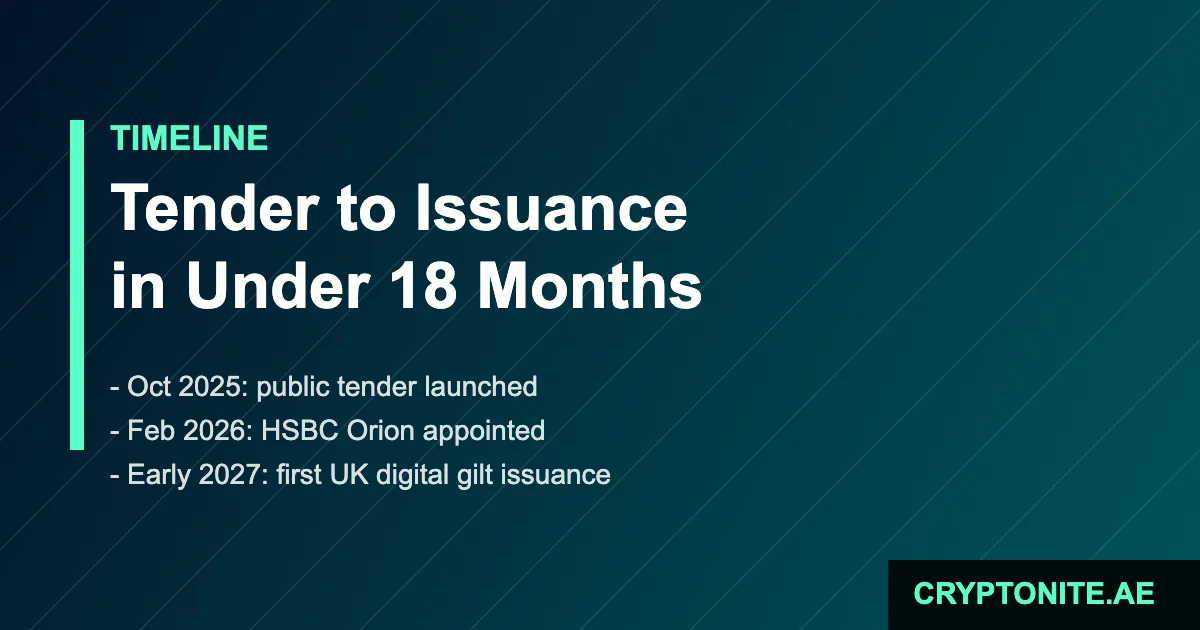
The early-2027 target gives the Debt Management Office roughly two gilt-market quarters to finalise legal documentation, complete sandbox onboarding, and run dress rehearsals with primary dealers. People close to the process describe the timeline as ambitious but achievable, provided the sandbox’s settlement-finality questions are resolved on schedule.
Central Bank Backing Changes the Calculus
Bank of England Governor Andrew Bailey has said the Bank plans to make DIGIT eligible as collateral in its market operations. That single design choice separates the UK digital gilt from most prior tokenized bond experiments: a tokenized instrument that counts as central bank collateral is not a demo, it is infrastructure.
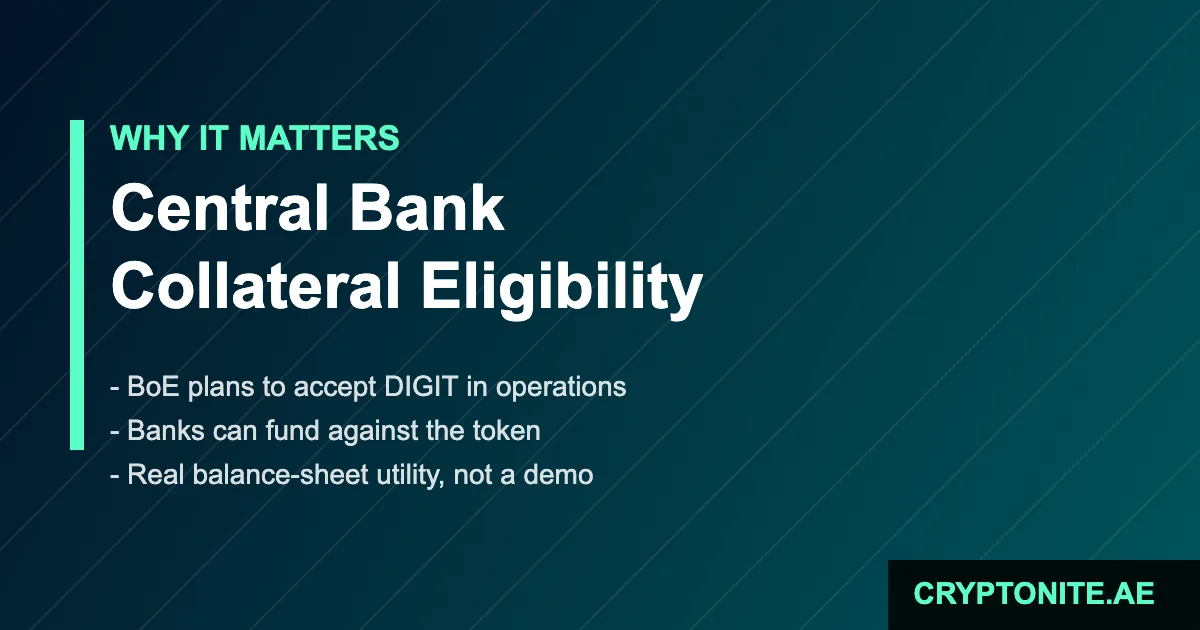
Collateral eligibility gives banks a concrete economic reason to hold and mobilise the UK digital gilt, seeding the secondary market activity that earlier corporate tokenized issues struggled to generate. A bond a bank can repo at the central bank behaves like any other gilt on the balance sheet, which is precisely the point: the technology changes, the risk treatment does not.
A Milestone for the RWA Market
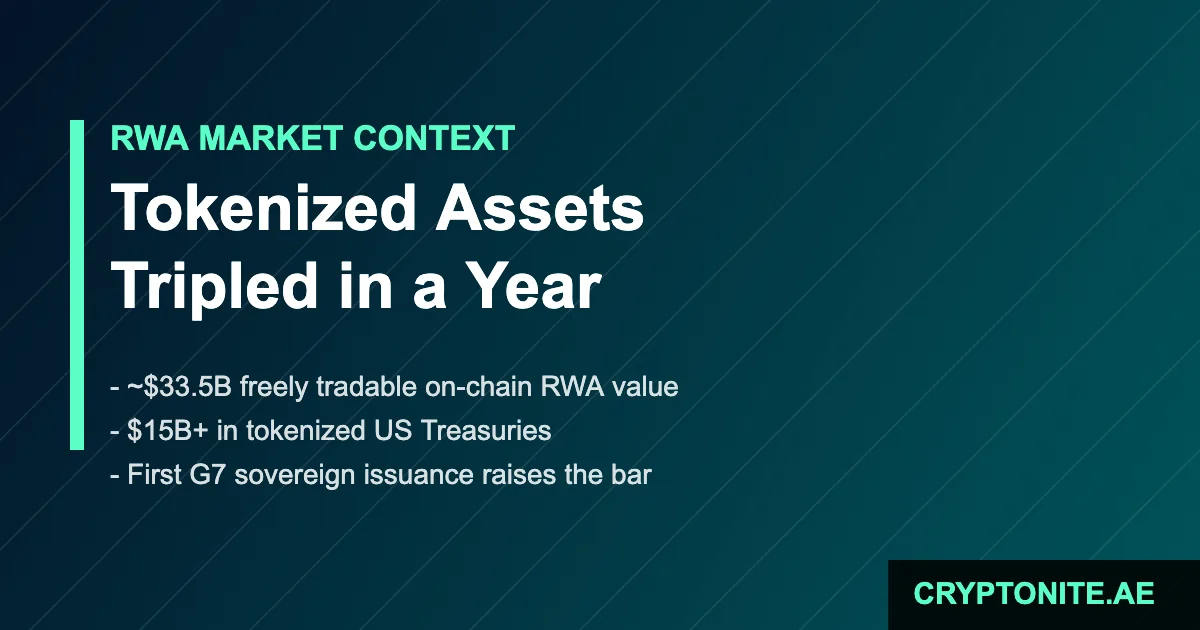
Sovereign issuance is the credibility test real-world asset tokenization has been waiting for. Freely tradable on-chain RWA value has roughly tripled over the past year to about $33.5 billion, and tokenized US Treasury products already exceed $15 billion, as we covered in our analysis of the RWA market’s growth in 2026. A G7 sovereign issuing natively on-chain moves the asset class from private-sector experimentation to public-debt infrastructure.
The demonstration effect is the real prize. Every institutional allocator that has hesitated over tokenized money-market funds or private credit now has a G7 reference issuance to point to in investment committee papers. And every treasury ministry weighing a pilot must now answer a simpler question: if London can issue a UK digital gilt inside a regulated sandbox, what is stopping us? For a comparison of the platforms competing to carry institutional RWA flow, see our breakdown of Ondo versus Mantra.
How DIGIT Compares With Earlier Digital Bonds
Tokenized bonds are not new; sovereign-scale ambition is. The European Investment Bank issued digital bonds on both public and private ledgers, the Hong Kong Monetary Authority ran multi-tranche digital green bonds, and Switzerland’s SIX Digital Exchange hosted listings settled in wholesale digital francs. Each proved a mechanism. None carried the full weight of a G7 treasury’s debt programme behind it.
The UK digital gilt differs on three axes. Scale of issuer: the gilt market is one of the deepest sovereign markets on earth, so even a pilot carries systemic visibility. Regulatory wrapper: the Digital Securities Sandbox provides statutory cover that ad-hoc pilots lacked. And monetary integration: no earlier digital bond came with a stated central-bank intention to accept it as collateral. That combination is why market infrastructure veterans describe the UK digital gilt as a category change rather than another proof of concept.
There is a competitive subtext as well. France’s public investment bank and the ECB’s wholesale DLT settlement trials have kept continental Europe in the race, and observers expect the first UK digital gilt issuance to accelerate those programmes. First-mover advantage in market standards, who defines the templates for on-chain sovereign debt, is the quiet prize.
What It Means for Gilt Market Plumbing
Behind the headline, the operational questions are where the pilot succeeds or fails. Today, gilts settle through CREST with primary dealers intermediating auctions. A natively digital instrument reroutes parts of that flow: allocation, settlement and registrar functions execute on Orion, while cash legs and sandbox rules govern how finality is recognised in law.
Primary dealers must therefore run dual plumbing during the pilot, conventional systems for the main programme and ledger connectivity for the UK digital gilt. Custodians face similar duplication. The Treasury’s bet is that the efficiency data from even a modest issuance will justify that transitional cost; the dealers’ bet is that early expertise becomes a franchise advantage if tokenized issuance scales. Both bets are rational, which is why participation is expected to be strong despite the overhead.
Settlement finality is the legal keystone. The sandbox lets regulators modify rules so that ledger entries constitute definitive records of ownership. Proving that construction in live sovereign issuance, through coupon cycles and secondary transfers, is arguably the single most valuable output the UK digital gilt can deliver for every market that follows.
The Policy Backdrop: London’s Digital Markets Push
The gilt pilot does not stand alone. It sits inside a broader UK strategy that includes the Digital Securities Sandbox itself, progressing stablecoin legislation, and stated ambitions to keep London competitive with New York, Singapore and Dubai in digital finance. After losing ground in crypto exchange listings and watching tokenization leadership drift toward the Gulf and Asia, the UK digital gilt is London’s most concrete counter-move to date.
Political durability matters for an instrument with a 2027 delivery date. Because the pilot is framed around cost efficiency and market modernisation rather than crypto enthusiasm, it has attracted little partisan opposition, and officials across the political spectrum have treated capital-markets digitisation as industrial strategy. That framing insulates the timeline from the political cycles that have derailed digital-asset initiatives elsewhere.
Metrics That Will Define Success
Institutional readers should watch four numbers when the UK digital gilt prices. Auction cover ratio: demand relative to size, benchmarked against conventional gilt auctions. Settlement cycle: how far below T+1 the pilot actually operates in practice. Cost per issuance: the Debt Management Office’s all-in comparison against conventional syndication and auction costs. And secondary turnover: whether collateral eligibility genuinely produces trading and repo activity rather than buy-and-hold inertia.
A strong print on all four would make expansion of the programme close to inevitable and would hand every treasury ministry a business case written in a G7 sovereign’s own data. A weak print would not kill tokenization, but it would push the timeline for sovereign adoption out by years. Either way, the UK digital gilt will produce the most consequential dataset the RWA market has ever received.
How a Digital Gilt Trades: A Practical Walkthrough
For portfolio managers who have never touched a tokenized instrument, the mechanics of the UK digital gilt will feel more familiar than expected. Allocation at auction credits the buyer’s position to a wallet address administered by its custodian on Orion. Ownership records update on the ledger at the moment of settlement, rather than through end-of-day reconciliation across intermediary books.
Coupon dates illustrate the efficiency argument in miniature. A conventional gilt coupon flows from the issuer through paying agents and custodial chains before landing in client accounts. On the UK digital gilt, a programmed lifecycle event can distribute payments to every wallet holding the bond at the record timestamp, in one operation, with an audit trail generated as a by-product rather than assembled afterwards.
Secondary trading is where the sandbox rules matter most. Transfers between sandbox participants settle ledger-to-ledger, compressing the settlement cycle and shrinking the counterparty exposure window that today requires margin and fails-management processes. If the UK digital gilt demonstrates reliable same-day or near-instant settlement at scale, the cost case for extending tokenization across the debt programme becomes straightforward arithmetic.
None of this eliminates intermediaries; it repurposes them. Custodians still safeguard access, dealers still make markets, and the Debt Management Office still runs the programme. What changes is the reconciliation burden between them, which is precisely where most post-trade cost in fixed income hides.
Custody, Wallets and the Institutional Checklist
Before an institution can hold the UK digital gilt, its operations team must answer questions that conventional gilts never raised. Who controls the keys, a global custodian, a sub-custodian, or the institution itself? How are wallet permissions segregated between front office and operations? What happens to ledger access in an insolvency, and how do existing client-asset rules map onto tokenized holdings inside the sandbox?
The encouraging news is that these questions now have institutional-grade answers. The major custodian banks have spent years building digital-asset arms precisely for this moment, and the sandbox framework gives their legal teams a statutory basis for client-asset treatment. Early participation in the UK digital gilt pilot is, for many of these firms, the payoff on infrastructure investments made half a decade ago.
Insurance and audit complete the checklist. Tokenized sovereign holdings will need coverage and controls attestation just like any other custody arrangement, and the audit profession’s growing familiarity with ledger-based evidence should make the UK digital gilt one of the easier digital instruments to sign off, given the quality of its issuer and the transparency of its record-keeping.
The View From the Gulf
For the GCC, the UK digital gilt is both validation and competition. The UAE built the world’s first complete multi-regulator framework separating RWA tokens from security tokens in law, and dirham-denominated tokenized instruments already trade on regulated venues. On rules, the Emirates arguably lead. On sovereign-scale endorsement, a G7 issuance is a magnitude of signal no framework announcement can match.
The competitive response worth watching is a Gulf sovereign or quasi-sovereign tokenized issuance, a sukuk would be the natural candidate, using the UAE’s existing rails. Regional debt management offices have studied tokenization for years; the UK moving first on conventional debt leaves Islamic finance instruments as an open lane where the Gulf could still claim a global first.
Risks and Open Questions
Execution risk remains real. The early-2027 target depends on sandbox performance, on resolving the legal treatment of on-chain settlement finality, and on market appetite at auction. Primary dealers must integrate with Orion without disrupting their existing gilt operations, and any technical incident at issuance would be a setback for the entire asset class, not just for one bond.
Distribution is the other open question. The pilot targets institutional participants inside the sandbox; whether the UK digital gilt ever reaches retail platforms depends on decisions not yet taken. And scale matters: a single pilot issuance proves the mechanics, but the efficiency case is only settled when tokenized issuance runs at programme size, repeatedly, through varied market conditions.
One further point deserves emphasis for readers building positions around this theme. Sovereign pilots create dated, public, auditable evidence in a field long dominated by vendor claims and consortium press releases. When the UK digital gilt prices, every number, cover ratio, settlement time, cost per issuance, becomes a citable benchmark in procurement documents, regulatory consultations and investment committee papers around the world. That is how one pilot bond in London ends up shaping tokenization roadmaps in Abu Dhabi, Tokyo and Washington simultaneously.
It is also why the composition of the first buyer group will be scrutinised as closely as the pricing. A book dominated by the usual gilt investors would signal that tokenized sovereign debt has crossed into the mainstream. A book filled mainly with digital-asset specialists would suggest the instrument remains a curiosity. Either result is information the market has never had before, and information, in the end, is what the UK digital gilt pilot was designed to produce.
What It Means
For institutional investors, the UK digital gilt is a low-risk window into on-chain settlement mechanics with a AAA-adjacent issuer. For the UK, it is a bid to keep London relevant in digital capital markets. For the RWA industry, it is the strongest legitimacy signal yet. And for the Gulf, it is a prompt: the frameworks are built, the platforms are live, and the window to lead with a sovereign instrument is narrowing. Whether other G7 treasuries follow will depend largely on what the first issuance data shows. Nothing here should be read as investment advice.
FAQ
Will retail investors be able to buy DIGIT?
The pilot is aimed at institutional participants inside the Digital Securities Sandbox. Retail access to the UK digital gilt would depend on how the instrument is distributed after the pilot phase.
Why does collateral eligibility matter?
If the Bank of England accepts DIGIT in its operations, banks can fund against it, giving the tokenized bond real balance-sheet utility rather than novelty status.
Is this the first tokenized government bond anywhere?
No, smaller sovereigns and public bodies have issued digital bonds before. The UK digital gilt is the first by a G7 government, which is why the signal to institutional markets is so much stronger.
What happens after the pilot?
The Treasury will evaluate settlement, cost and lifecycle metrics from the first issuance before deciding whether tokenized gilts become a permanent part of the debt programme.
Sources: CoinDesk, HSBC, The Block.

3 thoughts on “UK Taps HSBC Orion for First G7 Digital Gilt, Targeting Early 2027”