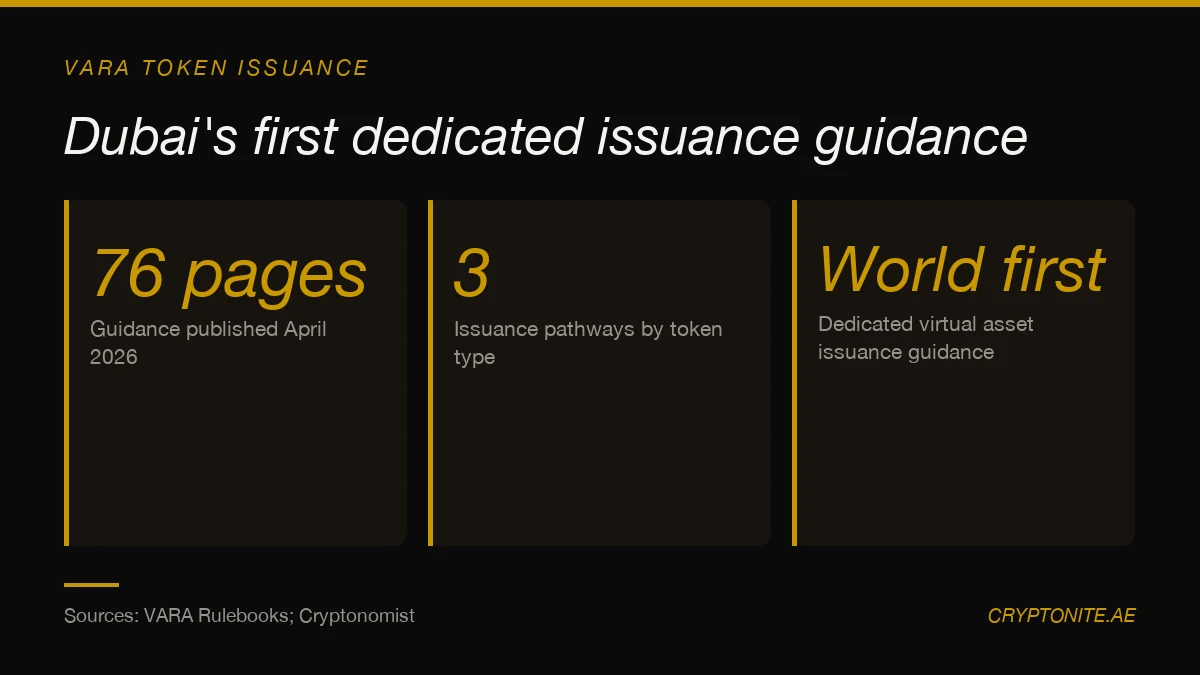
Dubai’s Virtual Assets Regulatory Authority (VARA) has moved decisively to close one of the last remaining gaps in the emirate’s crypto framework: how tokens themselves are created and sold. In April 2026, VARA published what it describes as the world’s first dedicated regulatory guidance on virtual asset issuance — a 76-page document that expands its existing Virtual Assets Issuance Rulebook and sets out clear pathways for any entity issuing tokens in or from Dubai.
For founders weighing a UAE launch, the practical takeaway is simple: your obligations are decided long before you raise a dirham. They are decided by how your token is classified.
Three pathways, decided by token type
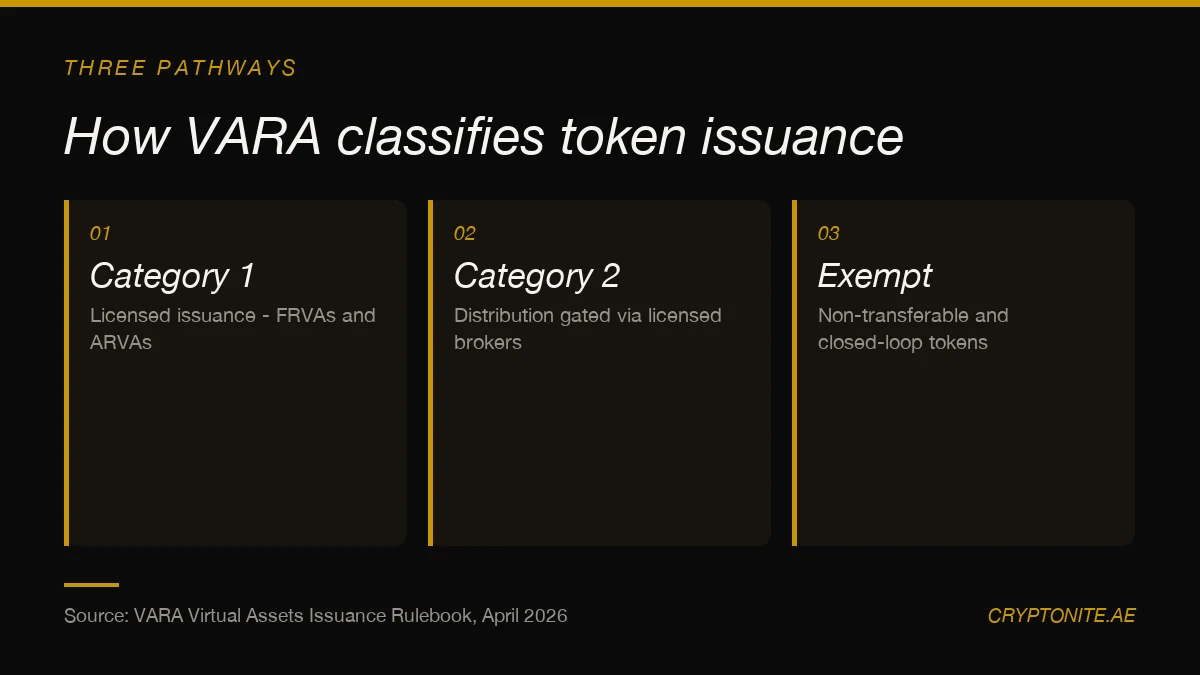
Rather than treating every token the same, VARA’s guidance sorts issuance into distinct buckets, each carrying its own requirements.
Category 1 — licensed issuance (stablecoins and asset-backed tokens)
This bucket covers fiat-referenced virtual assets (FRVAs) — stablecoins pegged to a currency — and asset-referenced virtual assets (ARVAs), including tokens backed by real estate, commodities, or other real-world assets. These are the highest-obligation instruments. Issuers must secure a specific VARA licence, comply with multiple mandatory rulebooks, hold and safeguard reserve assets, and obtain prior approval of their white paper before going to market.
Category 2 — distribution-gated issuance (most other tokens)
Governance tokens, protocol-linked assets, and most other tokens fall here. The issuer does not need a direct licence to create the token — but placement and distribution must be routed through VARA-licensed broker-dealers or distributors. In other words, you can issue, but you cannot sell to the public on your own.
Exempt virtual assets
Some instruments sit entirely outside the licensing regime. These include non-transferable tokens, redeemable closed-loop tokens, and tokens that can only be exchanged for specific goods, services, discounts, or purchases. A genuine in-game or loyalty utility token, structured correctly, may never touch VARA’s licensing requirements at all.
Why the classification comes first
The most common — and expensive — mistake founders make is designing the token first and asking the regulatory question second. Under VARA’s model, the token’s economic function determines whether you need a full licence, a distribution partner, or nothing at all. A token marketed as “utility” but structured to give holders a return can be pulled into Category 1, with all the reserve and white-paper obligations that entails.
That is why the guidance matters beyond compliance teams: it gives builders a design constraint they can work with from day one, rather than a surprise after launch.
What it signals for the UAE
VARA’s willingness to publish issuance rules ahead of most global regulators reinforces Dubai’s positioning as a jurisdiction where token projects can operate with legal certainty rather than in a grey zone. Coverage of the release noted it as a genuine first-mover step in the sector, giving issuers a defined process where other markets still leave token status ambiguous (The Cryptonomist; Sandmark).
For any team considering a token in the region, the message is clear: classify early, structure deliberately, and treat VARA’s guidance as the starting point of product design — not the final compliance checkbox.
Sources: VARA Virtual Assets Issuance Rulebook; The Cryptonomist; Sandmark. This article is general information, not legal advice.
Related: Track every licensed provider in our live tracker of Dubai’s 51 VARA-licensed VASPs.

3 thoughts on “VARA’s Token Issuance Rules: How Dubai Classifies Every Crypto Token in 2026”