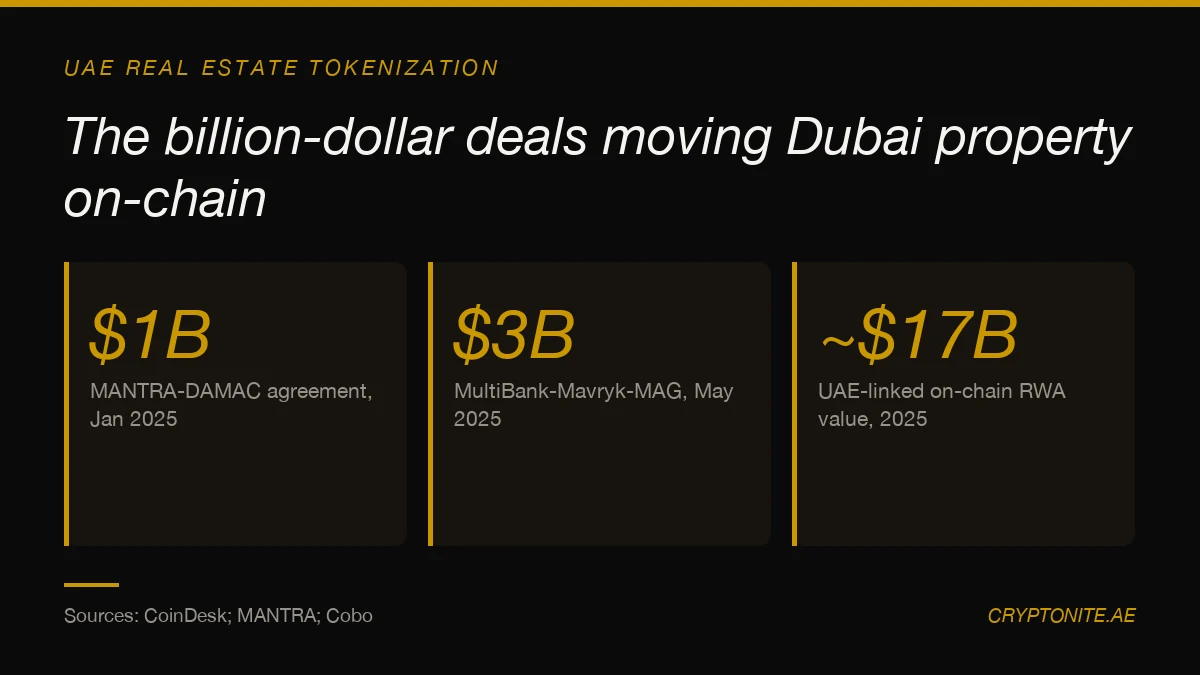
Real estate tokenization has moved from pitch deck to balance sheet in the UAE, and it now leads the broader tokenization of real-world assets (RWA) across the emirate. By 2025 the on-chain value of tokenized real-world assets linked to the UAE had reached roughly $17 billion, a figure that reflects how quickly institutional capital has moved into the emirate’s blockchain infrastructure (Cobo).
The headline deals are large and concrete. In January 2025, blockchain platform MANTRA signed a landmark $1 billion agreement with DAMAC Group to tokenize the developer’s portfolio spanning real estate, hospitality, and data centres — letting investors gain exposure to assets that were previously the preserve of institutions (CoinDesk). Months later, in May 2025, MultiBank Group, Mavryk, and MAG announced a $3 billion tokenization agreement covering assets that include The Ritz-Carlton Residences, Dubai.
Government is building the rails, not just watching
What separates Dubai from most tokenization markets is that the state is an active participant. The Dubai Land Department (DLD) launched a pilot to tokenize real estate title deeds directly on-chain — a rare case of a property registry putting its own records on a blockchain. Its retail-facing platform, Prypco Mint, enables fractional ownership from as little as AED 2,000 and had recorded around $5 million in secondary trading volume by February 2026.
That combination — a government registry, a licensed fractional-ownership platform, and a low entry point — is what turns tokenization from a theoretical efficiency gain into something a retail investor in Dubai can actually use.
The underlying market is enormous
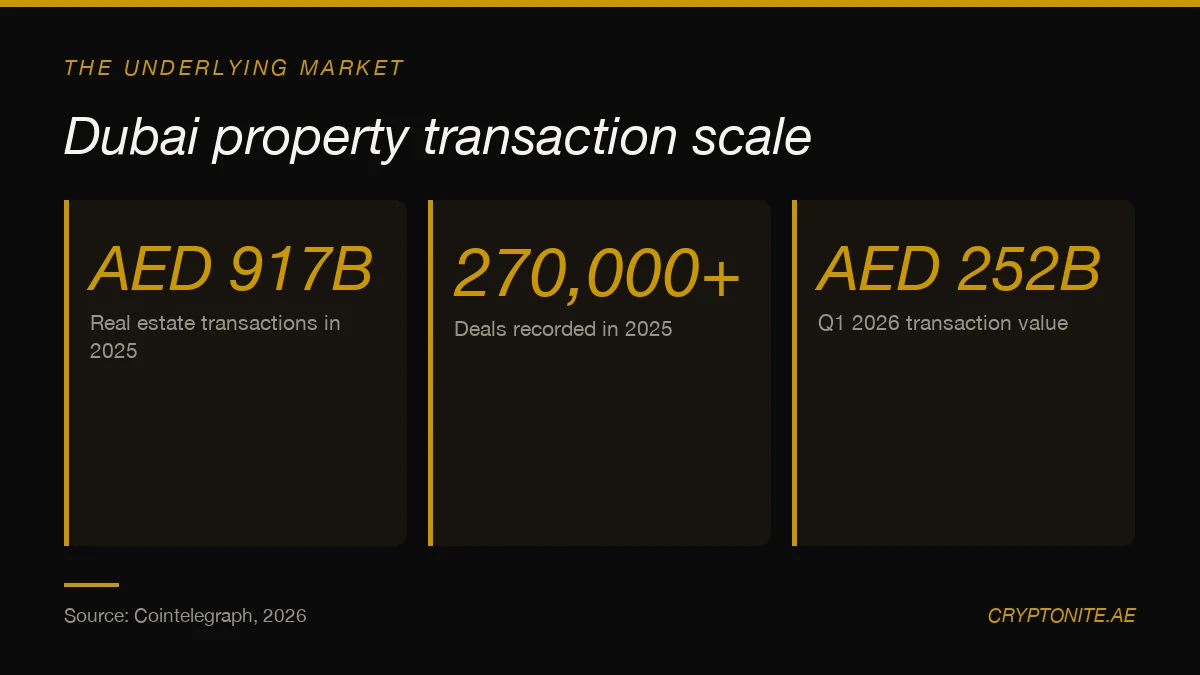
Tokenization is compelling in the UAE precisely because the asset base is so large. Dubai recorded more than AED 917 billion in real estate transactions across over 270,000 deals in 2025, and the market crossed AED 252 billion in transaction value in Q1 2026 alone (Cointelegraph). Even a small percentage of that volume migrating on-chain represents a step-change in the size of the tokenized-asset market.
Why the regulatory piece matters
None of this scales without a legal wrapper. Asset-backed tokens fall under VARA’s asset-referenced virtual asset (ARVA) category, which carries licensing, reserve, and disclosure obligations — meaning a tokenized property claim is issued inside a defined framework rather than a grey zone. Combined with DLD’s on-chain title work and ADGM’s structuring options, the UAE now offers something most jurisdictions still lack: a path from a physical building to a compliant, tradable digital token.
For developers, family offices, and platforms, the signal is that RWA tokenization in the UAE has crossed the threshold from experiment to infrastructure. The billion-dollar deals are signed, the government rails are live, and the entry point is low enough to reach ordinary investors. The question for 2026 is no longer whether tokenized real estate works here — it is who captures the volume as it moves on-chain.
Sources: CoinDesk; Cointelegraph; Cobo; MANTRA.
Real estate tokenization explained
The deals above are the headline. Below is how UAE real estate tokenization actually works, who can take part, and what to weigh before you do.
What is real estate tokenization?
Real estate tokenization is the process of representing ownership of a property, or a share of it, as digital tokens on a blockchain. Instead of buying a whole apartment, you buy tokens that each represent a fraction of it. Own 5% of the tokens, own 5% of the property — and a proportional share of any rent it generates.
The idea is not new; fractional property investment has existed for years through funds and syndicates. What real estate tokenization adds is the blockchain layer: ownership records that are transparent, tokens that can move faster than a whole-unit sale, and the potential for a secondary market where you resell your slice rather than waiting to sell the entire building.
How real estate tokenization works in Dubai
Dubai’s model is worth understanding in detail because it is among the most institutionally serious in the world. In March 2025 the Dubai Land Department launched the pilot phase of its Real Estate Tokenisation Project, described as the first blockchain-based tokenisation launched by a real estate registration authority in the Middle East. By February 2026 a secondary market had opened, enabling the resale of around $5 million in fractional property ownership.
The structure links tokens directly to DLD property certificates, so the on-chain token maps to the official ownership record rather than sitting beside it. The project runs with the Virtual Assets Regulatory Authority, the Dubai Future Foundation and the Central Bank, with participants including Prypco Mint and Ctrl Alt, whose infrastructure uses the XRP Ledger, and Zand Bank handling the banking layer. That combination — land registry, virtual-asset regulator, central bank, licensed banking — is what gives Dubai’s real estate tokenization its legitimacy.
Who can invest, and how much
The entry point is deliberately low. Real estate tokenization in Dubai starts at around AED 2,000, opening high-value property to people who could never buy a whole unit. That accessibility is the headline benefit and the main reason the model attracts attention.
There is an important limit on the demand side, though: for now, only UAE ID holders can invest in the DLD project, with expansion to foreign investors described as planned rather than live. Anyone reading about Dubai real estate tokenization as an overseas investor should treat foreign access as a future feature, not a current one, and verify the status before making plans.
The rules that protect you
A well-designed real estate tokenization regime is defined as much by its restrictions as its openness, and Dubai’s has several worth knowing.
Tokens are treated as securities and carry compliance rules accordingly. The Central Bank monitors money movement and enforces anti-money-laundering checks. Issuers must be licensed, and investors must clear KYC before participating. Crucially, no single person may hold more than 20% of a single property through tokens — a concentration limit that keeps tokenized ownership genuinely distributed rather than a workaround for one buyer to control an asset quietly.
These guardrails are the difference between real estate tokenization as a regulated investment and the unregulated fractional-property schemes that have caused losses elsewhere. They add friction, and that friction is the protection.
Why real estate tokenization matters here
Dubai has tied real estate tokenization to a concrete ambition: a stated plan to tokenize around $16 billion of property by 2033. That is not a marketing number floating free of policy — it sits inside an active government programme with a live pilot and a functioning secondary market behind it.
For a property market as deep and internationally owned as Dubai’s, the appeal is obvious. Real estate tokenization can broaden the buyer base, improve liquidity in an asset class famous for being illiquid, and make ownership records clearer. It also dovetails with the emirate’s wider virtual-asset strategy; see our guide to real-world asset tokenization for the broader trend Dubai is riding.
The risks to weigh
Real estate tokenization is genuinely promising and genuinely early, and both halves of that sentence matter.
Liquidity is not guaranteed. A secondary market exists, but “exists” and “deep enough to sell quickly at a fair price” are different things. Early markets can be thin.
The property risk is still property risk. Tokenization changes how you own an asset, not whether the asset holds value. If the underlying property falls in value or sits vacant, your token falls with it.
Regulatory and eligibility limits can shift. Foreign access, holding limits and tax treatment are all subject to change in a young programme. Plans announced are not plans delivered.
Platform and custody risk. Your token depends on the issuing platform, the infrastructure it runs on and the custody of the underlying title. Evaluate those the way you would any counterparty.
None of this argues against real estate tokenization. It argues for treating it as the early-stage regulated investment it is, sized accordingly.
How to approach a tokenized property investment
If you are eligible and considering a first purchase, the discipline is closer to buying property than trading crypto, and thinking of it that way will serve you well. Begin with the platform and its regulatory standing: in Dubai’s programme the participants are named and licensed, and you should be able to confirm that any platform you use sits inside the official framework rather than merely referencing it in marketing.
Then look through the token to the asset underneath. What is the actual property, where is it, what is its occupancy and rental history, and who manages it day to day? A token is only ever as good as the building it points to, and the blockchain layer does nothing to improve a poorly chosen asset. Read how income is distributed and how often, and how the platform values the property over time, because those numbers determine your real return.
Finally, plan your exit before you enter. Understand how the secondary market works, what fees apply to a resale, and how long a sale realistically takes given current liquidity. The promise of quick, divisible ownership is real, but it is a young market, and the sensible assumption is that selling takes longer than the marketing implies. Size your position so that a slow exit is an inconvenience, not a crisis.
Frequently asked questions
What is real estate tokenization in simple terms?
Buying a blockchain token that represents a fractional share of a property, with a claim on a proportional share of its value and rent.
Can foreigners invest in Dubai real estate tokenization?
Not yet in the DLD project — currently only UAE ID holders can invest, with foreign access planned but not live as of 2026. Verify current status before relying on it.
How much do you need to start?
As little as around AED 2,000 in Dubai’s programme, which is the main appeal of real estate tokenization for smaller investors.
Is real estate tokenization legal in the UAE?
Yes, within the regulated Dubai Land Department framework, which treats tokens as securities and enforces KYC, AML and holding limits.
Can I sell my tokens?
Dubai has opened a secondary market for resale, though early-market liquidity may be limited. Selling a token is faster than selling a whole property, but not instant or guaranteed.
The bottom line
Real estate tokenization in the UAE is one of the most credible examples of the technology anywhere, precisely because a land registry, a virtual-asset regulator and a central bank stand behind it rather than a startup alone. It lowers the barrier to property ownership to a few thousand dirhams and points at a $16 billion future. Treat it as early, regulated and promising — and read the eligibility and liquidity fine print before you commit.
Sources: CoinDesk on Dubai’s secondary market · Driven Properties guide · 10 Leaves UAE tokenisation guide. Details change — verify eligibility and figures before investing.
Disclaimer: General information, not financial or investment advice. Property values fall as well as rise. Do your own research and seek professional advice.

3 thoughts on “UAE Real Estate Tokenization Hits Scale: The $1B Deals Turning Dubai Property On-Chain”