For years, the story of crypto in the UAE was about exchanges, retail traders, and regulation. In 2026 the story has changed: the biggest names in traditional banking are now building digital-asset businesses in Dubai, and the conversation has shifted from speculation to settlement, custody, and how to onboard sovereign wealth funds safely.
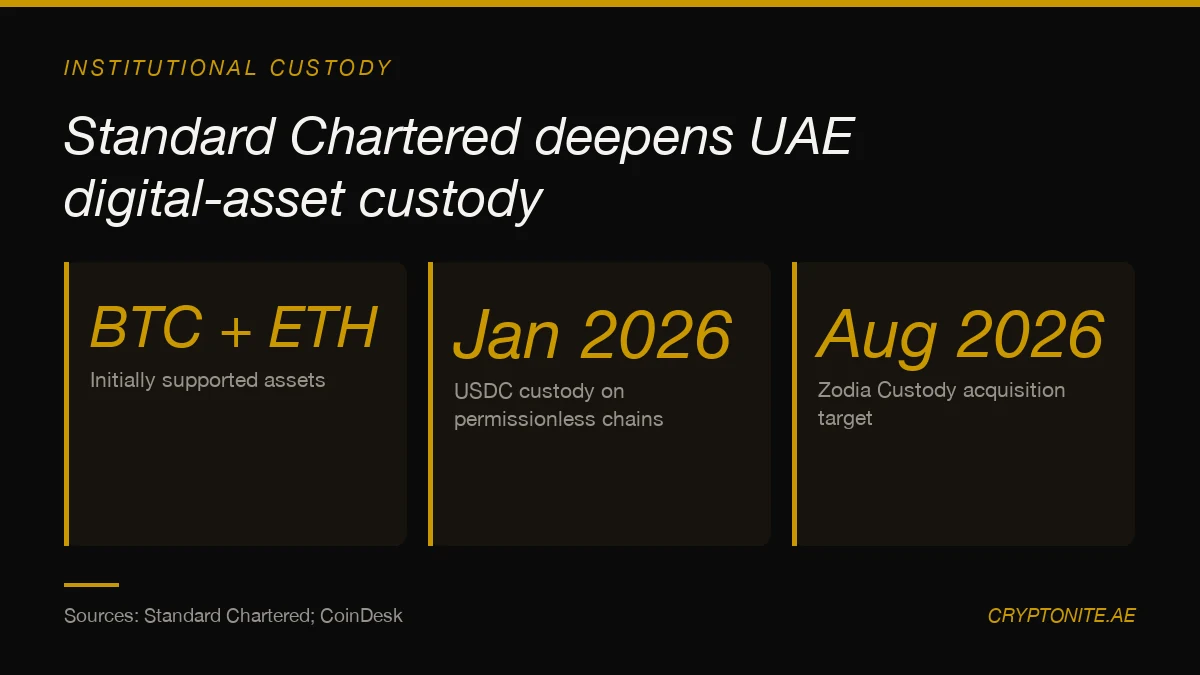
The clearest marker is Standard Chartered. The bank launched a digital asset custody service in the UAE, licensed by the Dubai Financial Services Authority (DFSA) and operating from within the Dubai International Financial Centre (DIFC). The service initially supports Bitcoin and Ethereum, and by January 2026 had expanded to offer USDC custody on permissionless chains, giving institutional clients more flexibility with regulated stablecoins (Standard Chartered).
Banks are buying, not just building
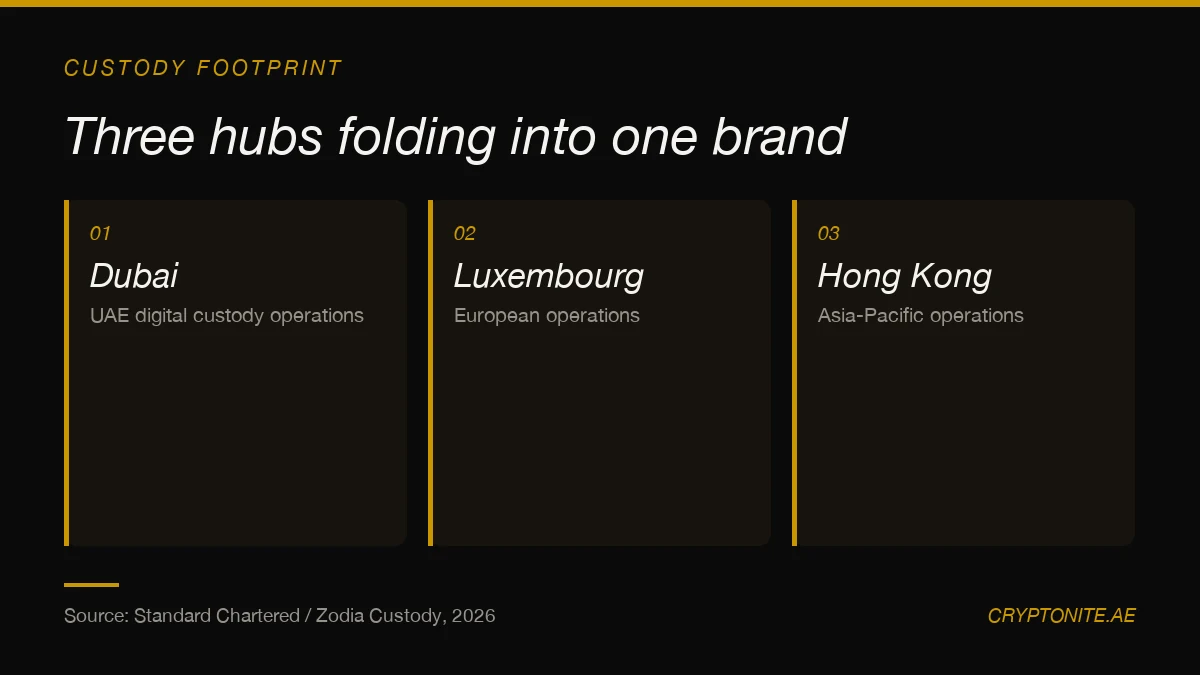
The maturation is visible in how these institutions are moving. Rather than run indefinite in-house experiments, major banks are acquiring established crypto-native platforms to obtain institutional-grade technology. Standard Chartered is set to fully acquire Zodia Custody by the end of August 2026, folding its existing digital custody operations in Dubai, Luxembourg, and Hong Kong into the Standard Chartered brand (CoinDesk).
That is a telling signal. When a global systemically important bank buys a crypto custodian outright rather than partnering, it is treating digital-asset custody as core infrastructure it intends to own — not a pilot it might wind down.
The conversation has moved up the stack
Market participants describe a distinct shift in what institutions are actually asking about. The questions are no longer “is crypto legitimate?” but operational: settlement finality, institutional-grade custody, and how to onboard sovereign wealth funds and family offices into digital assets safely (Khaleej Times).
In a region defined by large pools of sovereign and family-office capital, that framing matters. The barrier to institutional allocation was never appetite — it was the absence of custody, settlement, and regulatory certainty a fiduciary could rely on. Those pieces are now arriving.
Regulation is the enabler
Underpinning all of it is regulatory clarity. Dubai’s VARA framework, working alongside DFSA licensing in the DIFC and federal-level rules, has removed much of the uncertainty that previously kept conservative institutions on the sidelines. A licensed bank offering regulated custody inside a defined legal perimeter is a fundamentally different proposition to a startup exchange — and it is that proposition that unlocks institutional balance sheets.
The UAE’s crypto market has entered its institutional phase. The infrastructure being built today — bank-grade custody, regulated stablecoin rails, and clear licensing — is the groundwork for the far larger flows that follow once the world’s most cautious allocators are satisfied the plumbing works.
Sources: Standard Chartered; CoinDesk; Khaleej Times.
Related reading: Network School Malaysia and the ghost of 1965 — how the Forest City licensing clash fits the wider contest for mobile crypto capital.
Related: Track every licensed provider in our live tracker of Dubai’s 51 VARA-licensed VASPs.

1 thought on “Standard Chartered and the Banks Are Here: UAE Crypto Enters Its Institutional Phase”