
Hyperliquid HYPE has become one of the defining stories of the 2026 crypto market, as the decentralized perpetuals exchange and its native token attract a wave of institutional money that few predicted a year ago. With more than $170 million flowing into the first US spot HYPE ETFs, record-setting open interest, over $1 billion in cumulative protocol revenue and a buyback engine that recycles nearly all fees back to holders, Hyperliquid HYPE now sits at the center of the debate over whether decentralized exchanges can rival their centralized counterparts. It is a rise that has also drawn regulatory warnings, making the full picture more nuanced than the headline numbers suggest.
This guide explains what Hyperliquid is, why the HYPE token is drawing institutional flows, the metrics behind the momentum, the regulatory concerns, and what to watch next. It is analysis, not investment advice, and nothing here is a price prediction.
What is Hyperliquid and the HYPE token?
Hyperliquid is a decentralized exchange built around perpetual futures — leveraged derivatives that let traders bet on the price of assets without an expiry date. Unlike many decentralized platforms that struggle with speed, Hyperliquid runs on its own high-performance infrastructure designed to deliver the responsiveness traders expect from centralized venues while keeping custody and settlement on-chain. That combination has made it a magnet for active traders.
HYPE is the network’s native token, and it sits at the heart of the ecosystem’s economics. As Hyperliquid HYPE has grown, the token has become both a governance and value-accrual instrument, tied closely to the platform’s trading activity and fee generation. Understanding the token therefore means understanding the exchange beneath it, because the two are inseparable.
The spot HYPE ETF wave
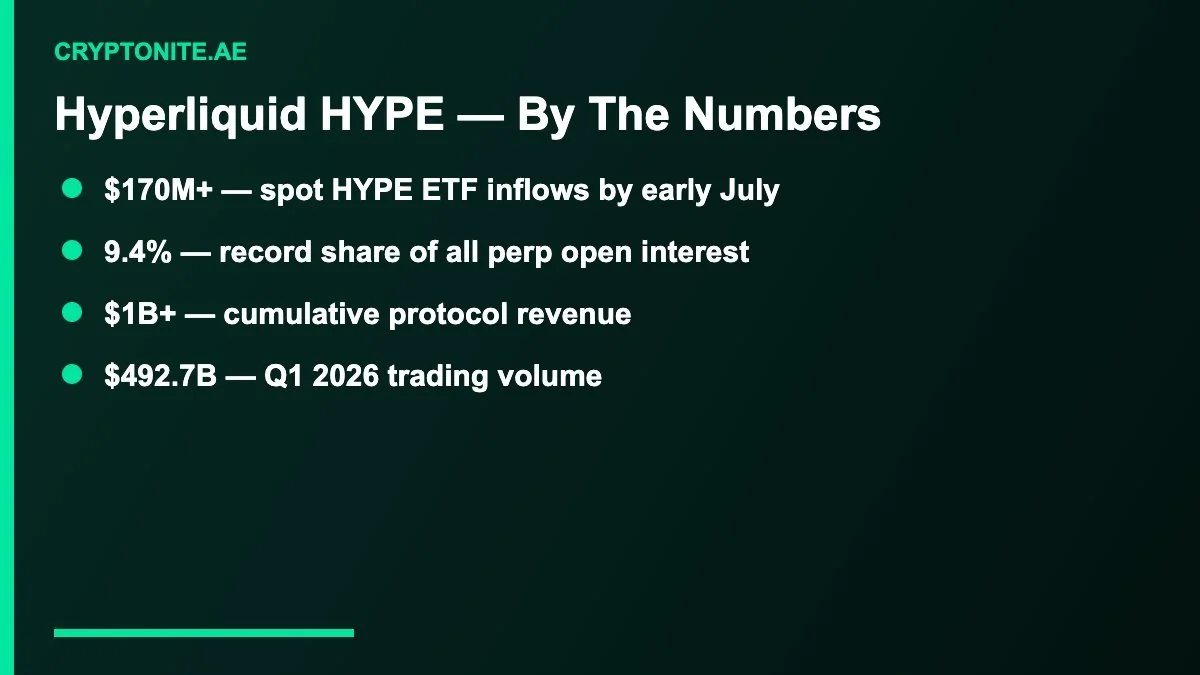
The most striking driver of the Hyperliquid HYPE story in 2026 is the arrival of exchange-traded funds. Bitwise’s BHYP and 21Shares’ THYP were listed in mid-May as the first US spot HYPE ETFs, and by early July their combined net inflows had passed $170 million. That is a remarkable figure for a token that, not long ago, was known mainly to on-chain derivatives traders rather than mainstream investors.
ETF access changes who can hold Hyperliquid HYPE. Instead of navigating on-chain wallets and decentralized interfaces, institutions and retail investors can gain exposure through familiar brokerage accounts. That accessibility has historically been a powerful catalyst for crypto assets, and it helps explain why HYPE has moved from niche to headline so quickly.
Record open interest and trader adoption
Beyond the ETFs, the underlying platform has posted eye-catching adoption metrics. On 18 July 2026, Hyperliquid’s open interest reached a record 9.4% of all perpetual-futures open interest across the market — a striking share for a single venue and a sign of how much trader activity it now commands. Open interest measures the total value of outstanding derivative positions, and a rising share indicates that more traders are choosing Hyperliquid to express their views.
This trader adoption is the foundation beneath the Hyperliquid HYPE narrative. ETFs may broaden ownership of the token, but it is the exchange’s genuine usage — real traders opening real positions — that generates the fees and revenue underpinning the token’s value case. Without that activity, the financial engineering around HYPE would be hollow.
The buyback flywheel: nearly all fees returned
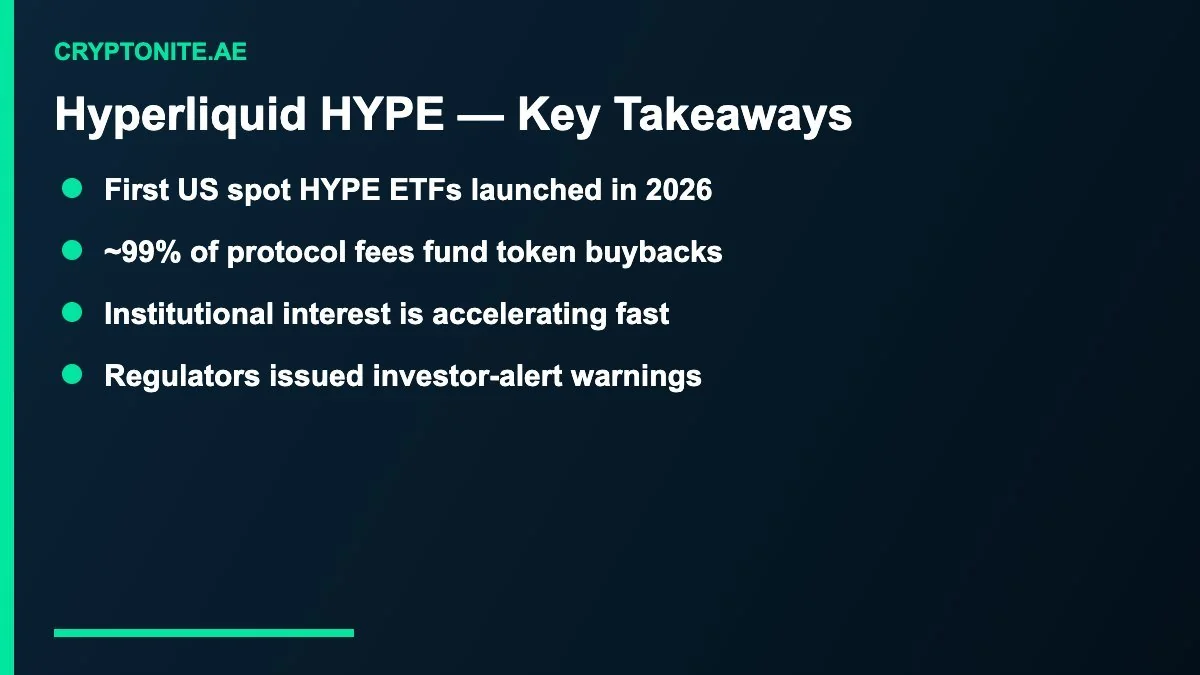
One of the most distinctive features of Hyperliquid HYPE is how the protocol handles its fees. Roughly 99% of trading fees are routed into open-market buybacks of the HYPE token. In effect, the more the exchange is used, the more of its revenue is deployed to purchase HYPE, creating a direct link between platform activity and demand for the token. Supporters describe this as a powerful value-accrual flywheel.
The logic is straightforward: rising volumes generate rising fees, which fund rising buybacks, which can support the token — potentially attracting more users and starting the cycle again. This mechanism is a large part of why Hyperliquid HYPE has captured attention, because it offers a clear, mechanical story for how usage translates into token demand, something many crypto projects struggle to articulate convincingly.
Billion-dollar revenue and volume near Coinbase
The scale of Hyperliquid’s business is genuinely notable. The protocol surpassed $1 billion in cumulative revenue on 30 June, and it generated an enormous $492.7 billion in trading volume in the first quarter of 2026 alone — a figure that placed it just below Coinbase by volume in some rankings. For a decentralized exchange to approach the trading volumes of a major listed company is a milestone that would have seemed improbable only a couple of years ago.
These fundamentals are what separate the Hyperliquid HYPE story from purely speculative token rallies. Whatever one’s view of the token’s valuation, the platform is producing real revenue and real volume at a scale that commands respect. That substance is precisely what has drawn serious institutional interest rather than mere speculative froth.
T. Rowe Price and institutional validation
Institutional validation has arrived from traditional finance as well. T. Rowe Price launched an actively managed multi-token spot crypto ETF on NYSE Arca, and disclosed holdings showed the fund allocating around 6.14% of its portfolio to Hyperliquid HYPE, placing the token among major holdings alongside Bitcoin. When a storied traditional asset manager includes a token in a diversified crypto fund, it signals a level of acceptance that goes beyond crypto-native enthusiasm.
Such allocations matter because they reflect professional due diligence. Asset managers building multi-token products weigh liquidity, fundamentals and risk before including an asset. The presence of Hyperliquid HYPE in such a fund suggests that at least some institutional allocators view it as a legitimate, investable component of the digital-asset landscape rather than a fleeting trend.
Grayscale and the widening ETF field
The ETF field around Hyperliquid HYPE is widening. Beyond the first movers, Grayscale filed its own S-1 registration with the SEC, signaling intent to launch a HYPE product of its own. A growing roster of issuers competing to offer exposure tends to deepen liquidity and normalize an asset, and it reflects genuine investor demand that issuers are racing to meet.
This competitive dynamic is a marker of maturation. When multiple established firms pursue products around the same token, it moves from being a single-issuer curiosity to a recognized category. For Hyperliquid HYPE, the expanding ETF landscape reinforces the sense that institutional interest is broad-based rather than concentrated in one or two adventurous providers.
Why perpetuals DEXs are winning
The Hyperliquid HYPE phenomenon is part of a larger shift toward decentralized derivatives trading. Perpetual futures are among the most popular instruments in crypto, and for years the biggest volumes ran through centralized exchanges. Platforms like Hyperliquid have narrowed the gap by delivering the speed and user experience of centralized venues while preserving on-chain settlement and self-custody, appealing to traders who want performance without surrendering control of their funds.
As confidence in decentralized infrastructure grows, more volume has migrated on-chain. Hyperliquid HYPE has been the standout beneficiary of that migration, but the trend speaks to a broader thesis: that decentralized exchanges can compete with, and in some segments rival, their centralized counterparts. That thesis, if it holds, has significant implications for the structure of crypto markets.
Tokenomics and the value-accrual debate
Not everyone agrees on how to value Hyperliquid HYPE, and the debate is instructive. Bulls point to the buyback mechanism and the platform’s revenue as evidence that the token has a clear, cash-flow-like basis for its value — a rarity in a market full of tokens with vague utility. In this view, HYPE behaves almost like equity in a fast-growing exchange, with buybacks functioning like returns of capital to holders.
Skeptics counter that token valuations can still run ahead of fundamentals, that buybacks depend on sustained high volumes, and that competition or a downturn in trading activity could weaken the flywheel. Both perspectives have merit, and the honest position is that Hyperliquid HYPE has a stronger fundamental story than most tokens while still carrying the elevated risks inherent to any fast-moving crypto asset.
Regulatory warnings: a note of caution
The Hyperliquid HYPE rise has not been without regulatory friction. In late June, the Monetary Authority of Singapore added Hyperliquid to its Investor Alert List, joining earlier warnings from UK authorities. These alerts typically flag that an entity is not licensed or authorized to offer services to residents in that jurisdiction, and they are an important counterweight to the bullish narrative.
For readers, these warnings underscore that regulatory status varies by jurisdiction and that rapid growth can attract scrutiny. They do not necessarily indicate wrongdoing, but they are a reminder to understand the legal and regulatory context before engaging with any platform. A complete view of Hyperliquid HYPE has to hold the impressive fundamentals and the regulatory caution side by side.
Risks investors should weigh
Several risks accompany the Hyperliquid HYPE story. The token’s value case depends heavily on sustained trading volumes; a prolonged slowdown would reduce fees and weaken the buyback flywheel. Competition is intensifying as other decentralized and centralized venues vie for derivatives volume. And the regulatory warnings highlight jurisdictional uncertainty that could affect access in some markets.
There is also the ever-present reality of volatility. Tokens tied to fast-growing platforms can move sharply in both directions, and leverage in the derivatives market can amplify swings. None of these risks negates the genuine achievements of the platform, but they are essential context for anyone assessing Hyperliquid HYPE with clear eyes rather than through the lens of hype alone.
How Hyperliquid compares to rivals
Placed alongside its peers, Hyperliquid stands out for the scale of its volume and the clarity of its token economics, but it operates in a crowded and competitive field. Other high-performance chains and decentralized exchanges are pursuing similar goals, and centralized incumbents retain enormous liquidity and brand trust. The question for Hyperliquid HYPE is whether it can defend and extend its lead as competitors respond.
Network effects work in its favor: liquidity attracts traders, and traders deepen liquidity. But those effects can erode if a rival offers a better product or if market conditions shift. The competitive comparison suggests that Hyperliquid has built a strong position, while cautioning that leadership in crypto is rarely permanent and must be continually earned.
The UAE and institutional angle
For readers in the UAE and wider Gulf, the Hyperliquid HYPE story illustrates how quickly institutional interest can coalesce around a token with genuine fundamentals and accessible ETF wrappers. As regional investors and institutions deepen their engagement with digital assets under frameworks set by VARA and the FSRA, examples like HYPE show both the opportunity in high-growth on-chain businesses and the importance of weighing regulatory status carefully.
The broader lesson is that the line between decentralized crypto projects and institutional finance continues to blur. When traditional asset managers hold a decentralized exchange’s token and ETFs make it broadly accessible, the categories start to merge. Hyperliquid HYPE is a vivid case study in that convergence, with all the promise and the caveats it entails.
What to watch next
Several signals will shape the next chapter of the Hyperliquid HYPE story. ETF flows will show whether institutional demand is sustained or fleeting. Trading volumes and open interest will reveal whether the platform can maintain its momentum against rising competition. And regulatory developments across jurisdictions will determine how accessible the platform and token remain in key markets.
Above all, the durability of the buyback flywheel — which depends on continued high usage — will be the crucial variable. If volumes hold, the value-accrual story stays intact; if they fade, the narrative weakens. Watching these indicators over time, rather than reacting to any single data point, is the sensible way to follow Hyperliquid HYPE from here.
How Hyperliquid built its performance edge
A recurring question about Hyperliquid HYPE is how a decentralized platform managed to deliver the speed and responsiveness that traders normally associate with centralized exchanges. The answer lies in its purpose-built architecture, designed from the ground up to handle the demands of high-frequency derivatives trading while keeping settlement transparent and on-chain. Rather than retrofitting derivatives onto a general-purpose blockchain, the platform optimized specifically for the order-book and matching performance that active traders require.
This engineering focus is a meaningful part of the Hyperliquid HYPE story, because performance is what keeps traders on a platform. In derivatives markets, latency and reliability translate directly into money, and a venue that cannot keep up loses volume quickly. By solving the performance problem, Hyperliquid removed one of the biggest historical obstacles to decentralized derivatives adoption, and that technical foundation underpins everything the token narrative is built on.
Community, incentives and ecosystem growth
Alongside its technology, Hyperliquid has cultivated an engaged community and an ecosystem of tools, integrations and users that reinforce the platform’s momentum. Incentive programs, a widely discussed token distribution, and an active trader base have all contributed to the sense that Hyperliquid HYPE represents a genuine community-driven project rather than a purely top-down one. That grassroots engagement can be a durable competitive advantage in crypto, where user loyalty and network effects matter enormously.
Ecosystem growth also creates optionality. As more developers build around the platform and more products integrate HYPE, the token’s role can expand beyond a single exchange into a broader financial network. Whether that potential is fully realized remains to be seen, but the combination of strong technology, aligned incentives and an active community gives Hyperliquid HYPE a foundation that many rival tokens lack. It is one more reason the project has commanded such outsized attention in 2026.
The bottom line on Hyperliquid HYPE
Pulling the threads together, Hyperliquid HYPE stands out because it pairs a genuinely successful product with a token whose economics are unusually easy to understand. The exchange is producing real revenue and volume at a scale that rivals major players, the buyback mechanism ties that success directly to the token, and institutional wrappers have made HYPE accessible to a far wider audience than before. Those are the ingredients of a durable story rather than a fleeting rally, and they explain why so much capital and attention have converged on the project in 2026.
Yet durability is never guaranteed in crypto. Sustained volumes, competitive pressure and evolving regulation will all test the thesis in the months ahead, and the investor warnings are a reminder that rapid growth invites scrutiny. The balanced conclusion is that Hyperliquid HYPE has earned its place in the conversation on merit, while remaining a high-risk, high-volatility asset that demands careful, independent evaluation. As always, treat this as information rather than investment advice.
What it means
Hyperliquid HYPE captures a genuine shift in crypto: a decentralized exchange producing real revenue at institutional scale, a token with a clear value-accrual mechanism, and a wave of ETFs and asset managers bringing it to mainstream investors. Those are substantial achievements that set it apart from the many tokens that rise on speculation alone. The fundamentals are real, and the institutional embrace is meaningful.
At the same time, the regulatory warnings, the dependence on sustained volumes, and the intense competition are equally real, and they demand a clear-eyed view. The mature way to read Hyperliquid HYPE is to hold its impressive momentum and its genuine risks together. This article is information rather than investment advice, and readers should do their own research and consider professional guidance before acting.
Related on Cryptonite: our crypto ETF rotation analysis, Monad TVL coverage and Solana tokenized stocks.
Sources: CoinMarketCap, Yahoo Finance, Monetary Authority of Singapore.
Why is Hyperliquid HYPE surging in 2026?
Hyperliquid HYPE has surged on more than $170 million of spot HYPE ETF inflows, record open interest of 9.4% of all perpetual futures, over $1 billion in protocol revenue, and a buyback mechanism that routes roughly 99% of fees into the token.
What are the risks of Hyperliquid HYPE?
Key risks include dependence on sustained trading volumes to fund buybacks, intensifying competition, high volatility, and regulatory warnings such as Singapore’s MAS adding Hyperliquid to its Investor Alert List in June 2026.
Related: for a live example of how Hyperliquid’s on-chain transparency actually plays out in the market, see how a Hyperliquid whale escaped a $122M liquidation trap with nine minutes to spare.

1 thought on “Hyperliquid HYPE: Why Traders and ETFs Are Piling Into the DEX”