
The Worldcoin ETF era may be about to begin: on 20 July 2026, Grayscale filed a registration statement with the US Securities and Exchange Commission for a proposed Worldcoin ETF that would hold WLD, the native token of the World Network. If approved, this Worldcoin ETF would become the first US exchange-traded fund tied to Worldcoin, and the news sent WLD sharply higher even though the token still trades far below its former highs. It is a striking vote of confidence in one of crypto’s most ambitious and controversial projects.
This article explains exactly what Grayscale filed, how the proposed fund is structured, what Worldcoin actually is, why the filing matters, and the risks investors should weigh. It is analysis, not investment advice.
What Grayscale filed
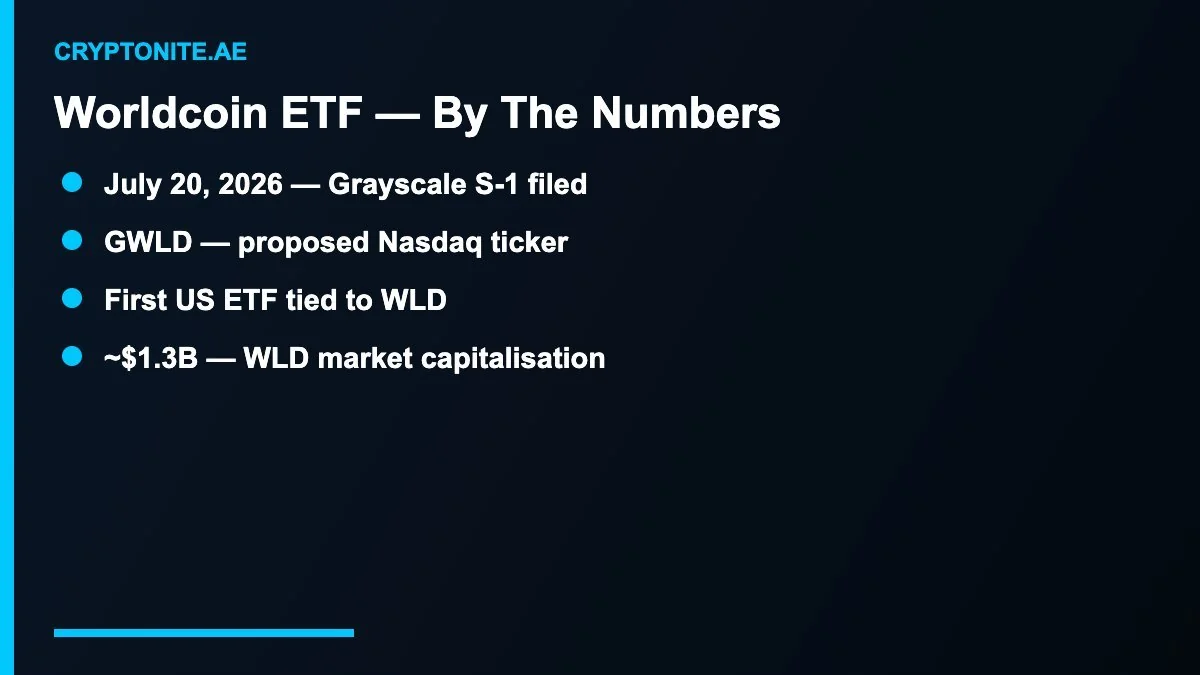
Grayscale submitted a Form S-1 registration statement to the SEC on 20 July 2026 for a proposed spot Worldcoin ETF. A spot fund of this kind would hold WLD directly, giving investors exposure to the token’s price through a regulated, exchange-listed wrapper rather than requiring them to buy and custody the asset themselves. The filing marks the first attempt to bring Worldcoin to Wall Street in ETF form.
The move fits a broader pattern in which issuers race to package individual crypto assets into ETFs as regulatory attitudes evolve. For Worldcoin, a project better known for its iris-scanning approach to digital identity than for mainstream financial products, the Worldcoin ETF filing represents a notable step toward institutional legitimacy.
Ticker, exchange and fund structure
According to the filing, the proposed Worldcoin ETF would list on the Nasdaq Stock Market under the ticker GWLD. The fund is organised as a Delaware Statutory Trust, formed on 10 July 2026 through the filing of a Certificate of Trust with the Delaware Secretary of State. These are standard structural elements for a Grayscale spot crypto product, mirroring the approach used for other single-asset funds.
The choice of Nasdaq under generic listing standards is significant, because streamlined listing rules can smooth the path for crypto ETFs that meet the criteria. While a filing is only the first step, the structure of the proposed Worldcoin ETF signals that Grayscale intends to follow the now-familiar template that has brought other digital assets to public markets.
Custody and service providers
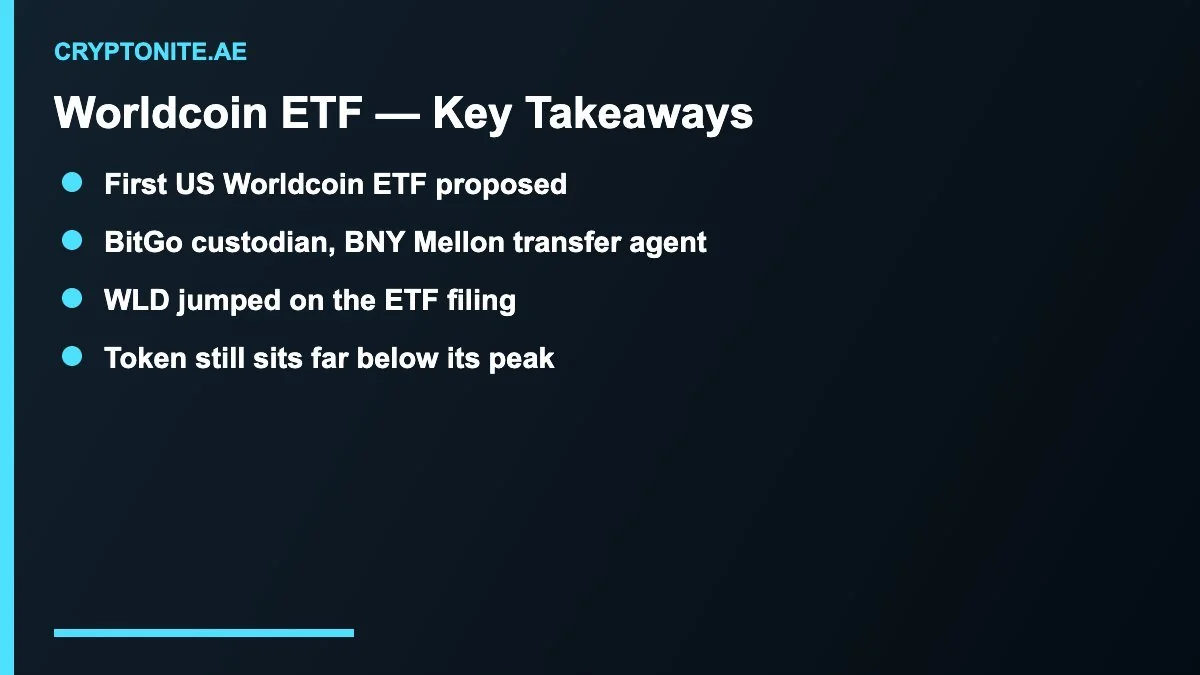
The filing names established service providers, which matters for institutional credibility. The Bank of New York Mellon would serve as transfer agent, while BitGo Bank & Trust, N.A. would act as custodian for the WLD held by the trust. Using regulated, recognised custodians and administrators is central to how a Worldcoin ETF would offer investors a safer, more familiar way to gain exposure than self-custody.
Custody is often the quiet crux of any spot crypto ETF, because investors are ultimately trusting that the underlying tokens are securely held. By naming a regulated custodian, the proposed Worldcoin ETF aligns with the standards institutions expect, addressing one of the first questions professional allocators ask about any digital-asset product.
What is Worldcoin and the World Network?
To understand the Worldcoin ETF, it helps to understand what WLD represents. WLD is the token of the World Network, a digital identity and financial network that combines several components. The project’s central idea is “proof of humanity” — verifying that a user is a unique, real person rather than a bot — in an age when artificial intelligence makes distinguishing humans from machines increasingly difficult.
The World Network was co-founded by figures associated with the broader AI industry, and it has drawn attention precisely because it sits at the intersection of identity, cryptocurrency and artificial intelligence. That ambitious scope is part of why a Worldcoin ETF is noteworthy: it would give investors regulated exposure to a project attempting something far broader than a typical token.
World ID, the Orb and proof of humanity
At the heart of the World Network is World ID, a form of digital identity that a person can obtain by verifying their uniqueness. The most distinctive — and controversial — method involves the Orb, a device that scans a person’s iris to confirm they are a unique human without, the project says, storing the raw biometric data. The network also references NFC-based identity credentials as additional verification methods.
This proof-of-humanity mechanism is the foundation on which the rest of the World Network is built. For anyone evaluating a Worldcoin ETF, the viability and adoption of World ID matters, because the token’s long-term value proposition is tied to whether this identity system achieves meaningful, sustainable use around the world.
World Chain and the World App
The World Network extends beyond identity into infrastructure and applications. World Chain is the network’s own blockchain, designed to prioritise verified human users, while the World App serves as the consumer gateway through which people access their World ID and interact with the ecosystem, including the WLD token. Together these components aim to create a financial and identity network usable by ordinary people.
Understanding this architecture is important context for a Worldcoin ETF, because the fund would ultimately track a token whose value is linked to the growth and utility of this entire stack. The more the World App and World Chain are used by verified humans, the stronger the fundamental case for WLD — and, by extension, for a fund that holds it.
Why the Worldcoin ETF filing matters
The significance of the Worldcoin ETF filing goes beyond a single token. It reflects how far the ETF wrapper has spread through crypto: from Bitcoin and Ethereum to a widening set of altcoins, each getting its own regulated product. A Worldcoin ETF would extend that trend to a project defined by digital identity and AI, broadening the range of themes investors can access through mainstream markets.
For Worldcoin specifically, an ETF would open the door to investors who cannot or will not hold tokens directly, potentially expanding the buyer base. That accessibility has historically been a meaningful catalyst for crypto assets, which is part of why the market reacted positively to the news of the Worldcoin ETF filing.
WLD’s price reaction
Markets responded quickly to the filing. WLD jumped on the news, with reports of gains in the region of 4% to 8% intraday as traders priced in the possibility of expanded institutional access. Such moves are common when a credible issuer files for a spot ETF, because the prospect of new, regulated demand can shift sentiment sharply in the short term.
It is worth stressing that a price pop on a filing is not the same as approval or sustained demand. The reaction to the Worldcoin ETF filing reflects optimism about what could come, not a guarantee of what will. Short-term enthusiasm around ETF news frequently fades if the regulatory path proves long or uncertain.
The context: WLD far below its peak
An important piece of context is that the Worldcoin ETF filing arrived while WLD was trading dramatically below its all-time high — by some measures around 97% off its peak, with a market capitalisation in the region of $1.3 billion. The token had recently touched new lows before the filing lifted it. That backdrop makes the filing both more surprising and more consequential.
For observers, this context is a reminder that an ETF filing does not erase a token’s history or its fundamental challenges. A Worldcoin ETF could broaden access, but the underlying project must still deliver adoption and utility to justify a durable recovery. The gap between the token’s current level and its former highs underscores how much execution risk remains.
The broader altcoin ETF wave
The Worldcoin ETF is part of a larger wave of altcoin ETF filings sweeping the market in 2026. Issuers have sought products around a growing list of tokens beyond Bitcoin and Ethereum, from XRP and Solana to newer assets, as they compete to meet investor demand for diversified, regulated crypto exposure. Grayscale’s move on Worldcoin extends that competition into the identity-and-AI corner of the market.
This proliferation of products is a sign of a maturing industry, but it also raises the bar for differentiation. Not every filing will be approved, and not every approved fund will attract meaningful assets. The Worldcoin ETF will ultimately be judged, like its peers, on whether investors see enough in the underlying asset to allocate capital.
How a spot crypto ETF works
For readers newer to the concept, a spot crypto ETF like the proposed Worldcoin ETF holds the actual token and issues shares that trade on a stock exchange, with the share price tracking the value of the underlying holdings. This structure lets investors gain exposure through ordinary brokerage accounts, with the fund handling custody and administration behind the scenes.
The appeal is convenience and familiarity: no wallets, no private keys, no navigating crypto exchanges. The trade-off is that investors rely on the fund’s structure and providers, and they gain price exposure without directly controlling the asset. Understanding this mechanism helps clarify both the promise and the limits of a Worldcoin ETF.
The approval path and what comes next
A filing is the beginning, not the end. The SEC will review the registration statement, and the timeline and outcome are uncertain. Regulatory attitudes toward altcoin ETFs have evolved, and streamlined listing standards may help, but approval is never guaranteed and can take time. The Worldcoin ETF now enters a process whose length depends on regulatory engagement and any required amendments.
Investors watching the Worldcoin ETF should focus on procedural milestones — SEC feedback, amendments and any decisions on listing — as the clearest signals of progress. Until and unless the fund is approved and launched, its impact remains prospective, however enthusiastic the initial market reaction has been.
Privacy, controversy and scrutiny
Worldcoin has faced significant scrutiny, particularly over the privacy implications of iris scanning and biometric identity. Regulators in several jurisdictions have examined its data practices, and debate continues about the ethics and safety of collecting biometric information at scale. Any assessment of a Worldcoin ETF has to hold these concerns alongside the project’s ambitions.
These controversies are material because they could affect adoption, regulatory treatment and the project’s long-term trajectory. A Worldcoin ETF would not insulate investors from these risks; it would package exposure to a project whose social and regulatory challenges are as notable as its technological aspirations. Clear-eyed evaluation means weighing both.
Risks for investors
The risks around a Worldcoin ETF are substantial. The token is highly volatile and trades far below its peak, adoption of the World Network’s identity system is still developing, and the regulatory and privacy questions are unresolved. On top of asset-specific risks, the ETF itself is only proposed, so there is no certainty it will launch at all.
These factors make the Worldcoin ETF a high-risk proposition even by crypto standards. The excitement around the filing is understandable, but it should not obscure the genuine uncertainties. Anyone considering exposure would need to weigh the speculative upside against a meaningful probability that the project or the fund does not meet expectations.
The UAE and global angle
For readers in the UAE and wider Gulf, the Worldcoin ETF filing is a useful example of how the ETF wrapper is expanding to encompass ever more of the crypto universe, including projects at the frontier of identity and AI. As regional investors engage with digital assets under VARA and FSRA frameworks, the global proliferation of single-asset crypto ETFs offers a preview of the product landscape that may eventually reach more markets.
It also highlights the importance of scrutiny. The same identity and privacy questions that surround Worldcoin globally are relevant wherever the project operates, and Gulf institutions weighing exposure would apply the same careful diligence they bring to any novel asset. The Worldcoin ETF is a case study in both the reach and the risks of the current ETF boom.
What to watch next
Several signals will indicate where the Worldcoin ETF is heading. The SEC’s review process and any amendments to the filing will show whether the fund is progressing. WLD’s price and trading activity will reveal how the market continues to weigh the news. And developments in World ID adoption, World Chain usage and the project’s regulatory standing will shape the fundamental case beneath the token.
Following these indicators over time, rather than reacting to the initial filing pop, is the disciplined way to track the Worldcoin ETF. The story is early, and its outcome depends on both regulatory decisions and the project’s ability to deliver on its ambitious vision.
Grayscale’s role in the crypto ETF story
Grayscale has been a central figure in the evolution of crypto investment products, and its decision to file for a Worldcoin ETF carries weight because of that track record. The firm has spent years converting and launching digital-asset funds, and its involvement tends to lend a filing added visibility. When an established issuer chooses to pursue a product around a token, it signals that the issuer sees enough investor interest to justify the effort.
That said, Grayscale filing for a Worldcoin ETF is not an endorsement of the token’s fundamentals; it is a business decision to meet potential demand. Issuers file for many products, and the market’s job is to judge which underlying assets merit allocation. The Worldcoin ETF will rise or fall on whether investors believe in the World Network’s long-term vision, not merely on the prestige of its issuer.
Identity meets investing
Perhaps the most intriguing aspect of a Worldcoin ETF is that it brings a digital-identity project into the world of regulated investing. Most crypto ETFs track assets whose value rests on monetary or platform utility; Worldcoin’s thesis is bound up with proving human uniqueness in an AI-saturated world. That makes the proposed fund a bet on a very different idea than a typical token product, and it is part of why the filing has generated such interest.
For investors, this fusion of identity and investing is both the appeal and the risk. If the World Network’s identity vision succeeds, the upside could be significant; if it stalls amid privacy concerns or weak adoption, the downside is equally real. A Worldcoin ETF would package that binary directly, which is why careful, independent evaluation matters so much here.
What it means
The Worldcoin ETF filing is a milestone that says as much about the ETF boom as it does about Worldcoin itself. It shows issuers pushing the wrapper into new territory — a project defined by digital identity and AI — and it gave WLD a short-term lift. But the filing is only a first step, and the token’s depressed price and the project’s unresolved controversies are reminders that access is not the same as value.
The mature reading is to recognise the genuine significance of a first US Worldcoin ETF filing while holding the substantial risks clearly in view. This is information rather than investment advice, and readers should do their own research and consider professional guidance before acting.
Related on Cryptonite: our crypto ETF rotation analysis, Ethereum price surge and Bitcoin ETF inflows.
Sources: SEC filing, Decrypt, The Block.
What is the Worldcoin ETF that Grayscale filed?
On 20 July 2026, Grayscale filed an S-1 with the SEC for a proposed spot Worldcoin ETF that would hold WLD, the token of the World Network. It would list on Nasdaq under the ticker GWLD and, if approved, be the first US ETF tied to Worldcoin.
Does the Worldcoin ETF filing mean it is approved?
No. A filing is only the first step. The SEC must review the registration statement, and approval is not guaranteed and can take time. WLD rose on the news, but the fund remains proposed rather than launched.