

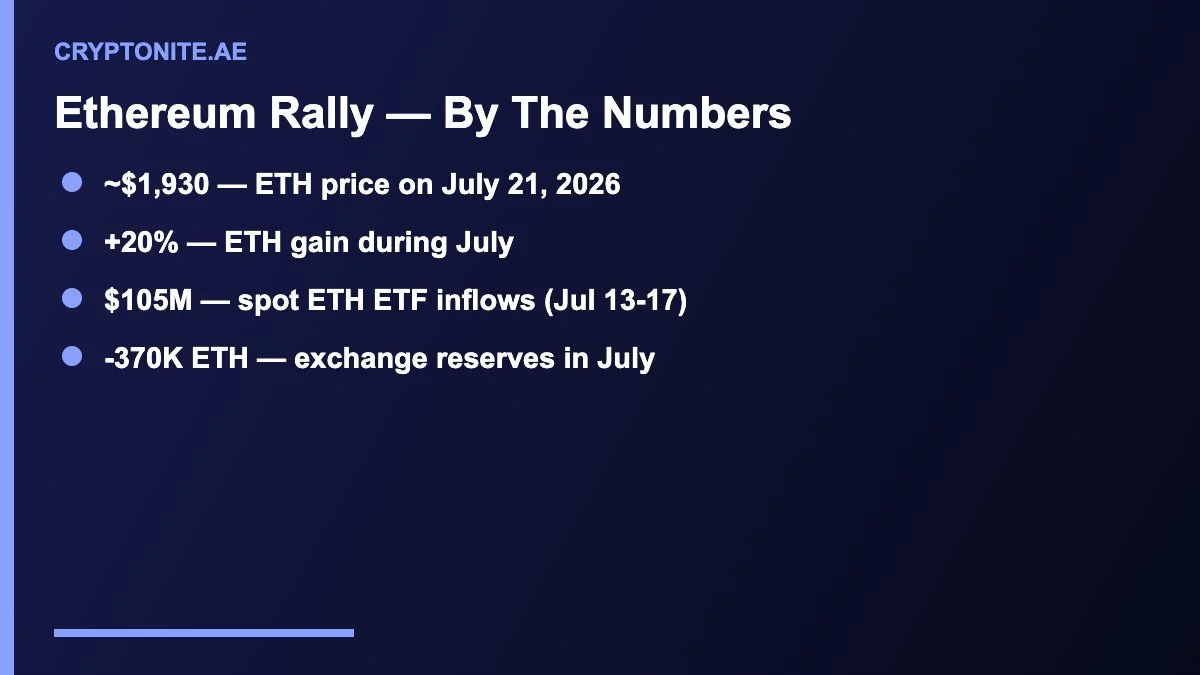
The Ethereum price surge has made ETH the single most-watched cryptocurrency heading into late July 2026, with the token trading near $1,930 after climbing roughly 20% over the month. This Ethereum price surge is being driven by a rare alignment of forces — heavy spot ETF inflows, a cooler US inflation reading, shrinking exchange reserves and growing staking demand — that together have flipped sentiment from cautious to constructive. For investors watching the majors, ETH has become the story of the moment.
This report breaks down exactly what is fuelling the move, how it compares with Bitcoin, what on-chain data reveals, and the risks that could stall it. It is analysis, not investment advice, and no target here is a guarantee.
Ethereum becomes the most-watched coin
By 21 July 2026, Ethereum had overtaken its peers to become the most-viewed asset on major market trackers, a status that reflects both its price action and the intensity of investor attention. ETH gained close to 4% in a single 24-hour stretch and extended its July advance above 20%, outperforming much of the market. When an asset leads both the price and the attention charts, it usually signals that a genuine narrative shift is underway.
The Ethereum price surge matters beyond ETH itself because Ethereum sits at the heart of decentralized finance, stablecoins and tokenization. A strong Ethereum tends to lift sentiment across the sectors built on it, which is part of why the move has drawn such broad interest from retail and institutions alike.
Driver one: spot ETF inflows outpace Bitcoin
The clearest catalyst behind the Ethereum price surge is institutional money arriving through exchange-traded funds. US spot Ethereum ETFs took in roughly $105 million in net inflows between 13 and 17 July, a figure that notably outpaced Bitcoin’s inflows over the same window. A single day, 16 July, saw about $53.9 million flow in, led by BlackRock’s ETHA product.
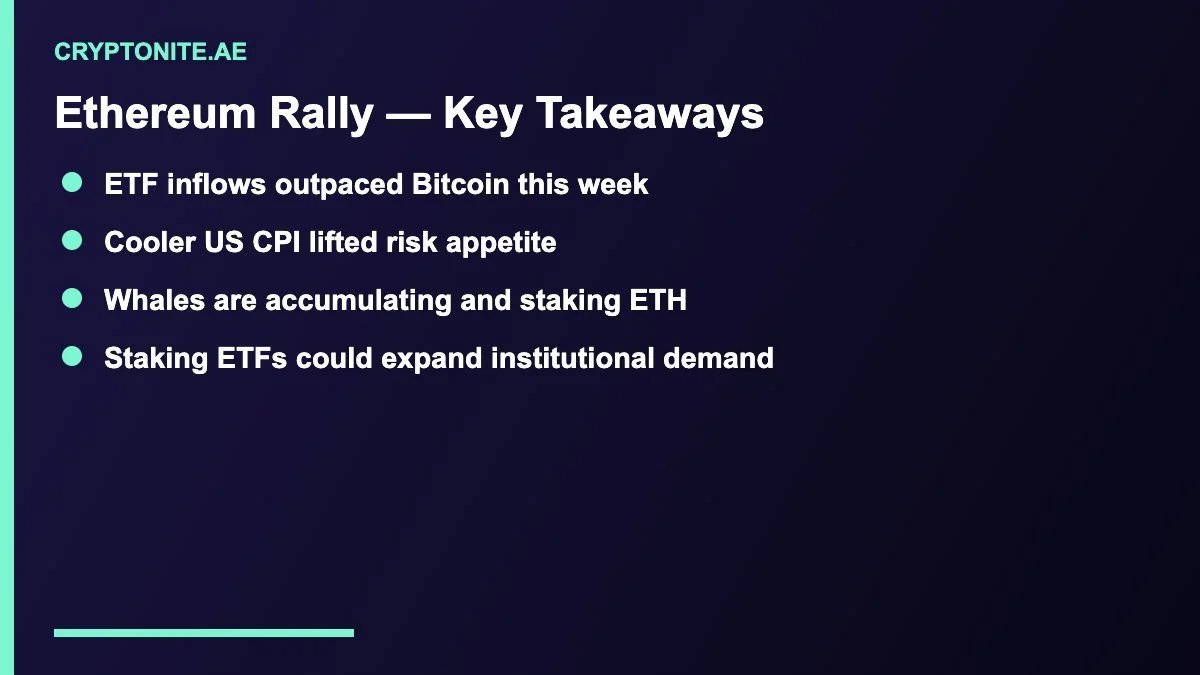
That ETF demand is significant because it represents durable, regulated capital rather than short-term speculation. When flows into Ether products exceed those into Bitcoin — historically the default institutional crypto allocation — it suggests allocators are actively rotating toward ETH. That rotation is a powerful engine for the Ethereum price surge.
Driver two: cooler CPI and macro tailwinds
Macro conditions have provided a supportive backdrop. A cooler-than-expected US consumer price index reading trimmed market expectations for further Federal Reserve rate hikes, improving risk appetite across assets. Weakening Treasury yields added to the tailwind, making higher-risk, higher-growth assets like Ethereum more attractive at the margin.
Crypto remains sensitive to these macro signals, and the Ethereum price surge has ridden the improvement in sentiment. When the cost of capital is expected to ease, investors are generally more willing to hold volatile assets, and ETH — as a large, liquid proxy for the smart-contract economy — is a natural beneficiary of that shift.
Driver three: on-chain accumulation and falling reserves
On-chain data reinforces the bullish read. Exchange reserves of ETH fell by around 370,000 coins during July, indicating that holders are moving Ether off trading venues and into private wallets — a classic sign of accumulation that reduces the supply readily available to sell. Analysts tracking large wallets noted fresh addresses withdrawing thousands of ETH from exchanges and staking them.
These flows are the plumbing beneath the Ethereum price surge. When coins leave exchanges for cold storage or staking, sell-side pressure eases, and price can rise more readily on incremental demand. On-chain accumulation does not guarantee further gains, but it is consistent with the behaviour of conviction buyers rather than short-term traders.
Driver four: staking demand and new ETF structures
Staking has emerged as a defining theme of the 2026 Ethereum price surge. As regulatory clarity around the treatment of proof-of-stake rewards has improved, institutional interest has shifted from purely speculative price exposure toward total-return strategies that capture staking yield. Filings from major firms — including Morgan Stanley’s applications for spot ETH and Solana ETFs with staking features — point to a coming wave of yield-bearing products.
This matters because staking changes ETH’s investment profile. A yield-bearing Ether competes with income assets that institutions already understand, broadening its appeal. The prospect of more staking-enabled ETFs is a structural tailwind that could sustain the Ethereum price surge well beyond any single week of flows.
Driver five: Robinhood Chain and ecosystem activity
Rising activity across the Ethereum ecosystem has added fuel. Growing usage on newer layer-2 and app-chain environments, including activity tied to Robinhood’s chain, reflects expanding demand for Ethereum’s settlement layer. More activity means more fees, more usage of ETH, and a stronger fundamental case beneath the price.
Ecosystem momentum is easy to overlook amid the focus on ETFs and macro, but it is an important part of the Ethereum price surge. A network that is being used more heavily has a more durable demand base than one riding sentiment alone, and Ethereum’s breadth of applications gives it a wide foundation.
How the Ethereum price surge compares to Bitcoin
A defining feature of this rally is that Ethereum has been leading Bitcoin, both in price momentum and in ETF flows. For much of the current cycle, Bitcoin set the tone and altcoins followed; the Ethereum price surge partly reverses that pattern, with ETH outperforming and drawing capital that might otherwise have gone to Bitcoin. That relative strength is itself a signal that some investors see distinct value in Ethereum’s smart-contract and yield story.
It would be premature to declare a permanent leadership shift, since these dynamics rotate. But the fact that Ether is outpacing Bitcoin during this stretch underscores that the market is differentiating between assets rather than treating crypto as a single monolithic trade — a hallmark of a maturing market.
What whale behaviour signals
Large-holder, or whale, behaviour has been a recurring theme in the Ethereum price surge. Reports of newly created wallets withdrawing eight-figure sums of ETH from exchanges and immediately staking them suggest that sophisticated players are positioning for the longer term rather than trading in and out. Staked ETH is effectively locked and earning yield, further tightening available supply.
Whale activity is not a foolproof indicator — large holders can be wrong, and their moves can reverse — but consistent accumulation and staking by big wallets is generally read as a vote of confidence. It aligns with the broader on-chain picture of coins leaving exchanges, reinforcing the narrative underpinning the Ethereum price surge.
The role of ETH staking economics
Understanding staking helps explain why the Ethereum price surge has staying power in the eyes of many analysts. Staking involves locking ETH to help secure the network in exchange for rewards, turning the asset into something that generates yield. For institutions building total-return strategies, that yield is a meaningful part of the appeal, and it distinguishes Ether from non-yielding assets.
As staking-enabled products proliferate, more ETH may be locked away to earn rewards, reducing liquid supply while institutional demand grows. That supply-demand dynamic is one of the strongest structural arguments behind the Ethereum price surge, though it depends on continued regulatory clarity and product adoption to play out fully.
Technical picture and key levels
On the charts, the Ethereum price surge has pushed ETH toward closely watched levels near and above $1,900, with traders eyeing the psychologically important $2,000 mark. Momentum indicators turned positive as the rally gathered pace, and a decisive move through resistance would, in the eyes of chart-focused traders, open the door to further gains. These levels are reference points, not predictions.
Technical analysis should always be paired with fundamentals and risk management. The levels traders watch cluster around round numbers and prior highs and lows, and while they can influence short-term behaviour, they do not dictate outcomes. Anyone using them to interpret the Ethereum price surge should treat them as one input among many.
Risks and what could stall the rally
No rally is without risk, and the Ethereum price surge faces several. Macro conditions could turn: a hotter inflation print or hawkish central-bank signals would pressure risk assets, ETH included. ETF flows are volatile and can reverse quickly, and a stretch of outflows would remove a key pillar of support. Broader market volatility and leverage can also amplify pullbacks.
There are project-specific considerations too, from competition among smart-contract platforms to the pace of upgrades and adoption. None of these negates the current momentum, but they are essential context. A balanced view of the Ethereum price surge holds the genuine strength of the move alongside the factors that could interrupt it.
The ETF landscape: BlackRock ETHA and beyond
The exchange-traded fund landscape is central to the Ethereum price surge. BlackRock’s ETHA has been a leading destination for inflows, and the earlier arrival of staked-Ether products added a yield dimension that broadened ETH’s appeal. As more issuers launch and expand Ether products — including staking-enabled structures — the range of ways institutions can access ETH keeps growing.
A deeper, more varied ETF ecosystem tends to normalize an asset and attract steadier capital. For Ethereum, the expanding product set is both a cause and a consequence of rising demand, creating a feedback loop that has helped power the Ethereum price surge and could support it going forward.
The institutional shift to total-return strategies
Perhaps the most important structural change behind the Ethereum price surge is the institutional shift from price-only exposure to total-return thinking. Where earlier institutional interest focused on capital appreciation, improved clarity around staking rewards has opened the door to strategies that combine price exposure with yield. That reframing makes ETH relevant to a wider set of allocators, including those who prioritize income.
This shift is subtle but powerful. It changes the question from “will the price go up” to “what total return can this asset deliver,” a framing that resonates with pensions, endowments and treasuries. As that mindset spreads, it provides a more durable foundation for demand than sentiment-driven speculation, lending the Ethereum price surge a more institutional character.
The UAE and Gulf angle
For readers in the UAE and wider Gulf, the Ethereum price surge is especially relevant given the region’s growing engagement with staking and yield-bearing digital assets. Gulf allocators accustomed to income-generating investments are natural candidates for total-return ETH strategies, and the region’s clear regulatory frameworks through VARA and the FSRA make institutional participation more straightforward than in less-regulated markets.
As the Ethereum ecosystem underpins much of the tokenization and stablecoin activity that Gulf institutions are exploring, a strong ETH has broader significance for the region’s digital-asset ambitions. The current move is a reminder of how central Ethereum remains to the infrastructure on which much of the future of finance is being built.
What to watch next
Several signals will show whether the Ethereum price surge has legs. ETF flows are the clearest gauge of institutional conviction and should be watched over weeks, not days. Macro data — especially inflation readings and central-bank guidance — will shape risk appetite. On-chain metrics, including exchange reserves and staking participation, will reveal whether accumulation continues.
The progress of staking-enabled ETF products is another key marker, since their launch could unlock a new wave of demand. Following these indicators over time, rather than reacting to each price swing, is the disciplined way to track the Ethereum price surge from here.
Ethereum’s fundamentals beneath the price
It is worth stepping back from the ticker to remember what gives the Ethereum price surge its foundation. Ethereum is the largest smart-contract platform, hosting the bulk of decentralized finance, a major share of stablecoin activity, and a growing volume of tokenized real-world assets. Every transaction on the network consumes ETH for fees, and every application built on it adds to the demand for block space. That underlying utility is what separates Ethereum from assets whose value rests on narrative alone.
As usage grows, so does the fundamental case beneath the price. The Ethereum price surge is therefore not purely a financial event; it is partly a reflection of an expanding economy of applications settling on the network. For long-term observers, the health of that ecosystem — measured in active users, fees and total value locked — is at least as important as any single price move.
Layer-2 growth and scaling
A crucial part of Ethereum’s evolution has been the rise of layer-2 networks that process transactions more cheaply while settling back to the main chain. This scaling has made using Ethereum-based applications far more affordable, expanding the addressable user base and reinforcing the demand that supports the Ethereum price surge. Rather than being a bottleneck, Ethereum has increasingly become the secure settlement backbone for a family of faster, cheaper networks.
The growth of these layer-2 ecosystems, including consumer-facing chains tied to major fintech platforms, broadens Ethereum’s reach into everyday use cases. As more activity flows through this expanding stack, the base layer captures value from a wider economy. This structural scaling story is an important, if less headline-grabbing, pillar of the Ethereum price surge.
Sentiment, positioning and the fear index
Despite the rally, broad market sentiment gauges have at times still registered caution, with some fear indices sitting in conservative territory even as ETH climbed. That combination — rising price against a backdrop of lingering caution — can be constructive, because it suggests the move is not yet driven by euphoric, over-leveraged positioning. Rallies that climb a “wall of worry” sometimes prove more durable than those fuelled by unbridled optimism.
Positioning matters because crowded trades are vulnerable to sharp reversals. If the Ethereum price surge is being driven substantially by genuine accumulation and institutional flows rather than frothy leverage, it has a firmer footing. Watching sentiment and positioning alongside price helps distinguish a sustainable move from a fragile one, and so far the evidence has been more encouraging than not.
What it means
The Ethereum price surge of July 2026 is notable not just for its size but for the quality of its drivers: durable ETF inflows, supportive macro, genuine on-chain accumulation and a structural shift toward staking-based total-return demand. Together they give the move a more institutional and fundamentally grounded character than a typical sentiment-driven rally.
The honest caveat is that momentum can fade and risks remain, from macro reversals to volatile flows. The mature way to read the Ethereum price surge is to appreciate its genuine strengths while respecting what could interrupt it. This is information rather than investment advice, and readers should do their own research and consider professional guidance before acting.
Related on Cryptonite: our crypto ETF rotation analysis, UAE Ethereum staking guide and Bitcoin price outlook.
Sources: FXStreet, crypto.news, The Cryptonomist.
Why is Ethereum surging in July 2026?
The Ethereum price surge is driven by spot ETH ETF inflows that outpaced Bitcoin, a cooler US CPI reading, falling exchange reserves as holders accumulate and stake, and growing demand for staking-enabled products. ETH traded near $1,930, up about 20% in July.
What could stop the Ethereum rally?
Risks to the Ethereum price surge include a hotter inflation print or hawkish central banks, a reversal in ETF flows, broad market volatility and leverage, and competition among smart-contract platforms. Momentum can fade quickly.

1 thought on “Ethereum Price Surge: 5 Reasons Why ETH Is Rising in July 2026”