Key Takeaways
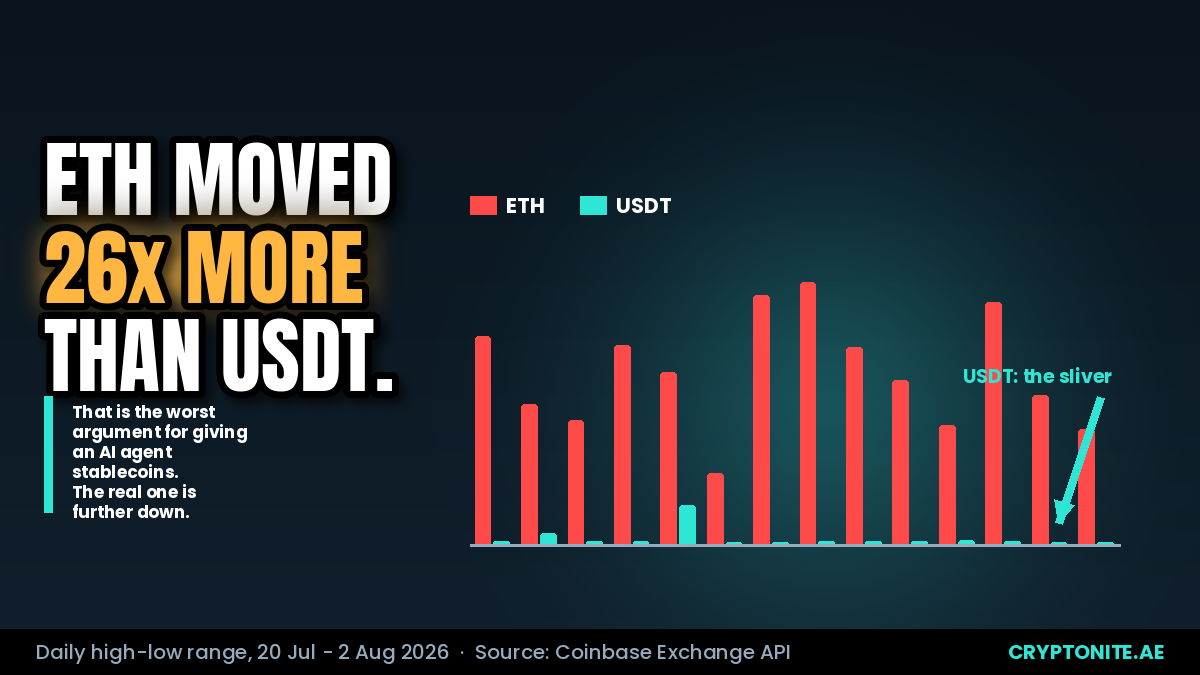
- The volatility argument is the weakest one. It is also the only one most coverage makes. Over the last fourteen days ETH’s average daily range was 3.35% against USDT’s 0.13% — a real gap, and largely beside the point.
- Finality is the actual reason. A stablecoin transfer is a state change an agent can verify by itself. A card authorisation is a promise that can be reversed months later, and no agent can reason about that window.
- Sub-cent economics are the second reason. Card interchange has a floor. Machine-to-machine payments priced in tenths of a cent die underneath it.
- “Stable” is not “fixed”. USDT closed 2 August at $0.99897 and had a 0.78% high-low range on its worst day in the window. On a $50,000 settlement that is $390.
- In the UAE the answer changes. Under the CBUAE Payment Token Services Regulation, foreign payment tokens like USDC and USDT may not be used for general goods and services on the mainland. Only a dirham payment token can do that job.
Do AI agents actually need stablecoins? Mostly yes, but not for the reason you have been told. AI agents stablecoins arguments almost always lead with price volatility, which matters least when an asset is held for seconds. The properties that actually do the work are programmatic finality, round-the-clock settlement and fees small enough to survive a fraction of a cent.
AI agents stablecoins: what does the volatility argument prove?
Less than it appears, and the AI agents stablecoins case leans on it hardest. Read the tape the way a trader would, because the numbers are real and they are less flattering to the standard case than people assume.
Across the fourteen sessions from 20 July to 2 August 2026, ether’s average daily high-low range was 3.35%, peaking at 5.09%. Bitcoin averaged 2.46%. Tether over the identical window averaged 0.13%. That is roughly a twenty-six-fold difference, and if an agent were holding a treasury for a quarter it would settle the argument on its own.
But that is not what agents do. An agent that receives a payment, calls an API and forwards value holds the asset for seconds. Over seconds, a 3% daily range is not a 3% risk — it is a rounding error against the gas it just paid. The volatility case for AI agents stablecoins is an argument about custody, borrowed and applied to a context that has almost none.
Now the part the same data shows that nobody quotes. Tether’s worst session in that window still had a 0.78% high-low range, and it closed 2 August at $0.99897 — about ten basis points under peg. Both facts are unremarkable in isolation. Both matter the moment you multiply them. An agent settling a $50,000 invoice inside a 0.78% band is exposed to $390 of slippage on an asset described in every explainer as stable. Stable is a description of variance, not a guarantee of par.
So the honest reading of the chart is not “use stablecoins because crypto is volatile”. It is: volatility is the one property you can most afford to ignore at agent timescales, and the residual instability that remains is the one you should actually size.
What are the real reasons AI agents stablecoins matter?
Three properties do the real work in any AI agents stablecoins design, and they survive even if you delete price stability from the list entirely.
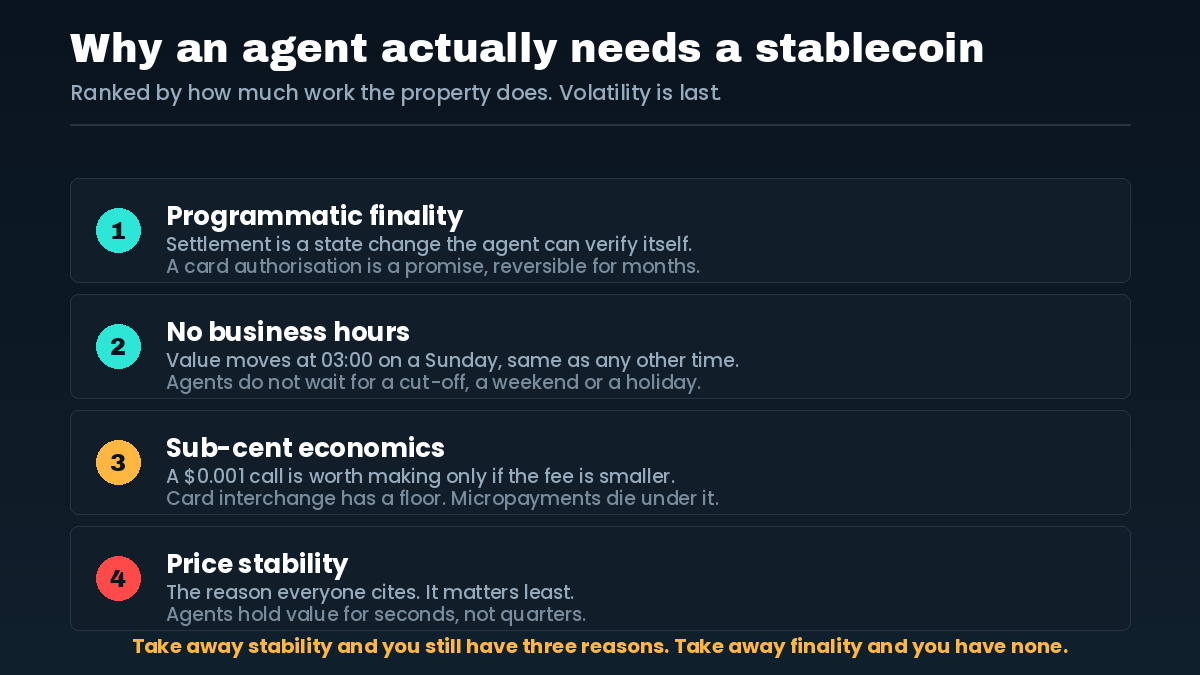
Programmatic finality. This is the load-bearing one. When an agent receives a stablecoin transfer, settlement is a state change it can verify without asking anyone. When it receives a card authorisation, it has received a promise — one that can be pulled back through a chargeback window measured in months. A human merchant prices that risk into a business model. An agent has no business model. It has a rule, and “paid” has to mean paid.
No business hours. The second AI agents stablecoins property. Agents do not observe cut-off times, weekends or public holidays. Any rail with a settlement window introduces a state where the agent believes it has been paid and the money has not moved. That gap is where reconciliation bugs live.
Sub-cent economics. The case for AI agents stablecoins is strongest exactly where traditional rails are weakest. A one-tenth-of-a-cent API call is only worth making if the fee is smaller than the call. Card interchange has a hard floor well above that. This is the whole reason the x402 protocol exists, which we unpacked in how AI agents pay each other.
Notice what happens if you remove stability from that list: you still have three reasons. Remove finality and the other three stop mattering, because the agent can no longer tell whether it has been paid.
When do AI agents stablecoins stop being necessary?
More often than the category admits, and this is where most AI agents stablecoins commentary quietly overreaches.
If the agent is spending its owner’s money with a named counterparty on a normal invoice, a card or a bank transfer is fine, and AI agents stablecoins add nothing. India’s UPI settles instantly, around the clock, at effectively zero cost. Instant SEPA does the same across the euro area. Neither needs a token, and both come with dispute rights the agent’s owner may actively want.
There is also a genuine argument against. Reversibility is not a defect of card rails — it is the product. Stablecoin finality means an agent’s mistake is permanent, which is precisely the failure documented in what happens when an AI agent gets hacked, and precisely why an unsupervised strategy that draws down has no recovery path, as we showed in whether AI agents can legally trade DeFi. The property that makes stablecoins usable by machines is the same property that makes machine errors unrecoverable. Anyone selling you AI agents stablecoins as pure upside is not describing the trade.
AI agents stablecoins in the UAE: what may actually be paid with?
Here the global answer stops applying, and almost nobody writing about AI agents stablecoins notices.
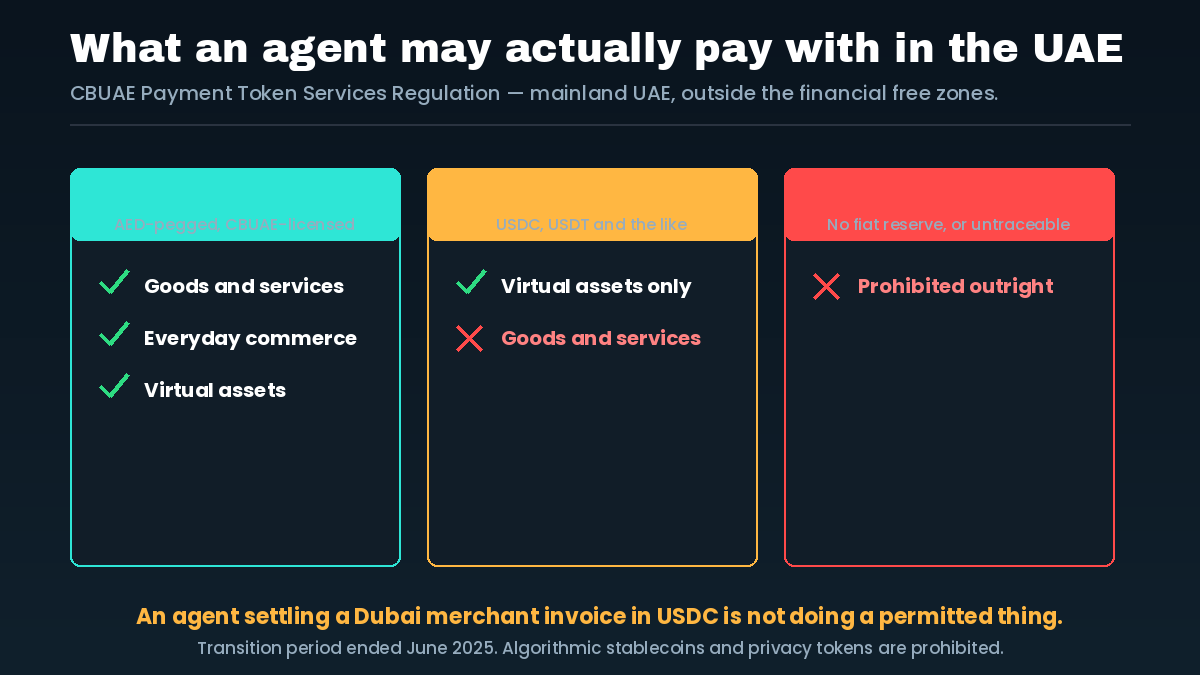
The Central Bank of the UAE’s Payment Token Services Regulation separates dirham payment tokens from foreign payment tokens and does not treat them alike. A dirham payment token, issued under CBUAE licence, can be used for goods and services. A foreign payment token — which is what USDC and USDT are here — is limited to specified virtual-asset transactions. It is not a general means of payment on the mainland.
Read that against how AI agents stablecoins stacks are actually built in practice. x402 settles in USDC. Effectively every reference implementation assumes a dollar token. An agent following that default and settling a Dubai merchant invoice in USDC is not performing a permitted transaction, and the licensing question lands on whoever operates it rather than on the software.
Three further points of fact. The regulation’s one-year transition period ended in June 2025, so this is live rather than forthcoming. Algorithmic stablecoins and privacy tokens are prohibited outright, which removes a whole design space. And the perimeter covers three licensable activities — issuance, conversion, and custody and transfer — so an agent platform that holds balances for users may be doing more than it thinks. The wider UAE picture sits in agentic AI UAE regulation.
Two markers of how fast this is moving: AE Coin was licensed as the first regulated dirham stablecoin in December 2024, and on 30 January 2026 the CBUAE approved USDU, issued by ADGM-regulated Universal Digital, as the first foreign payment token issuer registered with the central bank. The door is opening, on the central bank’s terms and on its timetable.
What nobody can tell you yet is how a supervisor would treat an autonomous agent that routes around this by holding a foreign token and converting at the point of sale. There is no public enforcement to reason from. Anyone claiming certainty is guessing.
Does a dirham token change the AI agents stablecoins calculation?
For anyone operating from the UAE, more than any protocol upgrade will. A dirham payment token is the only instrument in the CBUAE framework cleared for general goods-and-services payment, which makes it the only one an agent can use for the ordinary commercial transactions people actually want automated: paying a supplier, settling a subscription, buying compute.
That has a second-order effect worth thinking through. If the compliant instrument is AED-denominated and the counterparty prices in dollars, you have reintroduced foreign exchange into a flow that was supposed to be frictionless. The agent now holds two tokens, or converts at the point of sale, and conversion is itself a licensable activity under the same regulation. The clean AI agents stablecoins architecture that works in a single-currency jurisdiction acquires a currency leg here.
The counter-argument is that this is temporary. USDU’s registration on 30 January 2026 shows the central bank is willing to admit foreign issuers to the framework rather than shut them out, and a registered foreign token is a different object from an unregistered one. What it does not do is change the permitted-use rule. Registration governs who may issue; the use restriction governs what the token may buy. Conflating the two is the most common error in current coverage of AI agents stablecoins in this market.
The practical read for a builder: if your agent’s transactions are themselves virtual-asset transactions, a foreign token is workable today. If they are ordinary commerce on the UAE mainland, design for a dirham token and treat the dollar leg as a conversion problem with its own licensing question attached. And if you sit inside DIFC or ADGM, none of the above is your regime: the financial free zones run their own rules, which is exactly the jurisdictional split that catches teams building for “the UAE” as though it were one perimeter.
Does a dirham token change the AI agents stablecoins calculation?
For anyone operating from the UAE, more than any protocol upgrade will. A dirham payment token is the only instrument in the CBUAE framework cleared for general goods-and-services payment, which makes it the only one an agent can use for the ordinary commercial transactions people actually want automated: paying a supplier, settling a subscription, buying compute.
That has a second-order effect worth thinking through. If the compliant instrument is AED-denominated and the counterparty prices in dollars, you have reintroduced foreign exchange into a flow that was supposed to be frictionless. The agent now holds two tokens, or converts at the point of sale, and conversion is itself a licensable activity under the same regulation. The clean AI agents stablecoins architecture that works in a single-currency jurisdiction acquires a currency leg here.
The counter-argument is that this is temporary. USDU’s registration on 30 January 2026 shows the central bank is willing to admit foreign issuers to the framework rather than shut them out, and a registered foreign token is a different object from an unregistered one. What it does not do is change the permitted-use rule. Registration governs who may issue; the use restriction governs what the token may buy. Conflating the two is the most common error in current coverage of AI agents stablecoins in this market.
The practical read for a builder: if your agent’s transactions are themselves virtual-asset transactions, a foreign token is workable today. If they are ordinary commerce on the UAE mainland, design for a dirham token and treat the dollar leg as a conversion problem with its own licensing question attached. And if you sit inside DIFC or ADGM, none of the above is your regime: the financial free zones run their own rules, which is exactly the jurisdictional split that catches teams building for the UAE as though it were one perimeter.
AI agents stablecoins against the alternatives
| Rail | Finality | Always on | Sub-cent viable | Reversible | Usable by software alone |
|---|---|---|---|---|---|
| Stablecoin on-chain | Minutes, verifiable | Yes | Yes | No | Yes |
| Card | Months, provisional | Yes | No | Yes | Needs a cardholder |
| Instant bank transfer | Seconds to hours | Mostly | Marginal | Limited | Needs an account holder |
| Traditional bank transfer | 1–3 days | No | No | Limited | Needs an account holder |
Quiz: how well do you know the agent payments stack?
Five questions. Reasoning appears when you submit.
Why This Matters
If you believe agents need stablecoins because crypto is volatile, you will build the wrong thing. You will optimise for holding a stable balance and pay no attention to whether your settlement is actually final, which is the property your code depends on every time it decides an invoice is paid.
Getting the AI agents stablecoins ranking right changes concrete decisions. It tells you that a card rail with an agent-friendly API is still not a substitute, because provisional settlement breaks the agent’s model of the world. It tells you that a fast domestic bank rail may be a perfectly good substitute for large, named, infrequent payments. And it tells you the residual peg risk is worth sizing on anything material, because at 0.78% a day the word stable is doing less work than it looks.
For anyone building from the UAE, the AI agents stablecoins question has a local answer that differs from the global default, and the default is the one baked into every reference implementation you will pick up. That is worth knowing before you ship, not after a supervisor asks.
Frequently Asked Questions
Do AI agents need stablecoins, or just any crypto?
Any transferable on-chain asset gives an agent finality and round-the-clock settlement. A stablecoin adds a stable unit of account, which matters for pricing and accounting rather than for the seconds an agent actually holds the balance.
Which stablecoin do agent payment protocols actually use?
Across AI agents stablecoins implementations USDC dominates, x402 included. That is a default rather than a requirement, and it is the default that collides with UAE mainland rules.
Can an AI agent hold stablecoins in its own name?
No. Software has no legal personality, so the balance belongs to a person or a company however the keys are arranged. The wallet question is covered separately in whether an AI agent can legally own a crypto wallet.
Is a depeg a real risk for agent payments?
For the seconds-long holds typical of AI agents stablecoins flows, small. For float held across a day, or for large single settlements, it is real and quantifiable — a 0.78% band on $50,000 is $390. Size it rather than assuming par.
Can my agent pay a UAE merchant in USDC?
Not as a general means of payment on the mainland. Foreign payment tokens are limited to specified virtual-asset transactions under the CBUAE regulation; a dirham payment token is the instrument built for goods and services. Take advice on your specific structure.
This article is information, not investment or legal advice. Cryptonite does not recommend any token, issuer or protocol. Regulatory positions described here are general and change; take advice on your specific facts before moving money.
Written by Vaibhav Ali, Editor at Cryptonite, covering crypto, Web3, stablecoins, RWAs and agentic AI from the UAE.