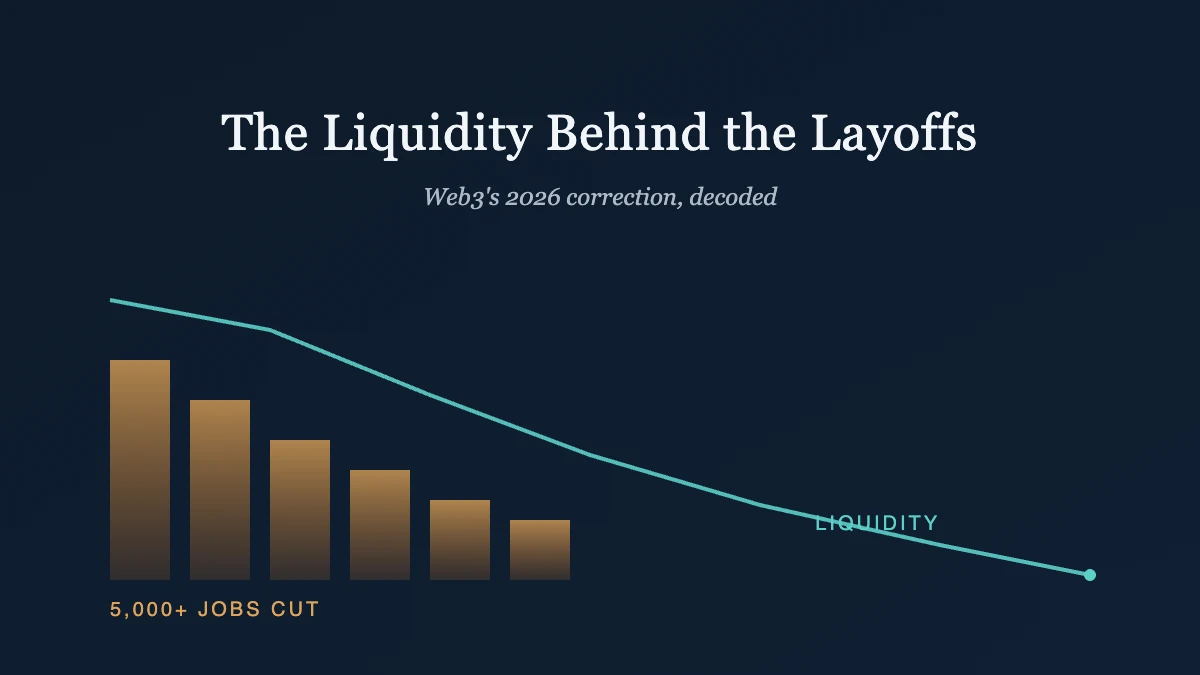
Web3 layoffs in 2026 have passed 5,000, but AI is not the real cause. The deeper driver is revenue: crypto’s money supply — stablecoins — has stopped growing, thinning trading volume and fees. Firms funded by falling token treasuries are cutting, while those earning real revenue in stablecoins, RWA, and infrastructure keep hiring.
Key Takeaways
- Trackers put 2026 Web3 layoffs above 5,000, with a concentrated wave in March across Coinbase, Gemini, Crypto.com, Algorand, and others.
- Companies increasingly frame the Web3 layoffs as an AI pivot, but recruiters see little evidence of AI replacing workers at scale.
- The deeper driver is revenue — and the clearest warning sign is that stablecoin supply, crypto’s real money supply, has stopped growing.
- The firms bleeding hardest are token-treasury-funded protocols; the ones hiring are revenue-generating stablecoin, RWA, and infrastructure businesses.
- Unlike 2022, this is a business-model correction, not a solvency crisis — which makes it more instructive.
Web3 layoffs have moved from a trickle to a defining story of 2026, with sector trackers counting more than 5,000 job cuts since January and a concentrated wave in March. What makes this round of Web3 layoffs different from the 2022 crypto winter is the explanation attached to it: companies are no longer only blaming the market. They are, increasingly, blaming — or crediting — artificial intelligence. The question worth asking is whether that framing is accurate, convenient, or a little of both.
The honest answer is that AI is the story companies are telling, thin revenue is the condition underneath, and liquidity is the mechanism connecting the two.
The Numbers Behind the Web3 Layoffs
The concentration is striking. In a matter of weeks in March 2026, CoinDesk and sector trackers reported cuts at Crypto.com (~180 roles, about 12%), the Algorand Foundation (~50, roughly 25%), Gemini (200–300 positions, 25–30%), OP Labs (~20), and others, alongside larger reductions earlier in the year at firms including Coinbase and Kraken.
Hiring tells the same story from the other side. New crypto job postings ran at roughly 6.5 per day in January 2026, down about 80% year-on-year. For context, the 2022 winter erased more than 26,000 tracked roles — so 2026 is smaller in absolute terms, but the shape of it is different.
The AI Story Companies Are Telling
The narrative shift around the Web3 layoffs is explicit. Gemini said plainly that “AI is now too powerful not to use,” and Crypto.com’s leadership has warned that firms failing to pivot to AI “will fail.” Across the market, AI mentions in Web3 job listings jumped from around 23% in early 2025 to 53.1% by March 2026 — more than half of new roles now ask for AI skills outright.
There is a real trend inside this. Roles are shifting from doing tasks toward managing automation, producing a new “agent manager” profile. Efficiency gains are genuine, and some headcount is being replaced by tooling.
Why the AI Explanation Doesn’t Fully Hold
But the people who place these workers are skeptical. “I see no real indication that these layoffs have anything to do with AI workforce replacement at scale,” crypto recruiter Dan Eskow said, attributing the cuts instead to cost-cutting and consolidation in crowded categories like restaking, DePIN, and Layer 2s.
That skepticism matters. “We are cutting because AI made us efficient” is a far more flattering sentence than “we over-hired against token prices that have since fallen.” AI reframes a cost problem as a strategy — modernity instead of retrenchment — and it plays well with investors. When a token like ALGO trades near $0.09, down some 98% from its peak, the efficiency narrative does convenient double duty.
Follow the Liquidity
Here is the part most Web3 layoffs coverage skips. The reason revenue evaporated is that crypto’s money supply stopped growing — and in this market, the money supply is stablecoins.
Stablecoin market capitalisation sits near $313 billion and has been contracting month-on-month. Because stablecoins are the base liquidity that funds trading, collateral, and fees, a stall in their supply behaves like a stall in M2: order books thin, spreads widen, and volume-dependent revenue dries up. Market makers and proprietary trading firms that once provided depth have reduced activity or exited, and overall market liquidity has fallen to levels not seen since early 2021. October 2025’s roughly $19 billion liquidation event exposed how fragile that thinner plumbing had become.
Weak liquidity means weak volume; weak volume means weak fees; weak fees mean shrinking treasuries — and shrinking treasuries mean layoffs. AI is what you announce at the end of that chain, not what started it.
The Revenue Problem Underneath
| Framing | What companies say | What the data suggests |
|---|---|---|
| AI pivot | “AI is too powerful not to use.” | Real efficiency gains, but little evidence of replacement at scale — partly narrative. |
| No revenue | Rarely stated outright | Headcount was funded by token-inflated treasuries, not recurring fees. |
| Liquidity | Cited as “macro headwinds” | Stablecoin supply — crypto’s M2 — has stalled, draining volume and fees. |
The uncomfortable truth is that much of Web3 built payroll on speculation rather than income. The era of “we’ll pay you mostly in tokens” is over; milestone-based grants and token options are replacing outright grants precisely because token-denominated compensation stopped being credible. Firms with actual revenue — fees, not float — are not the ones announcing 30% cuts.
What This Means
Read the survivor list and the thesis becomes obvious. The segments still hiring cluster around revenue: stablecoin issuers, real-world asset (RWA) tokenisation platforms, custody, and infrastructure that charges for a service. The segments bleeding are token-treasury-funded protocols in saturated categories. AI is not sorting winners from losers; revenue is.
For builders and operators, the practical signal is not the Web3 layoffs count — it is stablecoin supply. When that base liquidity resumes growing, volume, fees, and hiring tend to follow; while it contracts, no amount of AI messaging changes the arithmetic. That makes stablecoin float one of the more useful leading indicators for the crypto labour market, which is not where most people look.
And unlike 2022 — a solvency crisis driven by leverage and fraud — 2026 looks like a business-model correction toward revenue. That is painful for the displaced, but structurally healthier. The market is repricing the difference between a protocol that earns and a protocol that merely trades. AI is the headline; revenue is the story.
What It Means for the Gulf
The Web3 layoffs correction reads differently from the Gulf. The segments still hiring — stablecoin issuers, RWA tokenisation platforms, custody, and regulated infrastructure — are precisely the ones the UAE has spent two years licensing. VARA‘s Dubai regime, ADGM’s FSRA framework, and the CBUAE’s Payment Token rules have pulled revenue-generating firms toward Abu Dhabi and Dubai even as token-treasury protocols shed staff elsewhere. If stablecoin float is the leading indicator for crypto hiring, the MENA build-out — dirham-referenced stablecoins, tokenised real-world assets, and institutional custody — is one of the few places where that base liquidity is being deliberately engineered to grow rather than left to the market. For regional operators, the 2026 Web3 layoffs read less as a warning than a hiring signal.
Frequently Asked Questions
How many Web3 layoffs have there been in 2026?
Sector trackers count more than 5,000 crypto job cuts since January 2026, concentrated in a March wave across firms including Coinbase, Gemini, Crypto.com, and Algorand.
Are crypto layoffs caused by AI?
Companies increasingly cite AI, and AI-related job requirements have risen sharply. But recruiters report little evidence of AI replacing staff at scale; cost-cutting and weak revenue appear to be the primary drivers.
How is liquidity connected to crypto job losses?
Stablecoin supply functions as crypto’s money supply. Its stall has thinned trading volume and fees, shrinking the treasuries that funded headcount — making liquidity a root cause of the cuts.
Which crypto sectors are still hiring?
Revenue-generating segments — stablecoins, RWA tokenisation, custody, and infrastructure — remain more resilient to the 2026 Web3 layoffs than token-treasury-funded protocols.
Sources
- CoinDesk — Crypto firms cut hundreds of jobs in weeks, blaming markets and AI in equal measure (March 21, 2026)
- CoinGecko — H1 2026 Global Crypto Hiring Market Analysis Report
- PYMNTS — Stablecoin Market Cap Suffers Biggest Decline in 4 Years
- CoinDesk Research — Market Spotlight: Inside Crypto’s $19 Billion Liquidation Event
This article is for informational purposes only and does not constitute financial, investment, or legal advice.
”
5 thoughts on “Web3 Layoffs in 2026: AI, No Revenue, or a Liquidity Crisis?”