Bottom Line Up Front
On AURA8 Episode 61, veteran investor Michael Terpin argued that Bitcoin’s midterm-year capitulation probably is not finished: he puts a 60–70% chance on a dip below $57,000 before a durable bottom he expects in the fourth quarter, most likely October. His base case is that the pain is a setup — a sharp recovery follows, with a worst case near $180,000 within roughly three years. The bigger call is a rotation: when the AI equity bubble deflates, he expects “smart money” to move into an undervalued Bitcoin. Everything here is Terpin’s view, not investment advice.
Bitcoin cycles always capitulate in midterm years, then run up sharply… smart money looks at undervalued sectors.
Michael Terpin, AURA8 Ep. 61
Key Takeaways
- Michael Terpin sees a 60–70% chance Bitcoin trades below $57,000 before a sustainable low, with the bottom most likely in Q4 (about a 30–40% chance the recent low already was it).
- He frames the move through his “four seasons” model: between halvings, price is driven by the math of supply and demand; the wild swings are fear and greed.
- This cycle’s shocks have been macro, not crypto — Iran, oil above $100, and a shift in rate-cut expectations — with no exchange or lender blow-ups so far.
- His central thesis: as an AI equity bubble eventually pops, capital rotates out of over-valued tech and into a comparatively cheap Bitcoin.
- None of this is advice; these are one analyst’s probabilistic forecasts, and diminishing returns each cycle are part of his own model.
Michael Terpin — founder of BitAngels and Transform Ventures, author of The Bitcoin Supercycle, and the analyst who popularised the “four seasons” framing of Bitcoin — returned to AURA8 for a market breakdown with host Vaibhavv Ali. The conversation, streamed live and featured on Binance Square, ranged across the cycle, the macro backdrop, the AI trade, and where he thinks capital goes next. What follows is a summary of his stated views, with all forecasts attributed to him.
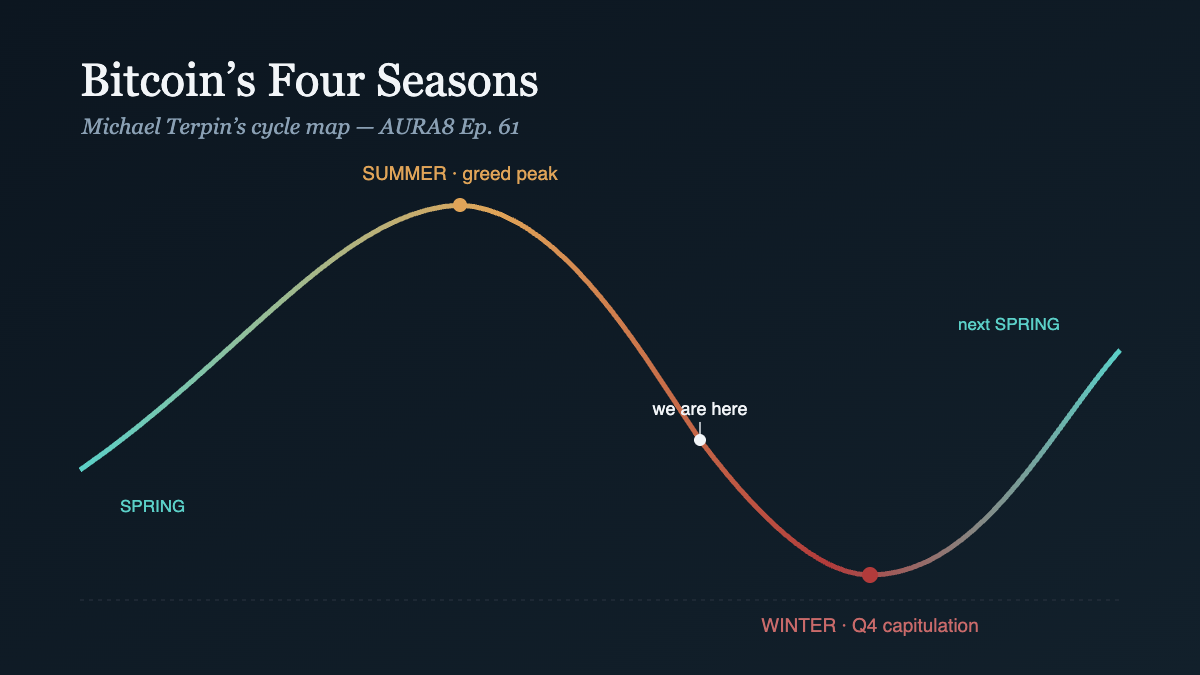
The Cycle Call: Why Michael Terpin Thinks the Bottom May Not Be In
Michael Terpin has been consistent that the recent low around the 200-week moving average had “some of the hallmarks of a bottom” — heavy selling that did not bounce back in the sharp V-shape of earlier dips. But he stopped short of calling it. He assigns roughly a 30–40% chance the low is already in, and a 60–70% chance Bitcoin revisits levels below $57,000 first.
His reasoning is historical rhythm. As he put it, history “doesn’t always repeat, but it rhymes.” The last two midterm-year bear markets, he noted, dumped in February and June, rebounded in July, gave the gains back in August, and bottomed in the fourth quarter. That pattern, he argues, appears to be repeating — which is why he keeps pointing to October, and why he has pushed back on those who called a bull market the moment price tagged the high-$60,000s without reclaiming $75,000.
The Math Behind the Four Seasons
Underneath the sentiment, Terpin insists, is arithmetic. Between halvings, he says, “as long as the amount of new money coming into the ecosystem exceeds the inflation, the price has to go up.” He traces the cycle peaks to make the point: roughly $12 after the first halving, about $670 after the second, near $8,700 after the third, and around $64,000 this most recent cycle — each top higher than the last, even as percentage returns shrink.
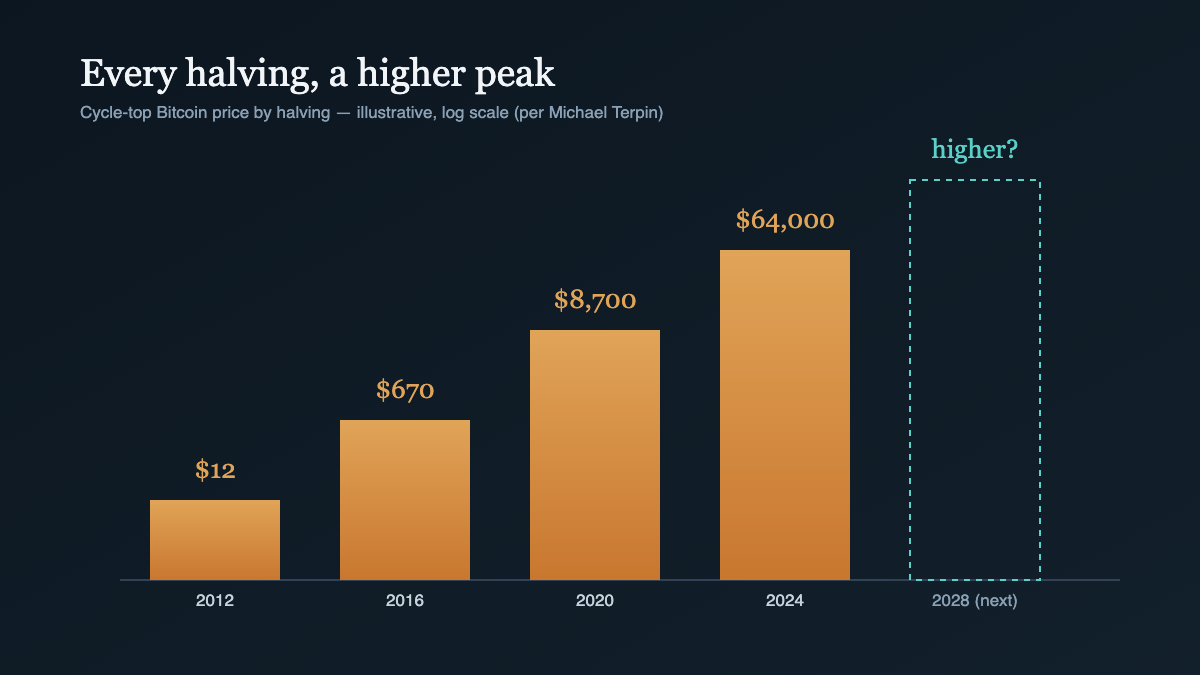
The diminishing-returns pattern is central to his model: prior cycles ran up roughly 100x, then 30x, then about 8x, with drawdowns of 85%, 83% and 75% respectively. This cycle, he says, “should have been up… three x” on neutral macro but fell short — an outcome he attributes partly to whales using traditional rails, for the first time at scale, to sell into strength and plan to rebuy lower. Retail, in his telling, does the opposite: buys the top, panic-sells the bottom.
Michael Terpin kept returning to the supply-and-demand core of his case: as long as the net Bitcoin bought over each four-year cycle exceeds the new coins mined, he argues, the price has to rise — a dynamic he says has held every cycle so far. It is why Michael Terpin treats the current drawdown as a season rather than a verdict, and why he frames the institutional bid from spot ETFs and treasury companies as a cushion under this Bitcoin bottom that earlier cycles never had.
This Time the Shocks Are Macro, Not Crypto

A recurring point from Michael Terpin: the industry has, so far, avoided a self-inflicted blow-up. “We really haven’t had any crypto shocks this time,” he said — no lender or exchange collapse of the BlockFi or FTX variety. Instead the pressure has come from systemic macro: renewed conflict involving Iran, oil pushing over $100, and a market suddenly pricing rate hikes rather than cuts — a chain of dominoes he says could alone drag Bitcoin under $57,000.
He credited the new class of Bitcoin treasury companies for behaving more responsibly than the last cycle’s leveraged lenders — none, he noted, has been forced into bankruptcy court. On the sharp drop in one Strategy-linked preferred instrument, he attributed the move to short sellers forcing a de-peg and over-leveraged carry-trade longs unwinding, rather than institutions capitulating — and said he expects it to return toward par as the cycle turns.
Michael Terpin on the AI Bubble and the Great Rotation
The most forward-looking part of the conversation was Terpin’s read on artificial intelligence. He flagged what he called the first negative cash flow at a mega-cap search company since its IPO, driven by tens of billions in AI capital spending, and argued that several AI bubbles will inflate and pop — much as the dot-com boom did, repeatedly, before the durable winners emerged. Host Vaibhavv Ali pushed back that distribution and reach can matter more than model quality; Terpin countered that “the best product” tends to win, citing how Google overtook AltaVista and Lycos.
That sets up the rotation thesis. Terpin’s view is that historically the biggest market drawdowns cluster at the end of a decade, and he floated 2029 as a candidate for an outsized “everything bubble” led by AI’s growing weight in the S&P. When that unwinds, he argues, investors sitting on profits from chip stocks and mega-cap tech will hunt for the next asymmetric bet — and land on Bitcoin. It is the same logic as the pull-quote above: capitulation, then rotation into what is undervalued.
Altcoins, Adoption and the Institutional Cushion
On altcoins, Michael Terpin was blunt: tokens “rotting in a lot of wallets” are, in his words, “never coming back.” Most alts pump the cycle they are hot, maybe less the next, and rarely a third unless they pivot hard or hold a sticky, enforceable user base. His example of durability was BNB, which he said has printed new highs most cycles — though he noted that priced in Bitcoin, even that has not outperformed every time, and that Ether did not make a new dollar high this cycle.
On adoption, he leaned on the classic technology curve. With an estimated 4–5% of the world holding Bitcoin and roughly 8% holding some crypto, he sees a tipping point near 7–8% where early adopters give way to the mainstream. He pointed to Morgan Stanley opening access beyond accredited investors, Charles Schwab entering, and established spot ETFs — none of which existed four years ago — as an institutional cushion under this bottom that earlier cycles lacked. As Terpin has argued on AURA8 before, the seasons matter more than the headlines, even if the headlines bite at the edges.
What This Means
The non-obvious signal in Terpin’s framework is not the price targets — it is the changing character of the cycle. Returns are compressing, the shocks have migrated from crypto-native failures to macro and geopolitics, and the marginal buyer is increasingly an institution with an ETF rather than a leveraged retail trader. That combination argues for shallower manias and shallower panics over time, not the 100x-then-85%-crash rhythm of Bitcoin’s early years.
The honest caveat belongs in the same breath. These are probabilistic forecasts from one analyst with a directional book, and his own model bakes in diminishing returns and a wide band of outcomes — a 30–40% chance the bottom is already in sits right beside the 60–70% chance it is not. The rotation from AI into Bitcoin is a thesis about human behaviour under stress, not a certainty. For readers, the useful takeaway is the framework, not the number: cycles, supply-and-demand math, and where liquidity tends to flow when one bubble deflates and another asset looks cheap.
Frequently Asked Questions
What is Michael Terpin’s Bitcoin price prediction?
On AURA8 Ep. 61, Michael Terpin said a durable low is most likely in Q4, with a 60–70% chance of a dip below $57,000 first, followed by a recovery he framed as a worst case near $180,000 within about three years. These are his forecasts, not advice.
What are the “four seasons” of Bitcoin?
It is Michael Terpin’s framing that Bitcoin moves through recurring cycle phases tied to the halving. Between halvings, he argues, price is driven by supply-and-demand math, while the large swings reflect fear and greed.
Why does Terpin expect a rotation into Bitcoin?
He expects an AI equity bubble to deflate in stages. As investors take profits from over-valued tech, he argues they will seek undervalued assets — and views Bitcoin as a prime candidate for that capital.
Is this article investment advice?
No. It summarises Michael Terpin’s views from an interview and is for informational purposes only. It is not financial, investment, or trading advice.
AURA8 Episode 61 was streamed live and featured on Binance Square, supported by BitAngels, EcoXDubai, CryptoMonday and OffChain Global. This article is for informational purposes only and does not constitute financial, investment, or legal advice.

11 thoughts on “Michael Terpin: Bitcoin’s Q4 Bottom and the $180K Cycle Case”