
Key Takeaways
- BitMEX will permanently cease operations on 23 September 2026 at 04:00 UTC; parent HDR Global Trading Limited cited a “strategic review.”
- The BitMEX shutdown ends an 11-year run for the exchange that invented the perpetual swap — now the most-traded product in all of crypto.
- Market reaction was split: the exchange’s BMEX token fell roughly 90%, while analysts expect little impact on the wider derivatives market.
- BitMEX’s relevance had already faded after the 2020 US enforcement action, as liquidity migrated to Binance, Bybit and newer venues.
- The real lesson of the BitMEX shutdown is second-order: in crypto, inventing the category does not protect you — compliance and distribution do.
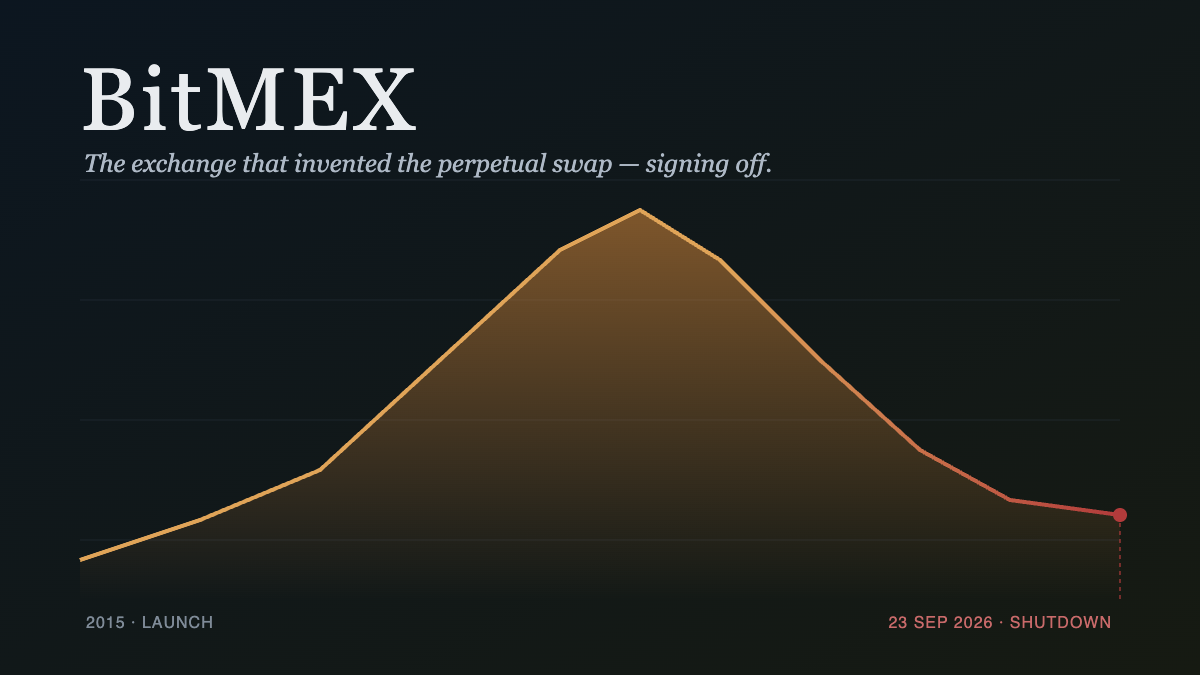
The BitMEX shutdown is now official. On 23 July 2026, BitMEX told users the exchange will permanently close on 23 September 2026 at 04:00 UTC, ending an 11-year run. Its owner and operator, HDR Global Trading Limited, said it made the decision following a “strategic review of the business.” What matters is less the closure itself than the symbolism: the venue that invented crypto’s most important trading product is exiting a market that its own invention now dominates.
What the BitMEX Shutdown Notice Said
In a post to users and on its official X account, BitMEX said it was sharing the news “with a very heavy heart.” The exchange has already stopped accepting new account registrations. From 26 August 2026, the platform moves to reduce-only, blocking new positions and permitting only closures, before the full wind-down on 23 September.
Users have been urged to close positions and withdraw funds before the deadline. Co-founder Arthur Hayes thanked employees, partners and customers, framing the closure as the company winding down responsibly and on its own terms — not a collapse, but a controlled exit. As CoinDesk reported, the BitMEX shutdown notice gives users a clear runway rather than a sudden freeze.
The Market Shrugged — With One Exception
The sharpest reaction to the BitMEX shutdown was contained to the exchange’s own ecosystem. The native BMEX token fell around 90% within hours of the announcement, as holders priced in a token with no platform behind it.
Beyond that, the broader market barely moved. Analysts widely expect the closure to have limited impact on crypto derivatives as a whole — a telling detail. A decade ago, a BitMEX shutdown would have drained a meaningful share of global futures liquidity. In 2026, the market can lose the exchange that started it all and hardly notice, which is what makes the BitMEX shutdown feel like an epitaph rather than an earthquake.
The Product That Outgrew Its Inventor
This is the part most coverage will underplay. In 2016, BitMEX launched the perpetual swap — a futures contract with no expiry, kept in line with spot by a funding rate. It became the single most-traded instrument in crypto, adopted across thousands of venues from Binance to Bybit to on-chain platforms like Hyperliquid.
The invention won so completely that it stopped needing its inventor. Once every major exchange offered perps with deeper liquidity and, later, clearer regulatory standing, BitMEX’s first-mover edge evaporated. The pioneer’s core innovation became a commodity feature — and commodities do not command loyalty, and the BitMEX shutdown simply makes that official.
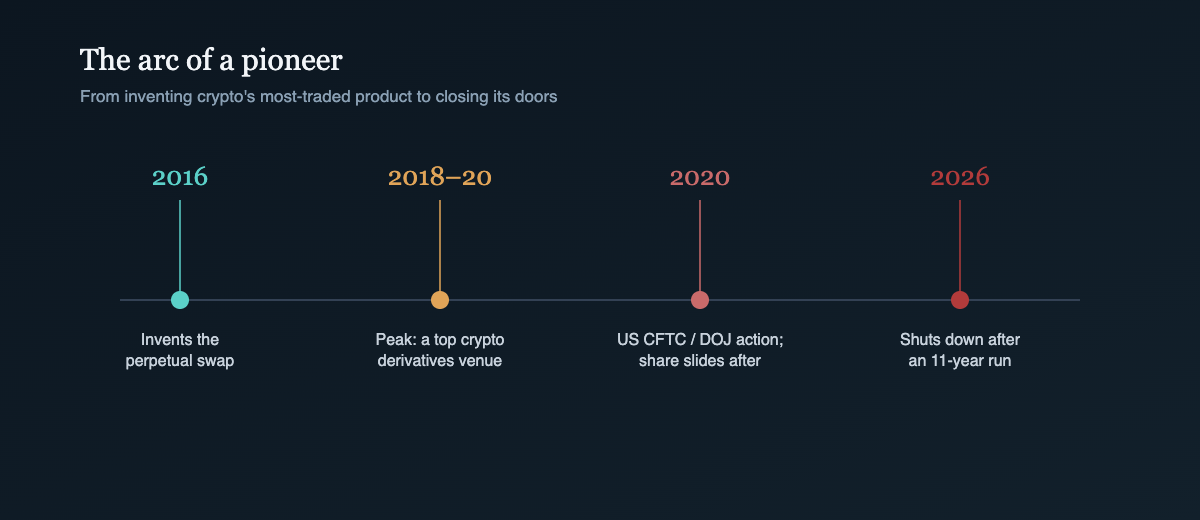
| Year | Milestone |
|---|---|
| 2014–15 | BitMEX launches; leveraged crypto derivatives for a niche audience |
| 2016 | Introduces the perpetual swap — no expiry, funding-rate design |
| 2018–20 | Peak influence as a top global crypto derivatives venue |
| 2020 | US CFTC and DOJ action; market share slides thereafter |
| 2026 | Announces permanent shutdown after an 11-year run |
A Legacy Inseparable From Its Reckoning
BitMEX’s legacy cannot be told without its US enforcement chapter. In October 2020, the CFTC filed a civil action and federal prosecutors in the Southern District of New York indicted co-founders Arthur Hayes, Benjamin Delo and Samuel Reed, alleging BitMEX offered US persons unlicensed leveraged products and failed to implement adequate know-your-customer and anti-money-laundering programs.
The outcomes are matters of public record. BitMEX reached a $100 million settlement with the CFTC and FinCEN. Hayes and Delo each pleaded guilty to a single Bank Secrecy Act violation and each paid a $10 million fine. That episode — not the BitMEX shutdown announcement — is when the company’s market position began its long slide, as traders moved to venues building compliance in rather than bolting it on.
Notably, BitMEX also operated its entire 11-year run without losing customer funds to a hack — a record many larger, still-operating exchanges cannot claim. The official shutdown reason remains the “strategic review”; the company has not tied it to regulation, and any such link is industry speculation rather than confirmed fact.
What People Are Saying on X
Sentiment on X coalesced around “end of an era.” The dominant note was nostalgia — BitMEX was where a generation of traders first met leverage, funding rates and the liquidation cascade. Many credited it, accurately, as the birthplace of the perp.
The harder edge came from BMEX holders nursing a roughly 90% drop, and from commentators reading the BitMEX shutdown as confirmation that the offshore, no-KYC model it pioneered has simply run out of road. Hayes’s own message — proud of the team, exiting on its own terms — set the tone the community largely echoed: respect for the legacy, clear-eyed about the decline.
What the BitMEX Shutdown Actually Changes
Directly, very little — and that is the point. The perpetual swap is permanent; the venue that birthed it is not. Liquidity has already consolidated into a handful of dominant exchanges and a fast-growing on-chain derivatives layer, and it will keep doing so.
The durable lesson is about where derivatives flow now settles. Volume has gravitated toward venues chasing regulated status — a trend visible in the Gulf, where Dubai’s VARA framework has courted licensed derivatives activity, the near-opposite of BitMEX’s original offshore model. For builders, the takeaway is uncomfortable but clear: being first to an idea is not a moat. In crypto, the winners are the platforms that pair a good product with compliance and distribution — and BitMEX, for all its influence, was eventually out-executed on both. For related context on how enforcement reshapes exchange market share, see our earlier report on shifting derivatives market share under regulatory pressure.
Frequently Asked Questions
When is the BitMEX shutdown?
The BitMEX shutdown takes full effect on 23 September 2026 at 04:00 UTC, when the exchange permanently ceases operations. From 26 August 2026 the platform moves to reduce-only, allowing users to close positions but not open new ones.
Why is BitMEX shutting down?
Parent company HDR Global Trading Limited said it decided to close following a “strategic review of the business.” No further reason has been disclosed, and any link to past regulation is speculation, not confirmed fact.
What happens to my funds on BitMEX?
BitMEX has urged users to close positions and withdraw funds before the 23 September 2026 deadline. This article is informational only; check BitMEX’s official notices for the exact withdrawal process and timing.
What was BitMEX’s legacy?
BitMEX invented the perpetual swap in 2016, now crypto’s most-traded product, and ran 11 years without a customer-funds hack. Its influence was later overshadowed by a 2020 US enforcement action and a $100 million settlement.
This article is for informational purposes only and does not constitute financial, investment, or legal advice.
Related: the perpetual swap BitMEX invented now trades fully on-chain, with every position public — see how a Hyperliquid whale escaped a $122M liquidation trap that everyone could watch.

9 thoughts on “BitMEX Shutdown: The 11-Year Fall of the Perpetual Pioneer”