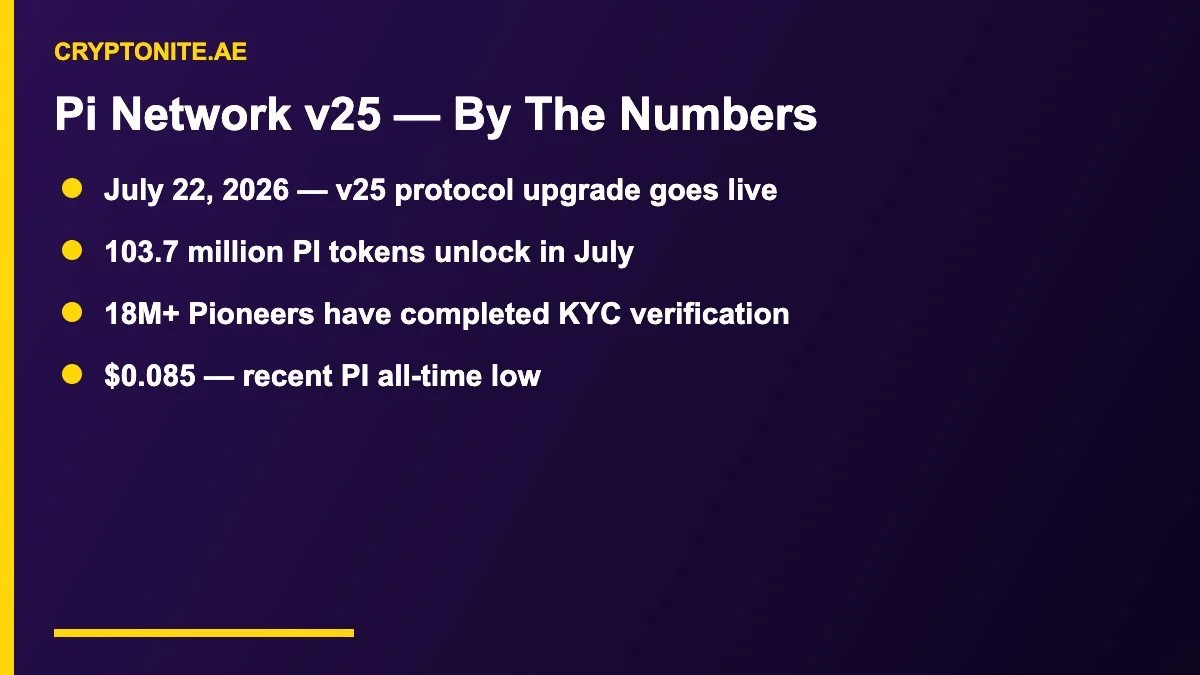
The Pi Network v25 upgrade is scheduled to go live on Wednesday, 22 July 2026, and it arrives at one of the most pivotal moments in the project’s history. The Pi Network v25 protocol release lands the same week that roughly 103.7 million PI tokens unlock and just days after the coin printed a fresh all-time low near $0.085, setting up a tug-of-war between genuine technical progress and heavy supply pressure. For a community that has spent years mining on mobile phones and waiting for utility, this is the upgrade that starts to answer the question of what Pi is actually for.
Below we break down exactly what the Pi Network v25 upgrade introduces, why the token-unlock schedule matters, where KYC and Mainnet migration now stand, and how the market is reacting. None of this is investment advice — it is a factual guide to a fast-moving story.
What the Pi Network v25 upgrade actually changes
At its core, the Pi Network v25 upgrade is an infrastructure release. The Pi Core Team has framed it as a step focused on network stability, reliability and — most importantly for developers — support for more efficient, privacy-preserving smart contracts. Where earlier protocol versions concentrated on getting Open Mainnet live and moving migrated balances on-chain, v25 is about making the chain a more capable platform for applications.
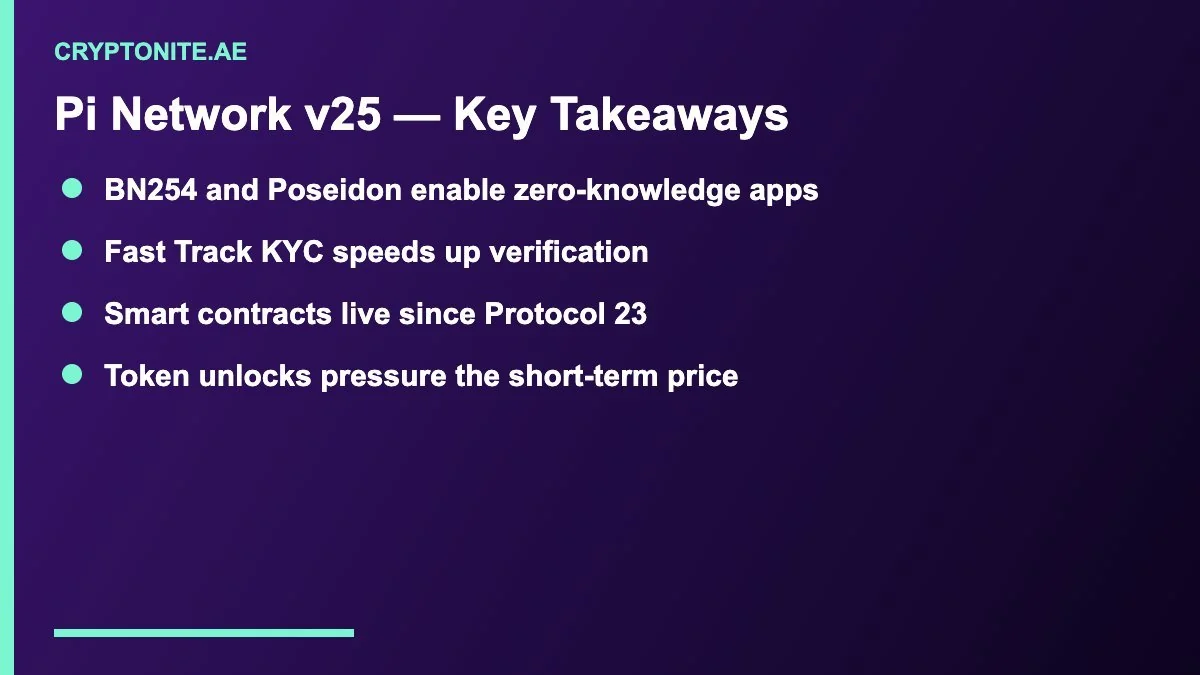
The headline technical additions are two cryptographic building blocks: BN254 elliptic-curve support and Poseidon hashing. Both are staples of modern zero-knowledge development. Together they let builders create applications that can prove a statement is true — that a user is verified, that a credential is valid, that a computation was performed correctly — without exposing the underlying data. In practical terms, that opens the door to privacy-preserving identity checks, verifiable credentials and other zero-knowledge use cases that sit well with Pi’s stated emphasis on real utility for everyday users.
The upgrade also coincides with a redesign of the Pi mining app menu, part of a broader push to make the ecosystem easier to navigate for the tens of millions of non-technical “Pioneers” who make up Pi’s user base.
BN254, Poseidon and why zero-knowledge matters for Pi
Zero-knowledge cryptography has become the default toolkit for blockchains that want privacy and scalability at the same time. BN254 is a pairing-friendly curve widely used in zk-SNARK systems, while Poseidon is a hash function designed specifically to be efficient inside zero-knowledge circuits. By baking these into the protocol, the Pi Network v25 upgrade gives third-party developers primitives they would otherwise have to bolt on awkwardly or not at all.
The most obvious application is identity. Pi has always leaned on Know Your Customer (KYC) verification to keep its network human rather than bot-driven. Zero-knowledge proofs could eventually let a Pioneer demonstrate that they are KYC-verified without handing over personal documents to every app they touch — a meaningful privacy improvement if it is implemented well. Lending protocols, decentralized exchanges and reputation systems could all build on the same foundation.
It is worth being measured here. Shipping the cryptographic primitives is not the same as shipping polished consumer apps that use them. The v25 release makes those apps possible; it does not guarantee they will arrive quickly or that they will attract users.
The 103 million token unlock hanging over Pi Network v25
The timing of the Pi Network v25 upgrade is inseparable from the project’s supply schedule. Roughly 103.7 million PI tokens are set to unlock in July 2026 — an increase of about 27 million on the prior month. Unlocks release previously locked supply into circulation, and when a large tranche hits a thin market, the result is often downward price pressure as some holders sell.
That dynamic helps explain why PI slid to an all-time low of about $0.0847 on 12 July 2026 before stabilising in the $0.09 range. The token now trades far below the highs it reached earlier in its life, and analysts broadly describe the medium-term outlook as cautious given the steady drumbeat of monthly unlocks. Technical optimism around the upgrade is real, but it is competing against a supply overhang that will not clear overnight.
For readers weighing the two forces, the honest framing is that the Pi Network v25 upgrade improves the long-term utility case while the unlock schedule pressures the short-term price. Those are different time horizons, and conflating them is how people talk themselves into bad decisions.
KYC, migration and the road to Open Mainnet
Pi’s transition from a closed system to a functioning network has been gradual. Open Mainnet is live, real PI transfers are active, and trading is available on selected supported platforms. Protocol 23, shipped in May 2026, activated smart contracts on Mainnet and made decentralized apps, DEX and lending protocols technically possible — the groundwork that v25 now extends.
On the identity side, the numbers are large. More than 18 million Pioneers have completed KYC verification, with a comparable number having migrated balances to Mainnet. To speed things up, the team introduced a Fast Track KYC flow and moved wallet-creation infrastructure in-house, replacing a third-party provider to smooth onboarding. Getting more verified users fully migrated is essential: locked, unmigrated balances are not yet part of the live economy, and a healthy ecosystem needs verified humans transacting, building and using apps.
Price action and market reaction
As of 21 July 2026, PI traded around $0.093, up modestly from its record low but down sharply over the year. Short-term sentiment has been described as cautiously constructive heading into the upgrade, driven by anticipation of v25, while the longer-term picture stays clouded by unlocks. Prediction ranges quoted by various outlets vary widely and should be treated as speculation rather than fact.
The more durable question is adoption. If the privacy-preserving tooling in the Pi Network v25 upgrade attracts developers who ship apps that real Pioneers use, the utility narrative strengthens regardless of week-to-week price swings. If it does not, another protocol version will struggle to change the story on its own.
The Pi Network ecosystem: apps, DEX and lending
An upgrade only matters if something is built on top of it, and here the picture is slowly filling in. Since Protocol 23 activated smart contracts on Mainnet in May 2026, the Pi ecosystem has had the technical ability to host decentralized applications, including exchanges and lending markets. The Pi Network v25 upgrade extends that foundation by giving developers the zero-knowledge primitives needed for more sophisticated, privacy-preserving apps rather than simple token transfers.
In practice, the earliest applications tend to be the obvious ones: a decentralized exchange where Pioneers can swap tokens, simple lending or staking mechanisms, and utility apps that plug into Pi’s identity layer. The Core Team has also promoted developer tooling, including app-building resources aimed at lowering the barrier for the community to ship products. The open question is whether these apps attract sustained usage or remain experiments — a challenge every young smart-contract platform faces, not just Pi.
What makes Pi unusual is the sheer size of its potential user base. Most new chains launch with a handful of power users and have to bootstrap demand; Pi starts with tens of millions of people who already have the app installed. If even a small fraction of them actively use on-chain apps, the network effects could be significant. Converting passive miners into active users is the central task of this phase.
How Pi Network v25 fits the mobile-mining story
To understand why the Pi Network v25 upgrade matters, it helps to remember what Pi set out to do. The project launched with a simple, controversial premise: let ordinary people “mine” a cryptocurrency from their phones without draining the battery, building a large, verified community first and worrying about utility second. That approach drew both an enormous following and persistent skepticism, with critics questioning whether the token would ever have real value or a functioning economy.
The multi-year march through KYC, migration, Open Mainnet and now smart contracts is Pi’s attempt to answer that skepticism with infrastructure. Each protocol version has moved the project a step further from “app-based points” toward “functioning blockchain.” Seen in that light, v25 is less a dramatic pivot than the latest installment in a deliberate, sometimes frustratingly slow, roadmap. The privacy-preserving tooling it introduces is squarely aimed at the identity-heavy use cases that fit Pi’s human-verified design.
None of this settles the debate about Pi’s long-term value, which will ultimately be decided by adoption and markets rather than announcements. But it does show a project methodically checking off the technical prerequisites for a real economy, which is more than many of its critics once expected.
Pioneer sentiment and community reaction
Community reaction to the upgrade has been a mix of enthusiasm and impatience. Long-time Pioneers, many of whom have mined for years, tend to greet each Pi Network v25 milestone as validation that the project is progressing. At the same time, the slide to new lows has tested patience, and some community members have voiced frustration that price has not reflected the technical progress they see.
That tension — genuine engineering progress on one hand, disappointing market performance on the other — is the defining mood around Pi in mid-2026. It is a reminder that community sentiment and token price can diverge sharply, and that neither is a reliable proxy for the other. For observers, the healthier signal to watch is on-chain activity: verified users transacting and using apps, rather than social-media enthusiasm alone.
Key dates to watch after the Pi Network v25 upgrade
Several markers will indicate whether the Pi Network v25 upgrade translates into momentum. The immediate one is the upgrade itself on 22 July and the stability of the network in the days that follow — infrastructure releases are judged partly on whether they ship cleanly. Beyond that, the pace of the monthly token unlocks will continue to shape the supply picture, and Pioneers will watch how much of the newly unlocked supply is absorbed versus sold.
On the development side, the arrival of applications that actually use the new zero-knowledge capabilities will be the clearest sign that the upgrade is delivering. Exchange support and liquidity are worth monitoring too, since deeper markets make the token more usable. Finally, continued progress on migrating the remaining verified Pioneers into the live economy will determine how large Pi’s functioning user base ultimately becomes.
For now, the Pi Network v25 upgrade is a meaningful technical step whose real-world impact will only become visible over the following months. Patience, and a focus on usage rather than headlines, remains the sensible lens.
Pi Network v25 and the road to a real Pi economy
Step back from the day-to-day price noise and the Pi Network v25 upgrade fits a longer arc: the transformation of Pi from a mobile mining experiment into a functioning digital economy. Every credible blockchain economy rests on a few pillars — verified users, a working ledger, programmable smart contracts, and applications people actually want to use. The Pi Network v25 upgrade strengthens the third pillar and lays groundwork for the fourth, which is why the Core Team has framed it as foundational rather than flashy.
The zero-knowledge capabilities introduced in the Pi Network v25 upgrade are particularly well suited to Pi’s identity-first design. Because the network has invested so heavily in verifying that its users are real humans, tools that let those users prove things about themselves without oversharing data are a natural fit. Imagine a lending app that needs to know a borrower is KYC-verified but does not need their passport, or a governance system that confirms one-person-one-vote without exposing identities. These are exactly the use cases the Pi Network v25 upgrade is designed to enable.
For developers, the calculus is straightforward. A platform with tens of millions of verified, engaged users is a rare distribution opportunity, and the Pi Network v25 upgrade lowers the technical barriers to building for them. The teams that ship useful, privacy-respecting applications early could capture outsized attention within the ecosystem. The risk, as always, is that building compelling products is far harder than shipping infrastructure, and adoption is never guaranteed by capability alone.
For the wider market, the Pi Network v25 upgrade is a data point in a broader trend: mainstream, mobile-first crypto projects maturing into real networks with real tooling. Whether Pi ultimately succeeds will depend on execution over the coming quarters, not on any single release. But the direction is unmistakable, and the Pi Network v25 upgrade is a concrete step along that path rather than a promise of one. As with everything in this space, readers should follow the on-chain data, weigh the supply dynamics honestly, and treat commentary as information rather than investment advice.
How the Pi Network v25 upgrade compares to other Layer-1 milestones
It is worth placing the Pi Network v25 upgrade in the broader context of how blockchains mature. Across the industry, the projects that have endured tend to follow a similar sequence: launch a network, attract users, add smart contracts, and then layer in advanced cryptography such as zero-knowledge proofs to unlock privacy and scale. Ethereum spent years moving from a basic smart-contract platform toward a rollup-centric, zero-knowledge-friendly architecture; other Layer-1 networks have raced to add the same primitives. In adopting BN254 and Poseidon, Pi is following a well-trodden technical path rather than inventing a new one.
What differs is the starting point. Most networks build cryptographic sophistication before they have meaningful users, then struggle to attract them. Pi has inverted that order, assembling an enormous verified community first and adding capability afterward. That sequence is unusual and carries both promise and peril: the promise of instant distribution if apps land, and the peril of disappointing a huge audience if they do not. The Pi Network v25 upgrade is the moment those two threads — users and capability — begin to meet.
Comparisons also highlight what still separates Pi from established smart-contract ecosystems. Networks like Ethereum and Solana have deep developer tooling, mature DeFi protocols, and billions in on-chain value securing their systems. Pi is early on all of those measures. The Pi Network v25 upgrade narrows the technical gap, but the ecosystem gap — the sheer density of builders, liquidity and battle-tested applications — takes years to close. Judging Pi against that yardstick keeps expectations realistic.
The most useful takeaway from the comparison is directional. The Pi Network v25 upgrade shows a project doing the unglamorous work of building real infrastructure, in the same order and with the same tools as the networks that came before it. Whether it converts that infrastructure into a thriving economy is the multi-year question that no single upgrade can answer. For observers in the UAE and globally, Pi remains a case study worth watching precisely because its scale is unmatched and its outcome is still genuinely open.
What it means
The Pi Network v25 upgrade is best read as a platform milestone rather than a price catalyst. It equips the chain with modern zero-knowledge primitives, improves stability and continues a methodical march toward a usable Mainnet — all genuine positives for a project long criticised for thin utility. At the same time, the July token unlock is a reminder that supply mechanics still dominate Pi’s short-term market, and no upgrade changes that arithmetic instantly.
For institutions and observers in the UAE and beyond, Pi remains a fascinating case study in mobilising an enormous retail base, even as it works to convert attention into on-chain activity. The technology is moving in the right direction; the economics and adoption still have to catch up. As always, treat price commentary as commentary — not advice — and verify the latest figures before acting.
Related on Cryptonite: our Pi Network July 2026 updates recap and Pi mainnet launch coverage.
Sources: Pi Network official blog, crypto.news, CoinDCX.
More trending on Cryptonite: Solana tokenized stocks overtake memecoins · Crypto ETF rotation into XRP and Solana · CLARITY Act stalls near 40% odds.
When does the Pi Network v25 upgrade go live?
The Pi Network v25 protocol upgrade is scheduled for Wednesday, 22 July 2026, focusing on network stability and privacy-preserving smart contracts via BN254 and Poseidon cryptography.
How many PI tokens unlock in July 2026?
Roughly 103.7 million PI tokens unlock in July 2026, about 27 million more than the previous month, adding supply pressure that coincided with PI hitting an all-time low near $0.085.

2 thoughts on “Pi Network v25 Upgrade Goes Live July 22 as 103 Million Tokens Unlock”