What Is RWA Tokenization? – Real-World Asset (RWA) tokenization is the process of converting ownership rights of high-value physical or financial assets—such as U.S. Treasury bills, real estate, gold, and private equity—into digital tokens on a public blockchain.
As of mid-2026, the RWA market (excluding fiat stablecoins) has exploded by over 930% in just three years, soaring past $33 billion in total on-chain value. This is no longer an experimental sandbox; it is the fundamental re-architecture of global capital markets. Financial titans like BlackRock, JPMorgan Chase, and Franklin Templeton are actively moving billions of dollars on-chain to achieve instant settlement, 24/7 liquidity, and unmatched capital efficiency.
What began as a niche play to generate yield on idle stablecoins has matured into a multi-sector institutional gold rush. The market has split into distinct asset classes, each crossing critical billion-dollar milestones:
Asset Class
Tokenized Value (Mid-2026)
Key Industry Leaders
Primary Blockchain Rails
U.S. Treasuries & MMFs
$13.4B+
BlackRock (BUIDL), Ondo Finance (USDY), Franklin Templeton
Ethereum, Solana, Stellar, BNB Chain
Commodities (Precious Metals)
$7.3B
Paxos (PAXG), HSBC, Tether (XAUt)
Ethereum, Gold-backed networks
Tokenized Equities (Stocks)
$1.0B+
Ondo Global Markets, xStocks
Ethereum, Arbitrum, Solana
Private Credit & Real Estate
$11.3B+
Centrifuge, Maple Finance, Figure
Base, Ethereum, Avalanche
The Macro Reality: In Q1 2026, the SEC, CFTC, and global bodies updated regulatory taxonomies, standardizing legal wrappers for on-chain securities. Meanwhile, exchanges like the NYSE and Nasdaq are testing their own 24/7 tokenized security infrastructure.
How RWA Tokenization Works: The On-Chain Lifecycle
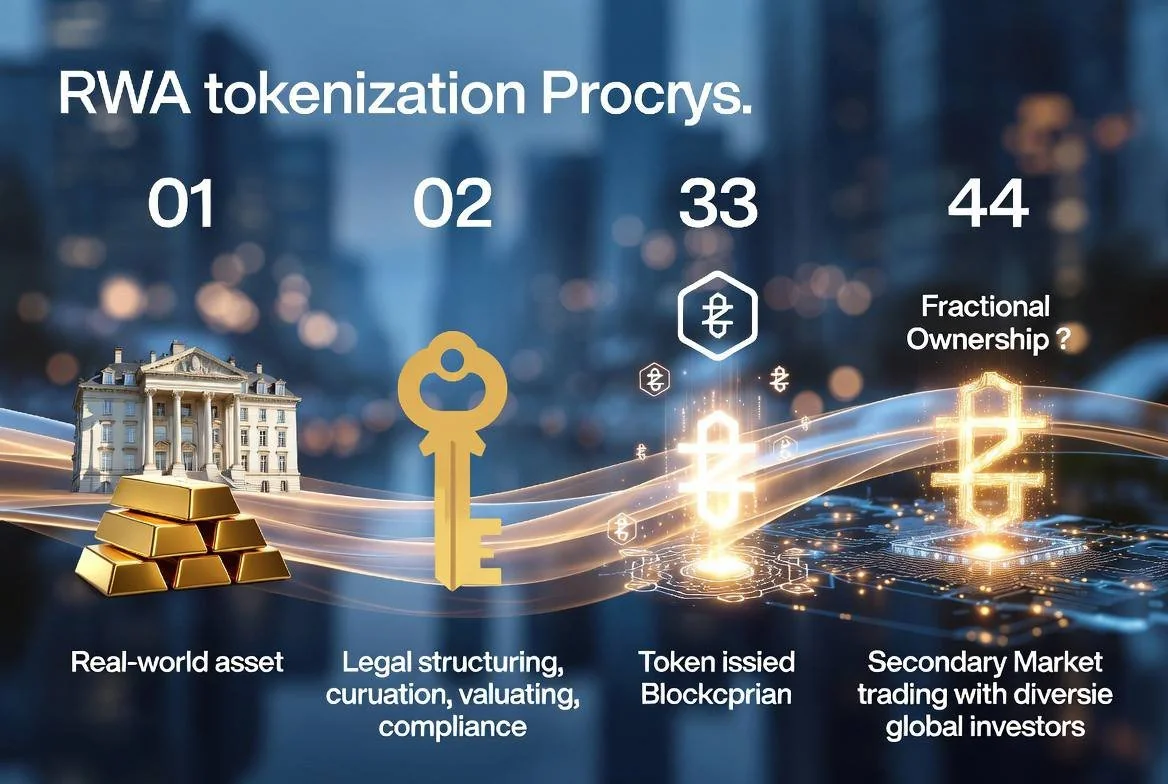
Tokenizing an asset requires bridging the physical, legal, and cryptographic worlds. This occurs in three distinct phases:
+-----------------------------------------------------------------+
|                       1. OFF-CHAIN ACQUISITION                  |
|  An institution purchases U.S. Treasuries, gold, or real estate |
|  and secures them in an off-chain custody vault (e.g., custodian)|
+-----------------------------------------------------------------+
                                │
                                ▼
+-----------------------------------------------------------------+
|                      2. ON-CHAIN TOKENIZATION                   |
|  An issuance platform mints a smart contract-enabled token      |
|  (e.g., ERC-20 or SPL Token-2022) representing ownership  |
+-----------------------------------------------------------------+
                                │
                                ▼
+-----------------------------------------------------------------+
|                      3. MULTI-CHAIN COMPOSTABILITY              |
|  The token goes live, distributed to verified, KYC-screened      |
|  investors and integrated into lending or collateral protocols |
+-----------------------------------------------------------------+
Off-Chain Origination: The asset must exist, be legally verified, and be safely custodied. For example, BlackRock’s BUIDL represents shares in a fund backed by short-term U.S. Treasuries held by BNY Mellon.
Regulatory & Smart Contract Wrapping: Developers code transfer restrictions, Know-Your-Customer (KYC) requirements, and dividend structures directly into the token’s smart contract code.
Distribution and Composability: The asset is minted on public blockchains. Once on-chain, these tokens are highly productive: they can be used as borrowing collateral on platforms like Aave, integrated into treasury operations, or swapped instantly.
Interactive Diagnostic: Is Your Business Ready for RWAs?
Evaluate your business’s alignment with the tokenized asset landscape using this interactive checklist:
[ ] Idle Capital Overhead: Does your treasury department hold idle stablecoins or cash that could be generating yield via on-chain U.S. Treasuries?
[ ] Intermediary Drag: Are your transaction settlement windows (T+2 or T+1) creating friction or lock-up periods in your supply chain or asset management operations?
[ ] Global Liquidity Reach: Could your underlying assets benefit from fractionalization to invite global, accredited, or retail-level participation?
[ ] Regulatory Compliance Readiness: Is your team equipped to handle on-chain KYC/AML verification, transfer hooks, and whitelisting controls?
If you checked 2 or more boxes, integrating an RWA strategy is an immediate operational imperative to remain competitive as the financial landscape shifts.
Why TradFi is Embracing Tokenization
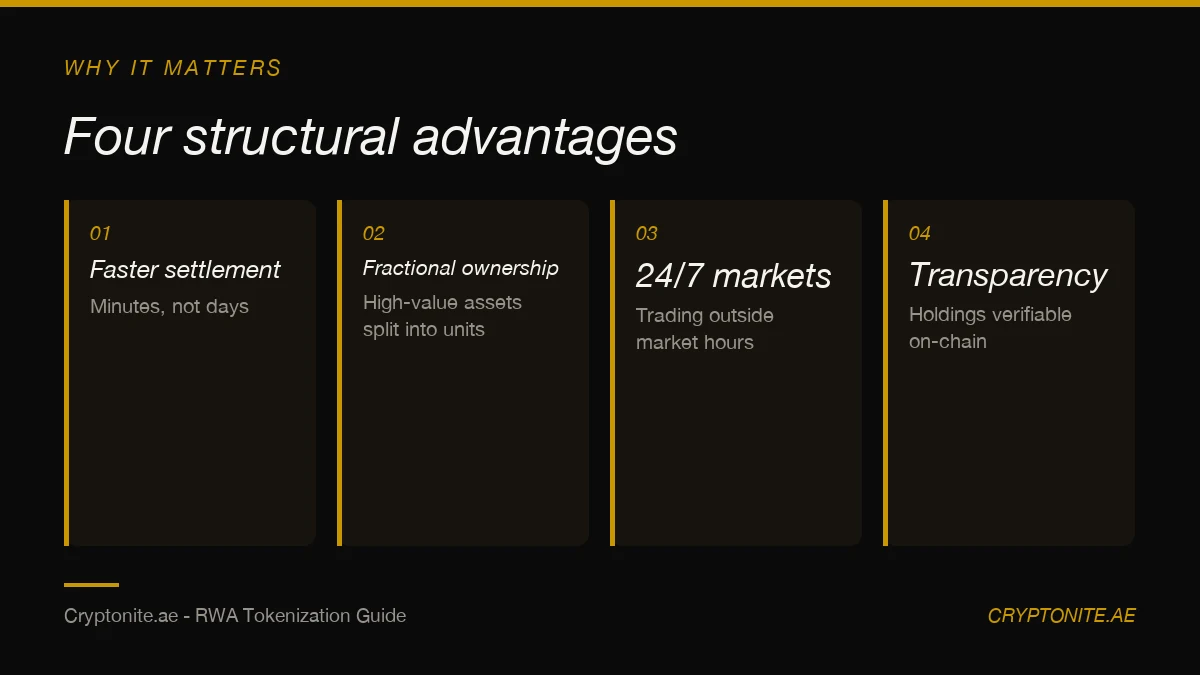
Historically, financial markets operate on rigid schedules—closing at 4:00 PM and resting over weekends. Tokenization rewires this entirely:
24/7 Global Trading: Blockchain networks never sleep, permitting immediate, borderless capital rotation at 2:00 AM on a Sunday.
Fractionalization: Multi-million dollar assets (like prime commercial real estate or early-stage IPO stocks) can be sliced into fractional tokens, allowing smaller, qualified participants to buy in.
Irreversible Transparency: Blockchain ledgers eliminate settlement reconciliation discrepancies between counterparties. Every transfer is auditable, public, and secure.
The Challenges: Regulatory Bottlenecks & Smart Contract Risk
While the growth curve is vertical, RWA issuers must continuously navigate structural challenges:
Cross-Jurisdictional Compliance: A tokenized security must adhere to local financial regulations not only in its country of issuance but in every country where its investors reside.
Cross-Chain Vulnerabilities: As tokenized funds expand to multiple networks, securing cross-chain bridge logic and keeping strict inventory audits remains a monumental operational hurdle.
About the Author
Sarah Fathima Ahmed
Co-Founder of Cryptonite.ae
Sarah Fathima Ahmed is an institutional Web3 strategist and the co-founder of Cryptonite.ae, the Middle East’s premier digital media and intelligence platform tracking emerging regulatory frameworks and institutional digital asset flows. With deep expertise in blockchain compliance, sovereign tokenization initiatives, and market microstructures, Sarah bridges the gap between traditional corporate finance and decentralized protocols.
Get MENA regulation moves, RWA deals and AI-money trends in one weekly brief — plus instant alerts when the MENA Regulation Tracker changes. Free, no spam.
Vaibhavv Ali is the founder and editor of Cryptonite (cryptonite.ae), an independent digital-asset news and analysis publication with a UAE focus. He covers virtual-asset regulation — VARA, ADGM and the UAE Central Bank — alongside real-world-asset tokenization, stablecoins and agentic AI in finance. Every Cryptonite article is human-edited and its sources are linked. He is also a celebrated speaker and host.



13 thoughts on “What Is RWA Tokenization? The Ultimate Guide to On-Chain Finance (2026)”