Key Takeaways
- AI agents DeFi trading is not illegal. No regulator has banned software from signing a swap. What regulators police is the relationship around the software, not the software itself.
- Four conditions turn a bot into a regulated adviser under the Investment Advisers Act: discretionary authority, compensation, holding out as an adviser, and a securities focus.
- The asset class picks the regulator. Securities pull you toward the SEC; futures, swaps and leveraged retail crypto pull you toward the CFTC under the Commodity Exchange Act.
- In the UAE the question is framed differently. VARA licenses the activity of managing virtual assets for others; whether a human or a model makes the call does not change the licensing category.
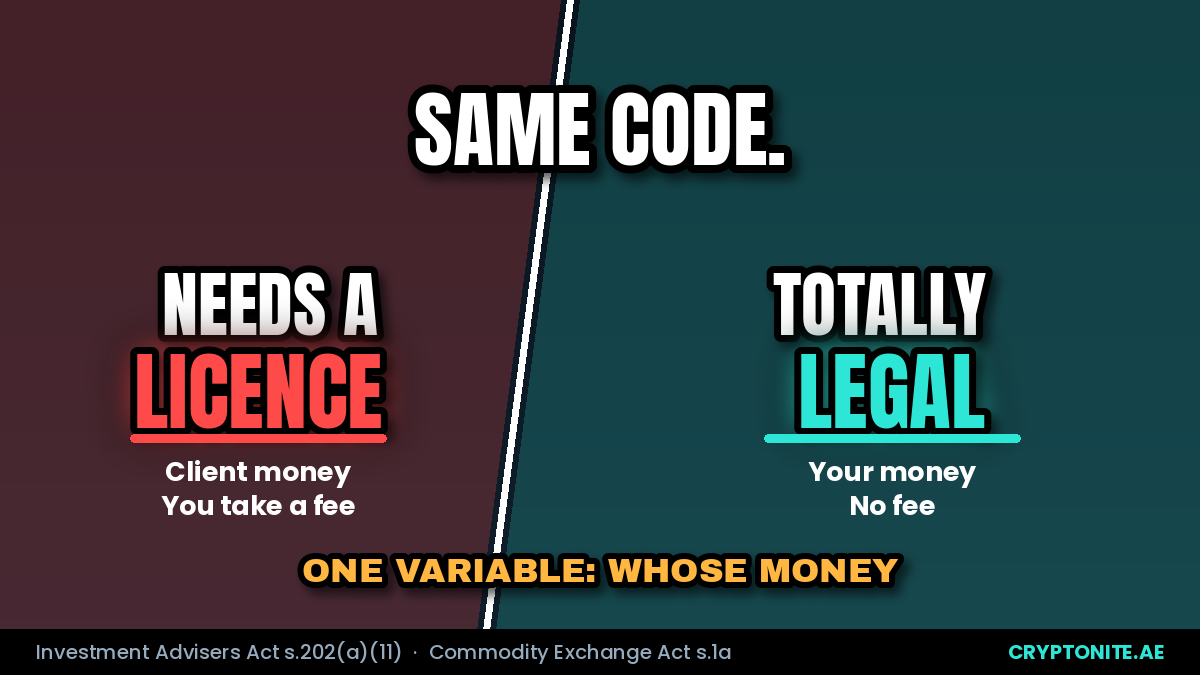
- Identical code ships two ways. Self-hosted, your own funds, no fee: an unregulated tool. Same repo run for clients at 20% of profit: a regulated business.
Can AI agents trade DeFi autonomously, and is it legal? Yes, and usually yes. AI agents DeFi trading is technically working today and lawful in most jurisdictions. It stops being lawful the moment four things line up at once: the agent has discretion over someone else’s money, you are paid for it, you market it as advice, and the assets are securities.
Can AI agents trade DeFi autonomously today?
Mechanically, yes. An agent needs three things to trade on-chain without a human: a key it can sign with, a way to read state, and a route to a venue. All three exist. Account abstraction under ERC-4337 lets a smart account delegate a scoped session key to software, and ERC-7715’s wallet_grantPermissions gives a wallet a standard way to hand an agent a permission object rather than a private key. We covered that plumbing in detail in our piece on whether an AI agent can legally own a crypto wallet.
What does not exist is a good track record. AI agents DeFi trading fails in ways that have nothing to do with the legal question and everything to do with market microstructure. A model that reasons in seconds is slow against a searcher that reasons in milliseconds. Slippage tolerance set by a language model is a gift to sandwich attacks. Oracle latency means the price the agent reasoned about is not the price it trades at. And an agent that constructs calldata from a natural-language plan can produce a transaction that is syntactically valid and economically ruinous.
So the honest framing is this: the constraint on AI agents DeFi trading in 2026 is competence and risk control, not permission. The legal perimeter only starts to bite when the agent stops trading its owner’s money.
What does a trending token actually look like to an agent?
Abstract risk arguments are easy to nod along to, so here is a live one. UNI, the governance token of the largest decentralised exchange, is the most instructive chart on the board this week for anyone thinking about AI agents DeFi trading.
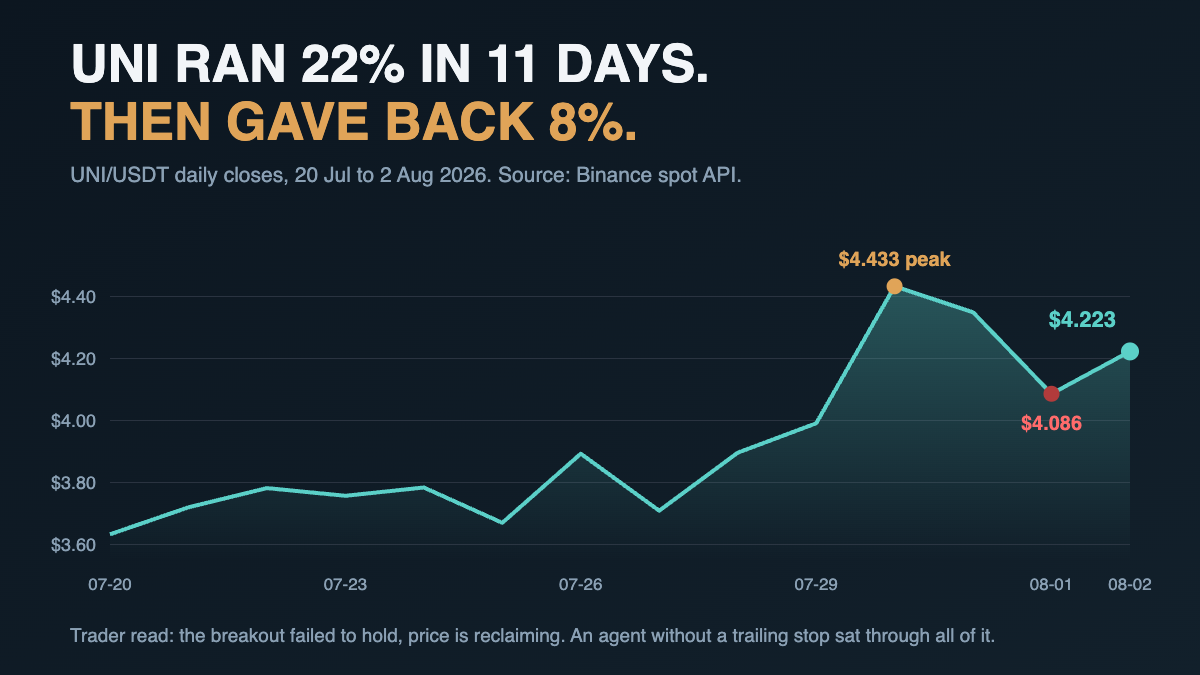
Read it the way a trader would, because this is the tape any AI agents DeFi trading strategy had to survive last week. The first week is chop: eight sessions oscillating between roughly $3.67 and $3.89, no trend, the kind of tape that grinds down anything trading breakouts. Then two impulse candles — 29 and 30 July — take the close from $3.99 to $4.433. That is the whole move. From the 20 July close of $3.633, the token is up 22% in eleven sessions, and almost all of that came in forty-eight hours.
Then the part that matters for AI agents DeFi trading. The breakout did not hold. Three sessions later price was back at $4.086, giving back 7.8% from the peak, before reclaiming to $4.223 on 2 August. Anyone who bought the 30 July close is still underwater. Anyone who bought the chop and trailed a stop is not.
Now put an agent on it. A momentum agent reading daily closes buys strength on 30 July, at the exact worst price of the run, then sits through the whole drawdown because nothing in its instructions says what a failed breakout looks like. A mean-reversion agent shorts the same candle and gets stopped on the 2 August reclaim. Neither outcome is a model failure. Both are the absence of position management — trailing stops, regime detection, a maximum drawdown that halts trading. The model picks the direction; the risk framework decides whether you survive being wrong, and most AI agents DeFi trading stacks ship a great deal of the former and almost none of the latter.
Here is where the legal frame reconnects. Take that same 7.8% drawdown and change one variable — whose money. On your own capital it is a bad week and nobody else has standing to care. On client capital, for a 20% performance fee, that identical sequence is now a fiduciary conversation about whether the strategy was suitable, whether the risk was disclosed, and whether an unsupervised model constitutes reasonable care. The chart did not change. The relationship did.
Prices above are historical closes, stated for illustration. Nothing here is a view on where UNI goes next.
What makes AI agents DeFi trading a regulated activity?
Read section 202(a)(11) of the Investment Advisers Act and you will notice something. It contains no exemption for software, no carve-out for models, and no mention of automation. It describes a relationship. That is the whole point, and it is why AI agents DeFi trading keeps producing confused commentary — people look for an AI rule and find none, then conclude they are outside the perimeter.
Four conditions matter, and they matter together.
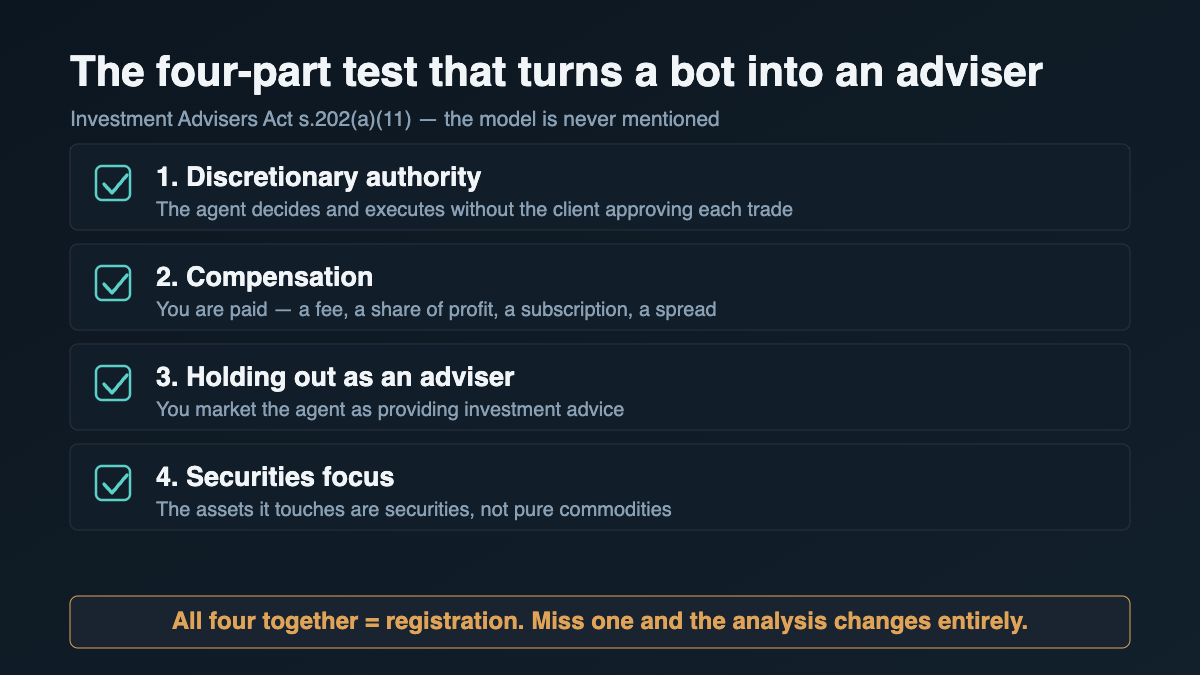
Discretionary authority is the first. If the agent decides and executes without the client approving each trade, it holds discretion. A tool that surfaces a suggestion and waits for a human to press the button does not.
Compensation is the second, and it is broader than people expect. A performance fee obviously counts. So does a flat subscription, a management fee, and in many readings a spread you take on the execution. Running the same agent for free, for yourself, does not.
Holding out is the third. Marketing matters. A landing page promising “AI-managed yield” is doing something a GitHub repository titled “defi-bot” is not.
Securities focus is the fourth. If the agent’s universe is tokens that are not securities, the Advisers Act analysis weakens — but you have not escaped, you have simply walked into the next regulator’s building.
The formulation used by practitioners is blunt: without discretion and compensation, an agent remains an unregulated tool. That single sentence explains most of the confusion around AI agents DeFi trading.
Which regulator claims AI agents DeFi trading: the SEC or the CFTC?
Both, depending on what the agent touches. AI agents DeFi trading does not map cleanly onto one agency. The Commodity Exchange Act reaches commodity interests, futures, swaps and leveraged retail commodity transactions. Add discretion and compensation on top of those instruments and you are looking at registration as a commodity trading advisor, a commodity pool operator, or a futures commission merchant, rather than as an investment adviser.
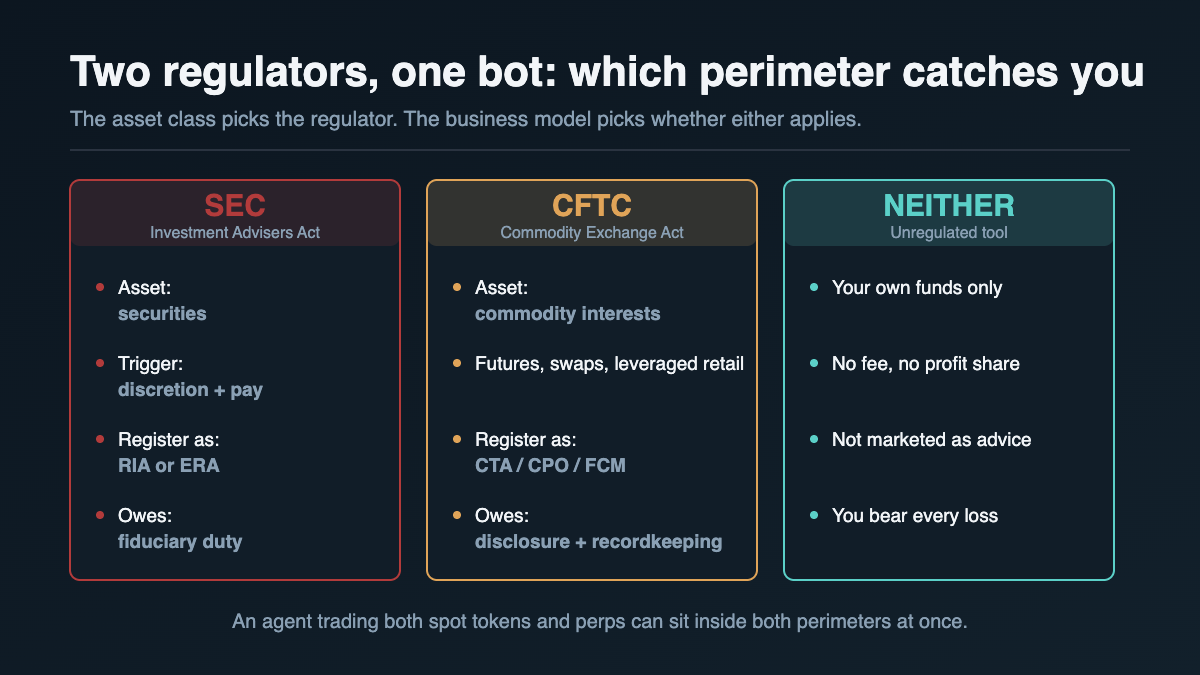
This is where AI agents DeFi trading gets genuinely awkward, because a single agent rarely stays in one lane. An agent that farms a stablecoin pool in the morning and opens a 5x perpetual in the afternoon has touched both perimeters in one session. There is no netting. You do not get to average the two and land somewhere comfortable in the middle.
Worth saying plainly: whether a given token is a security remains contested, and no article should pretend otherwise. What is not contested is the structure of the test. If you are trading someone else’s money for a fee, you need to know which box each instrument falls into before you deploy, not after.
Is AI agents DeFi trading legal in the UAE?
The UAE frames AI agents DeFi trading as an activity question rather than a technology question, which is arguably the cleaner approach. Dubai’s Virtual Assets Regulatory Authority licenses defined virtual asset activities, and managing virtual assets on behalf of others is one of them. Nothing in that framework asks whether the decision-maker is a portfolio manager or a model. If you are running discretionary strategies for third parties from Dubai, the licence question arrives regardless of how the trade was chosen.
Layered on top: the Securities and Commodities Authority at federal level, the DFSA in the DIFC, and the FSRA in ADGM each run their own regimes, and DIFC Data Protection Regulation 10 has imposed obligations on autonomous decision-making systems since September 2023. We mapped the full stack in agentic AI UAE regulation: what actually applies today.
What nobody can tell you yet is how any of these supervisors will treat a specific agent architecture in an enforcement setting. There is no meaningful public body of decisions on autonomous trading agents in the UAE. Anyone claiming certainty here is guessing.
What actually breaks when an agent trades unsupervised?
AI agents DeFi trading breaks in three recognisable ways, in rough order of how often they show up.
Excessive agency. OWASP catalogues this as LLM06:2025: the agent has more permission than the task requires. A trading agent granted unlimited ERC-20 approval to a router can be drained by a single bad instruction, and the approval was the vulnerability, not the model.
Prompt injection through market data. OWASP LLM01:2025. On-chain data is attacker-writable. Token names, NFT metadata, memo fields and contract event strings are all inputs an agent may read and none of them are trustworthy. We documented a real case, catalogued by the OECD, in what happens when an AI agent gets hacked.
No reversal. A card payment has a chargeback. A DeFi swap has nothing. When AI agents DeFi trading goes wrong, the loss is final and the question immediately becomes who carries it — a question we took apart in how agentic wallets use spend limits and session keys.
How do you keep AI agents DeFi trading on the right side of the line?
Running AI agents DeFi trading responsibly is two separate jobs: staying outside the perimeter if that is the plan, and not losing the money either way.
- Decide the business model before the architecture. Whether you take a fee, and whose funds you touch, determines your obligations more than any technical choice you make afterwards.
- Ship non-custodial by default. If the user’s keys never leave the user’s smart account and the agent only holds a scoped session key, you have removed the custody question from the table.
- Cap everything. Per-transaction limits, daily limits, an allowlist of contracts the session key may call, and an expiry. An uncapped approval is the single most common unforced error in AI agents DeFi trading.
- Simulate before signing. Every transaction should be dry-run against forked state and rejected on unexpected balance deltas. This catches both model error and injected instructions.
- Keep a human gate above a threshold. Below it, autonomy. Above it, a signature. This is also the cleanest way to argue the agent lacks full discretion.
- Log the reasoning, not just the transaction. If a supervisor or a client ever asks why a position was opened, a transaction hash is not an answer.
Three ways to ship the same trading agent
| Setup | Whose funds | Paid? | Likely status | What you must do |
|---|---|---|---|---|
| Self-hosted, personal | Yours | No | Unregulated tool | Nothing beyond tax reporting |
| Software licensed to users | Theirs, non-custodial | Subscription | Grey — depends on discretion and marketing | Avoid holding out as advice; keep the human gate |
| Managed accounts | Theirs | Fee or profit share | Regulated adviser or CTA | Register, disclose, keep records, accept fiduciary duty |
Quiz: would your agent need a licence?
Five questions. Reasoning appears when you submit.
Why This Matters
Most coverage of AI agents DeFi trading argues about capability — can a model really outperform, is this a bubble, how soon. That argument is unresolvable and, for anyone actually building, secondary. The decision that determines your legal exposure is made on a business-model whiteboard, not in a repository.
That is a useful thing to know early, because it is cheap to change at the start and expensive to change once you have users. Taking a performance fee is a one-line pricing decision that can convert an unregulated tool into a regulated adviser overnight, with fiduciary duties, disclosure obligations and recordkeeping attached. The code does not need to change at all.
For the UAE specifically, the activity-based framing means builders here get a clearer answer than most: ask what activity you are performing, not what technology performs it. That clarity cuts both ways. It also means you cannot argue your way out of a licensing category by pointing at the autonomy of your stack.
Frequently Asked Questions
Is AI agents DeFi trading illegal anywhere?
AI agents DeFi trading is not banned anywhere as a category. What is restricted is performing regulated activities without authorisation — managing others’ assets, advising for compensation, or dealing in regulated instruments. The agent is incidental to all three.
Do I need a licence to run a trading bot on my own money?
Almost certainly not. AI agents DeFi trading with your own funds is not a regulated activity, whether you do it manually, with a script, or with an agent. Tax reporting still applies.
Does charging a subscription instead of a performance fee avoid the rules?
No. Compensation under the Advisers Act is not limited to performance fees. A flat subscription is compensation. What matters more is whether you also hold discretion and hold yourself out as providing investment advice.
Can an AI agent be held liable for a bad trade?
No. Software has no legal personality, so liability lands on a person or a company — the operator, the developer, or the client, depending on the contract. Nothing about AI agents DeFi trading changes that basic allocation.
What is the single biggest technical risk?
Over-permissioning is the recurring theme in AI agents DeFi trading failures. An unlimited token approval or an unscoped key means one bad instruction can drain everything. Caps, allowlists and expiries limit the damage regardless of how the agent was fooled.
This article is information, not investment or legal advice. Cryptonite does not recommend any strategy, protocol or token. Regulatory positions described here are general and change; take advice on your specific facts before deploying capital.
Written by Vaibhav Ali, Editor at Cryptonite, covering crypto, Web3, stablecoins, RWAs and agentic AI from the UAE.
Related: Do AI agents actually need stablecoins? — why the volatility argument is the weakest one, and what UAE rules actually allow.