
The Circle national trust bank has become a reality after the Office of the Comptroller of the Currency granted final approval on 10 July 2026, marking one of the most significant regulatory milestones in the history of stablecoins. With the Circle national trust bank now chartered, USDC — one of the world’s largest dollar stablecoins — gains a path to federally regulated custody, aligning its infrastructure with the fiduciary standards long applied to traditional trust banks. For institutions that have watched stablecoins from the sidelines, it is exactly the kind of oversight they have been waiting for.
This article explains what Circle secured, how a national trust bank works, why the approval matters for USDC and the wider market, and what it signals for stablecoin adoption in the United States, the UAE and beyond. It is factual analysis rather than investment advice.
What the Circle national trust bank approval means
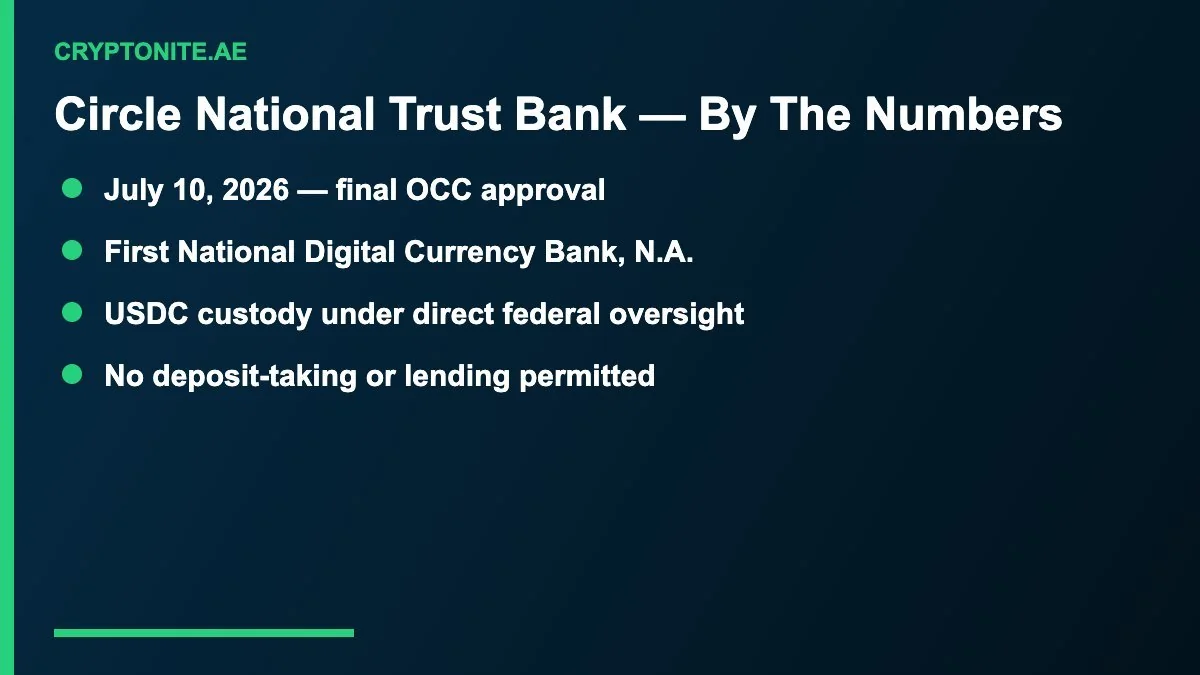
The approval allows Circle to establish a federally chartered entity, formally named First National Digital Currency Bank, N.A. and referred to as Circle National Trust. Crucially, this places the entity under the direct supervision of the OCC, the primary federal regulator for national banks and national trust banks. Rather than relying on a patchwork of state licences, the Circle national trust bank operates within a single, nationally recognised framework — a structural upgrade that carries weight with cautious institutional counterparties.
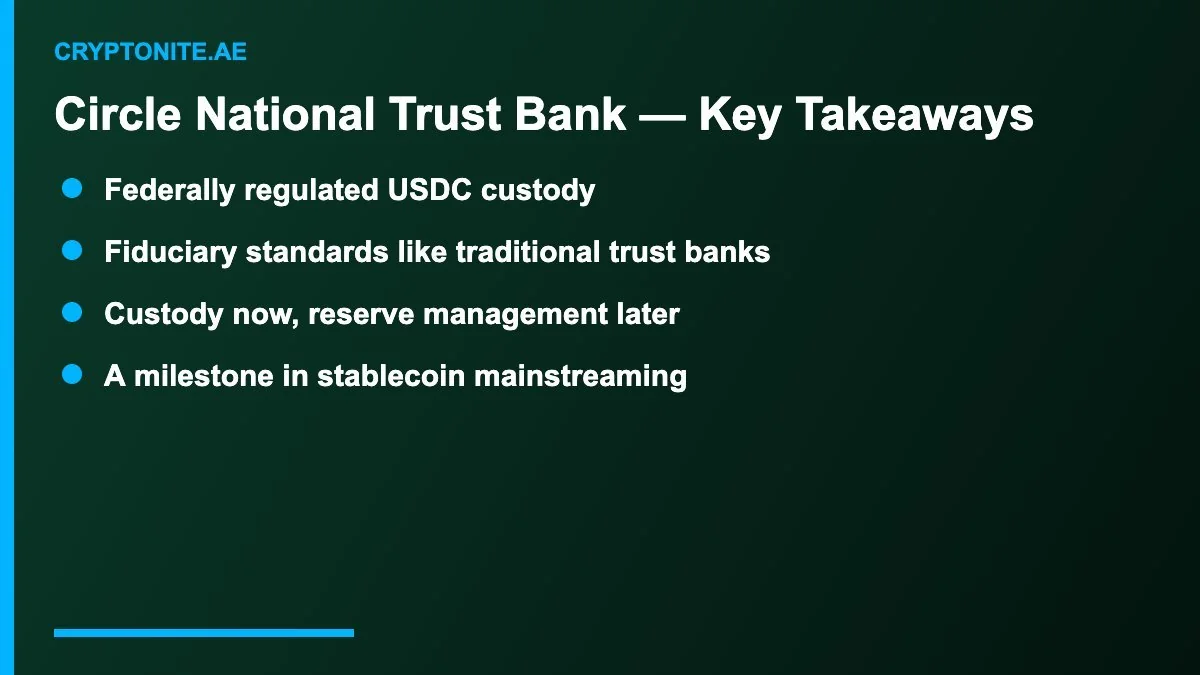
The core function of the new entity is custody. Circle National Trust is designed to provide fiduciary digital-asset custody services, initially for Circle and its affiliates, with the potential to expand to select institutional clients such as banks and other regulated financial firms. Over time, the charter also contemplates reserve-management capabilities for USDC, though that is described as a future step rather than an immediate one.
What a national trust bank can and cannot do
It is important to be precise about the scope of the charter, because a national trust bank is not the same as a full commercial bank. The Circle national trust bank is not permitted to take deposits in the ordinary sense, nor to make loans. Its remit is fiduciary: safekeeping assets, providing custody and administering them under strict standards of care. That narrower mandate is deliberate, and it is precisely what makes the charter suitable for a stablecoin issuer whose priority is trust and safety rather than lending.
This distinction matters for how observers should interpret the news. The Circle national trust bank does not turn Circle into a lender or a deposit-taking institution; it turns Circle into a federally supervised custodian. For a business whose product is a dollar-backed token, being held to the fiduciary standards of a trust bank is a feature, not a limitation, because it directly addresses the safety questions that institutions ask first.
The road to approval: a two-year journey
The final approval did not arrive overnight. Circle first applied to the OCC on 30 June 2025, received conditional approval in December 2025, and then worked through the remaining requirements before securing the final green light in July 2026. That deliberate, multi-stage process is characteristic of federal bank chartering, where regulators scrutinise governance, risk management and operational readiness before granting a licence.
The timeline is itself a signal. A two-year, methodical path to a national charter suggests both that Circle was willing to submit to serious regulatory scrutiny and that the OCC was prepared to bring a stablecoin-focused entity inside the federal perimeter. For a sector often criticised for operating in regulatory grey zones, the Circle national trust bank represents a deliberate move in the opposite direction — toward, not away from, supervision.
Why federally regulated custody matters
To understand the significance, it helps to remember what has historically made institutions nervous about stablecoins: the question of what actually backs the token and who is responsible for safeguarding it. Federally regulated custody speaks directly to that concern. When the entity holding and administering assets is supervised by the OCC and held to fiduciary standards, the counterparty risk that treasury teams and compliance officers worry about is materially reduced.
This is the essence of why the Circle national trust bank is more than a corporate formality. Custody is the unglamorous but foundational layer of financial infrastructure, and bringing it under a national charter closes a gap that has kept some large institutions cautious. In a market where trust is the entire product, a federally supervised custodian is a powerful credential.
What it means for USDC holders
For everyday USDC holders, the immediate mechanics of using the stablecoin do not change overnight. USDC continues to function as it did before. What changes is the institutional foundation beneath it. Over time, the Circle national trust bank is intended to strengthen how USDC’s custody — and eventually its reserves — are managed, embedding the token more deeply within the regulated financial system.
The longer-term implication is credibility. A stablecoin whose infrastructure is anchored by a federally chartered trust bank is easier for banks, asset managers and payment companies to integrate, because it fits their compliance frameworks. For USDC, the Circle national trust bank is a step toward becoming plumbing that regulated finance can rely on rather than a crypto-native instrument institutions approach with caution.
How Circle compares to other crypto trust banks
Circle is not the first crypto-focused firm to pursue a national trust charter, but the move places it among a small, select group of digital-asset companies operating inside the federal banking perimeter. Other firms have secured trust charters or pursued similar structures to offer regulated custody, and the trend points to a maturing industry that increasingly seeks legitimacy through supervision rather than avoiding it.
What differentiates the Circle national trust bank is its tie to one of the largest dollar stablecoins in circulation. Because USDC is used widely across exchanges, DeFi protocols and payment applications, anchoring its custody to a federal charter has ripple effects across the entire ecosystem that depends on the token. The scale of USDC gives this particular charter outsized systemic importance.
The stablecoin regulatory backdrop
The approval also fits a broader shift in how the United States treats stablecoins. Policymakers have moved steadily toward bringing dollar-pegged tokens into a clearer regulatory framework, recognising both their rapid growth and their potential role in payments. The Circle national trust bank is a concrete example of that direction of travel: a major issuer voluntarily stepping into federal supervision as the rules of the road become clearer.
For the market, this backdrop reduces a long-standing source of uncertainty. When issuers, custodians and regulators are aligned around a supervised framework, the systemic risks that critics have highlighted become easier to manage, and the path for institutional adoption widens. The Circle national trust bank is both a product of this maturing environment and a catalyst for further movement in the same direction.
Institutional adoption and the custody gap
One of the persistent barriers to institutional stablecoin adoption has been the so-called custody gap: large, regulated firms have often lacked a supervised, familiar way to hold digital assets at scale. The Circle national trust bank is designed precisely to close that gap for USDC, offering custody that fits within the fiduciary standards institutions already understand. That alignment lowers the operational and compliance friction that has slowed adoption.
The potential expansion to select institutional clients is particularly notable. If banks and regulated financial firms can eventually use Circle National Trust for digital-asset custody, the charter becomes not just infrastructure for Circle but a service that could accelerate broader institutional participation. In that sense, the Circle national trust bank is as much about enabling others as it is about serving Circle itself.
Risks, limits and open questions
No milestone is without caveats. The charter’s scope is deliberately narrow, and reserve management remains a future capability rather than a present one, so some of the most consequential functions are still to come. Execution matters: operating a federally supervised trust bank imposes ongoing obligations around governance, controls and reporting that Circle will need to meet consistently. Regulatory expectations can also evolve, and the framework around stablecoins is still developing.
There are competitive questions too. As more issuers and custodians pursue charters, the advantage of being federally supervised may become table stakes rather than a differentiator. And the broader health of the stablecoin market depends on factors beyond any single custodian, including transparency of reserves and the resilience of the underlying assets. The Circle national trust bank addresses one important piece of the puzzle, but not every piece.
The UAE and global stablecoin angle
For readers in the UAE and wider Gulf, the Circle national trust bank is a useful reference point as regional regulators build their own frameworks for stablecoins and digital-asset custody. Dubai’s VARA and Abu Dhabi’s FSRA have already established detailed regimes, and the global trend toward supervised custody reinforces the direction the region has taken. Watching how a major US issuer integrates with federal supervision offers a template for how regulated stablecoin infrastructure can develop elsewhere.
The broader lesson is that stablecoins are steadily moving from the crypto fringe toward the core of regulated finance. Whether in the United States, the Gulf or Europe, the institutions that will drive the next wave of adoption want supervision, custody and clear standards. The Circle national trust bank is a vivid example of an issuer meeting those expectations head-on, and it is likely to influence how peers and regulators approach the same questions worldwide.
USDC’s role in the digital-dollar economy
To appreciate why the Circle national trust bank matters, it helps to understand how central USDC has become to the on-chain economy. As one of the largest dollar stablecoins, USDC is used as a settlement asset across exchanges, a unit of account in decentralized finance, and increasingly a rail for payments and remittances. Billions of dollars in value move through it, and countless applications treat it as a dependable digital dollar. Anchoring the custody of such a widely used instrument to a federal charter therefore has implications far beyond Circle itself.
Because so many businesses and protocols depend on USDC, its stability and credibility are effectively public goods for the crypto ecosystem. The Circle national trust bank strengthens that credibility at the infrastructure level, reducing the systemic questions that arise when a critical asset relies on less-supervised arrangements. In a sense, hardening the foundation beneath USDC benefits the entire market that has come to rely on it.
Payments, settlement and the programmable dollar
Stablecoins are increasingly discussed not as speculative tokens but as programmable money — dollars that can move instantly, around the clock, and be embedded directly into software. That vision, from cross-border payments to machine-to-machine transactions between AI agents, depends on issuers whose infrastructure regulated institutions can trust. The Circle national trust bank is a step toward making USDC viable as programmable settlement infrastructure for exactly those use cases.
The practical appeal is speed and cost. Traditional cross-border payments can be slow and expensive; a supervised, dollar-backed stablecoin can settle in seconds at minimal cost. As enterprises and financial institutions explore these efficiencies, the assurance that USDC’s custody sits within a federally supervised trust bank makes the token far easier to adopt for serious, high-value flows rather than experimental ones.
Transparency and reserve reporting
A recurring theme in stablecoin credibility is transparency: whether the tokens in circulation are genuinely backed by high-quality, liquid assets, and whether that backing is verifiable. While the Circle national trust bank focuses initially on custody, the charter’s contemplated future role in reserve management points toward even tighter integration of USDC’s backing with supervised standards. Clear, consistent reserve reporting is one of the strongest tools an issuer has to earn institutional trust.
Supervision reinforces that discipline. Operating under a federal regulator brings ongoing expectations around controls, audits and reporting that go beyond voluntary disclosures. For USDC, layering federal oversight onto its custody — and potentially its reserves — helps answer the transparency questions that have historically dogged the stablecoin sector, and it sets a standard that peers may feel pressure to match.
What competitors and banks may do next
The Circle national trust bank is likely to influence how competitors and traditional banks approach the space. Rival stablecoin issuers may pursue their own charters or supervised structures to keep pace, accelerating a broader move toward regulated custody across the sector. Traditional banks, meanwhile, may see both a competitive prompt and a potential partner, since a federally supervised custodian speaks their language and fits their risk frameworks.
This dynamic could reshape the competitive landscape. As supervised custody becomes an expectation rather than a differentiator, the firms that moved early — the Circle national trust bank among them — may enjoy a head start in institutional relationships. The likely outcome is a stablecoin market that increasingly resembles regulated finance in its plumbing, even as it retains the speed and programmability that make digital dollars attractive.
A closer look at fiduciary custody
Fiduciary custody is a concept worth unpacking, because it sits at the heart of what the Circle national trust bank offers. A fiduciary custodian holds assets on behalf of others under a legal duty of care, keeping those assets segregated and administered according to strict standards. This is distinct from simply storing tokens; it carries legal and regulatory obligations designed to protect the asset owner. For institutions, that duty of care is precisely the assurance they need.
By bringing USDC custody under a fiduciary, federally supervised structure, Circle aligns its offering with the expectations of pensions, asset managers and corporate treasuries. These are entities for whom the safety and legal treatment of custodied assets is non-negotiable. The Circle national trust bank effectively translates the safety language of traditional finance into the world of digital assets, which is a large part of why the approval is being treated as a landmark.
What it means
The Circle national trust bank is best understood as an infrastructure milestone rather than a flashy product launch. By securing a national trust charter, Circle has brought USDC’s custody inside the federal banking perimeter, addressing the trust and safety questions that have kept some institutions cautious. It is a deliberate, unglamorous step that strengthens the foundation beneath one of the market’s most important stablecoins.
The story is not finished — reserve management, institutional expansion and consistent execution all lie ahead — but the direction is clear. Stablecoins are being absorbed into regulated finance, and supervised custody is a central part of that shift. Readers should treat this as information rather than investment advice, and verify the latest details against primary sources before drawing conclusions.
Related on Cryptonite: our stablecoins explained guide, Visa and Artemis on stablecoins and PayPal’s PYUSD on Polygon.
Sources: Circle, CoinDesk, American Banker.
What is the Circle national trust bank?
It is a federally chartered entity, formally First National Digital Currency Bank, N.A. (Circle National Trust), approved by the OCC on 10 July 2026 to provide fiduciary custody of USDC and digital assets under direct federal supervision.
Can the Circle national trust bank take deposits or make loans?
No. The national trust charter is limited to fiduciary activities such as custody and asset administration. It does not permit deposit-taking or lending, and reserve management for USDC is described as a future capability.

3 thoughts on “Circle National Trust Bank: A Landmark OCC Approval for USDC”