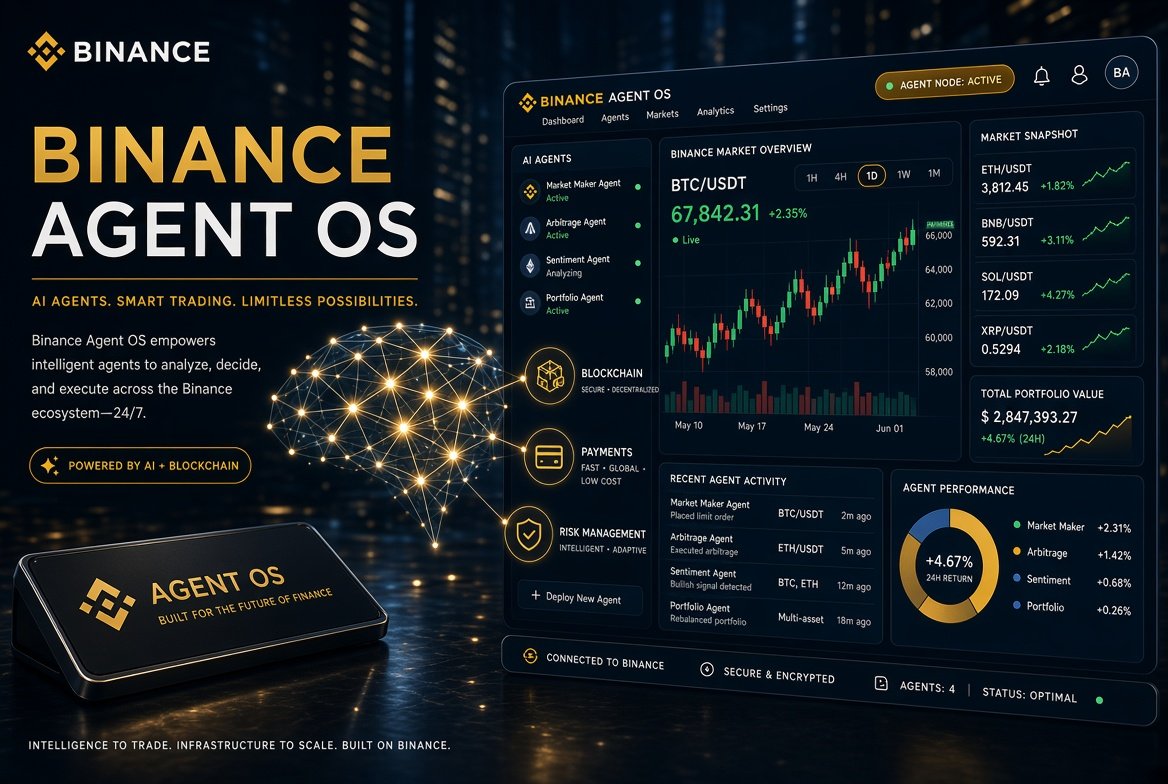
On August 20, 2026, Binance, the world’s largest cryptocurrency exchange by trading volume, launched Binance Agent OS. The platform marks a significant step in the evolution of agentic finance—the emerging field where autonomous AI agents can analyze markets, execute trades, handle payments, and interact with on-chain services under user-defined controls.
Rather than building yet another AI chatbot, Binance has created a standardized developer layer that connects existing AI tools and custom agents directly to its trading infrastructure, market data, wallets, and payment systems. The result is a controlled environment in which AI agents can act on real financial data and capital while users retain granular oversight.
This article explains what Binance Agent OS is, how it works, what agents can actually do, the security model, and why the launch matters for developers, traders, and the broader crypto industry.
Table of Contents
- What Exactly Is Binance Agent OS?
- How Binance Agent OS Works
- Core Capabilities: What AI Agents Can Do
- Security, Sub-Accounts, and Transaction Limits
- Integration With Popular AI Tools
- Why Binance Agent OS Matters for Agentic Finance
- Potential Risks and User Responsibility
- Who Should Pay Attention
- Final Takeaway
What Exactly Is Binance Agent OS?
Binance Agent OS is a developer platform and standardized access layer that connects AI applications and agents to Binance’s financial infrastructure. It unifies several existing and new components into one controlled environment:
- Binance APIs (REST and WebSocket)
- Binance Wallet Agentic Hub
- Binance x402 (programmable payments and transaction verification)
- Binance Skill Hub (ready-made agent skills)
- Newly introduced support for the Model Context Protocol (MCP)
According to Binance, the platform is part of its broader Binance Intelligence initiative, which focuses on AI-powered products and experiences. The goal is to solve the fragmentation developers face when trying to build agentic applications that need reliable market data, low-latency execution, and secure access to both crypto and traditional market tools.
In practical terms, once an AI agent is connected through Agent OS, it can read live market data, view designated account information, place trades, initiate payments, and interact with supported on-chain services—all within the permissions and limits the user configures.

How Binance Agent OS Works
At the technical center of Agent OS is support for the Model Context Protocol (MCP), an open standard that allows compatible AI tools to connect to external data sources and services. Binance provides an MCP server that developers can add to their preferred AI environment.
The typical connection flow is straightforward:
- Add the Binance MCP server to the AI tool or agent framework.
- Authenticate and authorize access.
- Assign the agent to a dedicated sub-account and set permissions and limits.
- The agent can then begin interacting with Binance infrastructure.
Users can also leverage ready-made skills from the Binance Skill Hub or build custom workflows using the underlying APIs. The platform is designed to work with both ready-made integrations and fully custom agents.
Jeff Li, Vice President of Product at Binance, described the intent clearly: Agent OS addresses the fragmentation developers encounter when building across crypto and traditional markets by providing “reliable data, low-latency infrastructure, and standardized interfaces.”

Core Capabilities: What AI Agents Can Do
Within the boundaries set by the user, AI agents connected via Agent OS can perform several high-value actions:
Trading Agents can monitor markets, react to signals, analyze risk, and place orders on spot or futures markets when predefined conditions are met. Strategies such as simple signal-based trading or more complex arbitrage become possible without constant human intervention.
Market Intelligence Agents gain access to live crypto and traditional market data, price feeds, order books, and on-chain information. They can track positions, portfolio balances, and market movements in real time.
Payments and Settlement Through Binance x402 and related tools, agents can send, receive, and settle transactions programmatically, opening the door to machine-to-machine payments and automated settlement flows.
On-Chain Operations Using the Binance Agentic Wallet and Web3 APIs, agents can interact with supported on-chain services and DeFi protocols, again subject to user-defined limits and rules.
Portfolio Tracking and Insights Agents can monitor balances and positions across designated accounts and surface insights through tools such as Binance AI Pro inside the Binance application.
All of these capabilities operate under the principle that the agent acts only within the sandbox the user has explicitly created.

Security, Sub-Accounts, and Transaction Limits
Security is deliberately user-centric. Binance does not attempt to inspect or control an agent’s internal reasoning, which typically occurs inside the user’s chosen AI application (ChatGPT, Claude, Cursor, etc.). Instead, the exchange focuses on account-level controls.
Key safeguards include:
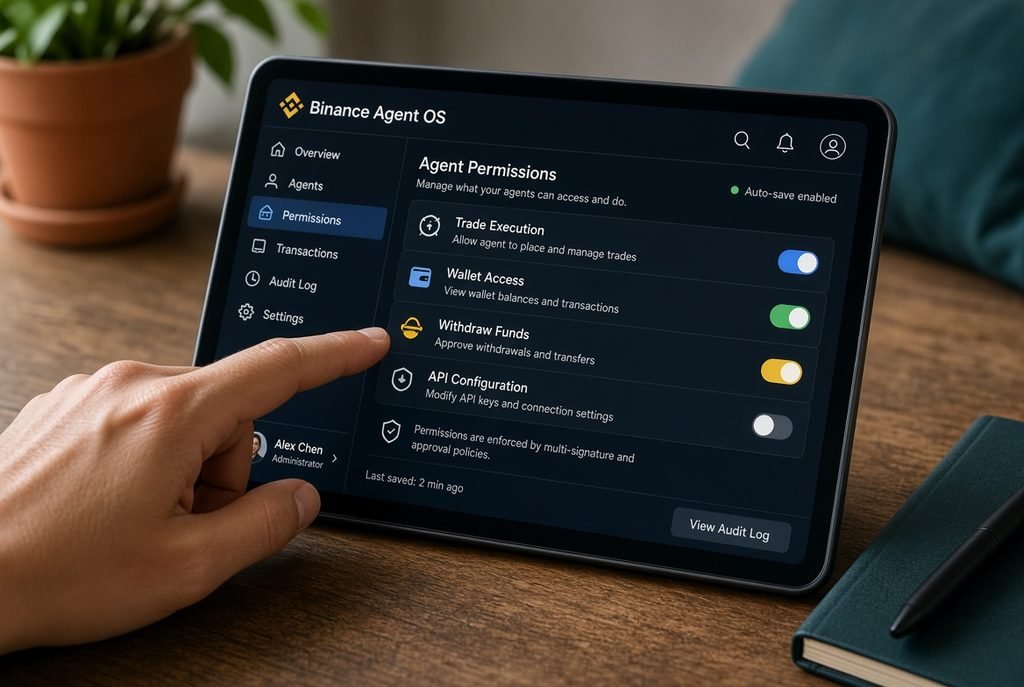
- Dedicated sub-accounts — Users assign each agent to its own sub-account, segregating funds and activity from the main account.
- Withdrawals blocked by default — Agents cannot withdraw funds from sub-accounts, creating a natural sandbox.
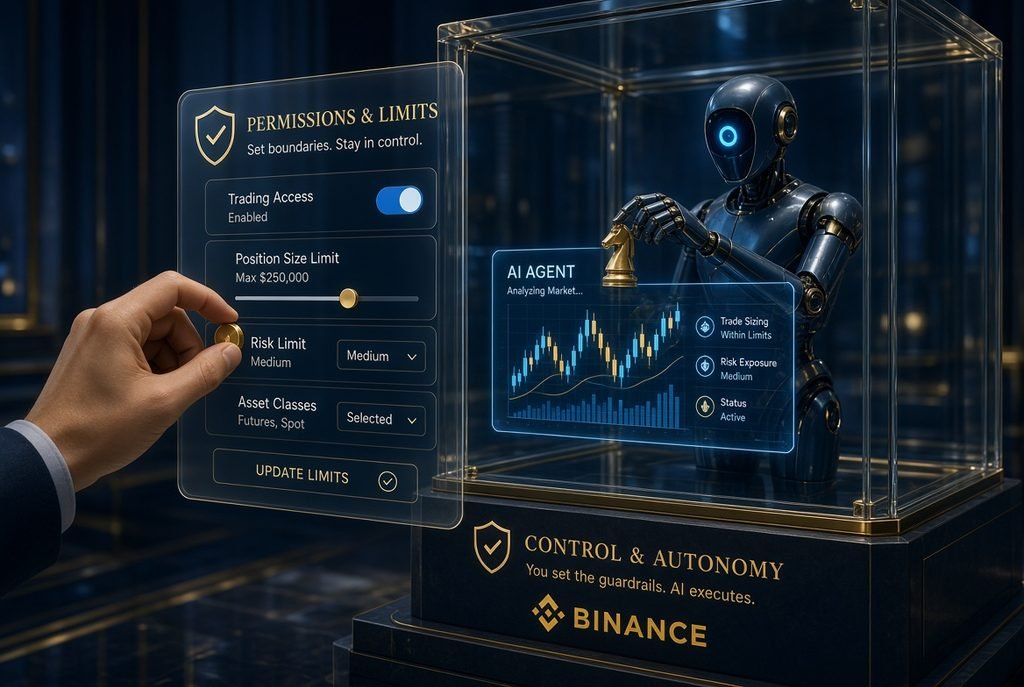
- Granular permissions — Users decide whether an agent can trade spot, futures, or both, and whether it can act autonomously or requires approval for each order.
- Daily limits on certain activities — For the Agentic Wallet, regular swaps are capped at $50,000 per day, DeFi transactions at $100,000 per day by default, and x402 payments at $20 per day (subject to change and user configuration).
Binance continues to apply its existing risk, compliance, and anti-money-laundering controls to the resulting trading activity. However, the company cannot see the agent’s decision process or detect prompt-injection attacks that may influence behavior. Ultimate responsibility for monitoring agent performance rests with the user.
Integration With Popular AI Tools
Agent OS is designed for interoperability. It currently works with widely used AI development and interaction environments, including:
- OpenAI’s ChatGPT and Codex
- Anthropic’s Claude Code
- Cursor
- Claude Desktop
- CLI workflows and various agent frameworks
- Direct REST and WebSocket API connections
This broad compatibility means developers and quantitative teams can bring their existing AI stacks rather than being locked into a proprietary interface.
Why Binance Agent OS Matters for Agentic Finance
The launch reflects a larger industry shift. For years, AI in crypto has mostly meant chatbots that answer questions or generate analysis. Agentic systems that can act—place trades, move capital, settle payments—have remained limited by fragmented infrastructure, security concerns, and lack of standardized access.
By providing a controlled, high-liquidity environment with clear permission boundaries, Binance is attempting to make agentic finance practical at scale. The combination of deep liquidity, 24/7 market access, and user-configurable guardrails lowers the barrier for both individual power users and professional teams building autonomous strategies.
It also positions Binance early in a competitive landscape where other exchanges and infrastructure providers are likely to follow with their own agent platforms.
Potential Risks and User Responsibility
Despite the controls, meaningful risks remain. AI agents can make mistakes, act on incomplete or manipulated information, or behave unpredictably under novel market conditions. Prompt injection and other adversarial techniques that influence an agent’s reasoning are currently outside Binance’s visibility.
Users must treat Agent OS as a powerful but imperfect tool. Best practices include starting with limited capital in the sub-account, requiring approval for significant orders, regularly reviewing agent activity, and maintaining human oversight of overall strategy.
Binance itself emphasizes that use of its AI services is at the user’s own risk and that AI outputs should not be relied upon as the sole basis for investment decisions.
Who Should Pay Attention
Developers and AI builders gain a standardized way to connect agents to one of the deepest liquidity pools in crypto without reinventing authentication, data feeds, and execution layers.
Quantitative traders and funds can experiment with autonomous or semi-autonomous strategies under controlled risk parameters.
Fintech teams exploring agentic payments and on-chain automation now have a major exchange-backed pathway.
Individual advanced users who already use AI coding tools or agents can extend those systems into real market interaction—provided they approach the capability with appropriate caution.
Final Takeaway
Binance Agent OS is not a fully autonomous trading robot handed to retail users. It is a carefully gated developer and power-user platform that brings AI agents into the realm of real financial action while keeping control of funds and permissions firmly in human hands.
By combining MCP support, sub-account isolation, ready-made skills, and access to Binance’s market infrastructure, the platform removes significant technical friction from agentic finance. At the same time, it underscores a core truth of the current moment: the more capable AI agents become at handling money, the more critical human judgment and robust controls become.
For those building or experimenting at the intersection of AI and crypto in 2026, Binance Agent OS is one of the most consequential infrastructure launches of the year. The tools are now available. The responsibility for using them wisely remains with the user