Key Takeaways
- Malaysian authorities ordered Network School Malaysia to cease operations in Forest City, Johor, with a business licence revoked effective 22 July 2026.
- The action followed allegations — which immigration checks did not confirm — that Israeli nationals had joined the community; Network School founder Balaji Srinivasan disputes the “shutdown” framing.
- Srinivasan has shelved a planned RM500 million expansion and signed an MoU with Kazakhstan.
- The popular “1965 all over again” comparison to Singapore’s separation is emotionally satisfying and analytically leaky.
- The real lesson is jurisdictional competition for mobile, crypto-era capital — a game the UAE has been quietly winning.
In July 2026, Malaysian authorities ordered Network School Malaysia — the crypto-flavoured coliving community founded by former Coinbase CTO and The Network State author Balaji Srinivasan — to cease operations in Forest City, Johor, revoking a business licence tied to the site. Network School had drawn globally mobile founders since launching in October 2024. The order, and the immigration controversy around it, revived an uncomfortable question: has Malaysia once again found a way to export its own upside — the way it famously did with Singapore in 1965?
The short answer: the analogy is tempting, partly fair, and mostly too neat. But the second-order story — where footloose capital and talent go next — is the part worth reading.
What Actually Happened in Forest City
Between roughly 13 and 17 July, immigration officers inspected Network School’s premises, checking passports and visas after online allegations that Israeli nationals had entered Malaysia on second-country passports to attend. Malaysia has no diplomatic relations with Israel and restricts entry for Israeli passport holders.
Immigration reported that inspected participants held valid travel documents; reported figures on how many were checked vary across outlets. Prime Minister Anwar Ibrahim said any Israeli nationals found via Network School would be deported. On 21 July, Johor Menteri Besar Onn Hafiz Ghazi announced the cease-operations order, and the local council moved to revoke a licence, citing a premise operating without proper authorisation.
Srinivasan pushed back hard, calling reports of a shutdown “fake news” and describing the matter as a sign-text correction plus a licensing issue on a coworking space stitched together from two units — one licensed, one not. He said Network School had invested “MYR100 million+” and employed dozens of Malaysians. He also said the quiet part loudly: further investment is “on hold,” the planned RM500 million expansion is shelved, and there is now an MoU with Kazakhstan promising “expedited visas, streamlined redomiciliation, and active recruitment of talent.”
So: is it a shutdown or a paperwork spat? Both sides have an incentive to sound certain. The distinction matters, because “licence revoked over an unlicensed unit” and “government expels a community over who its members are” are very different stories with very different consequences. The documents will decide it, not the press releases.
The Forest City Backdrop Nobody Mentions
To understand why this stings, you have to understand where Network School set up. Forest City is not a thriving metropolis that reluctantly made room for a startup commune. It is one of the most expensive property disappointments in the region — a reclaimed-land megaproject on the Johor Strait, near the Singapore border, marketed as a city for hundreds of thousands and largely empty for years.
Bloomberg described the roughly $100 billion development as a “broken dream city” that became a refuge for tech utopians. In other words, Network School was not squatting on prime real estate. It was one of the few tenants giving a stranded, half-built enclave a reason to appear in the international press for something other than vacancy rates.
That is the part the sovereignty framing obscures. Malaysia did not have a surplus of foreign founders begging to relocate to Forest City. It had one marquee experiment breathing narrative life into an asset that badly needed it. Whatever the merits of the licensing case, the timing means the story reads less like a country defending its borders and more like a country misplacing a rare piece of good fortune.
The 1965 Parallel Everyone Is Reaching For
Reaching for the 1965 comparison has become a regional reflex, and the fit is genuinely tempting. That year, Singapore separated from the Federation of Malaysia after political and communal friction proved irreconcilable. Malaysia kept the larger landmass and population; Singapore kept Lee Kuan Yew and a deep-water port, and proceeded to compound into one of the wealthiest economies per capita on earth.
The moral usually drawn — Malaysia let a generational asset walk out the door over politics — is a simplification of a painful, complicated separation. But the economic scoreboard is not really in dispute, which is why the meme has legs.
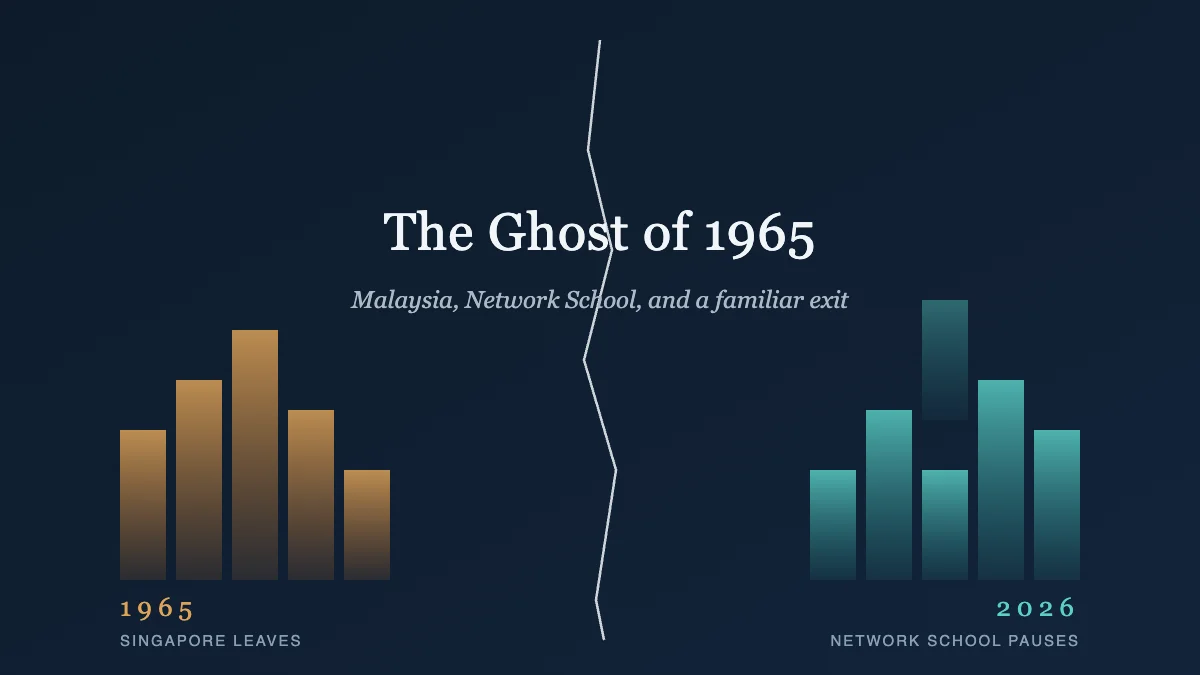
| Dimension | Singapore, 1965 | Network School, 2026 |
|---|---|---|
| What departed | A territory and its government | A private coliving / startup community |
| Trigger | Political and communal friction | Immigration allegations + a licensing dispute |
| Malaysia’s stated reason | Preserving stability and sovereignty | Enforcing immigration and licensing law |
| What Malaysia kept | Land, population, resources | The Forest City real estate; the tax base minus one tenant |
| What it arguably lost | Decades of compounding GDP | A talent magnet and a signalling win |
| Mobility of the asset | Low — fixed to geography | High — a laptop, a lease, an MoU |
| Reversibility | Effectively none | Unclear; possibly negotiable |
But the Analogy Has Holes
A startup society is not a sovereign nation, however many times its founder says “network state.” Singapore in 1965 was a place with people, a port, and no exit; Network School is a membership community whose core asset — mobile founders — can and did start relocating within the same week the story broke.
Malaysia also has a defensible position that 1965 Singapore never tested. Enforcing immigration law and business licensing is a legitimate function of any government, not a fit of pique. A state can be entirely within its rights on the law and still lose the narrative — the two are not the same thing, though official statements often blur them.
And the allegations at the centre of this remain exactly that: allegations, which immigration’s own checks did not substantiate. A landmark verdict on Malaysia’s judgment cannot rest on an unproven premise. The honest position is that the country may be procedurally correct and strategically clumsy at the same time.
What Network School Malaysia’s Exit Could Actually Cost
Here is the part the 1965 nostalgia obscures. In 1965, the asset that left took decades and a causeway to relocate. In 2026, it took a weekend and a memorandum with Kazakhstan.
The real prize was never one coliving campus. It was positioning — being seen as the open, low-friction base for the globally mobile, crypto-native founder class that treats jurisdictions like cloud regions: spin up where latency is low, migrate when policy risk spikes. Network School was a lighthouse for that demographic. Shelved expansion capital (a stated RM500 million) and, more importantly, the reputation for frictionless entry are the things that do not show up on a licensing ledger.
This is where most coverage will stop. It should not. The founder class that Network School aggregates has spent three years being actively courted elsewhere — most conspicuously by the UAE, where VARA, DIFC and long-residency visa schemes were built precisely to absorb mobile crypto capital and talent. When Malaysia and Kazakhstan trade an asset like this, the quiet beneficiary is whichever hub already optimised for exactly these people. Capital does not need a divorce anymore. It needs a Wi-Fi password and a plausible visa.
What Kazakhstan Is Actually Offering
Read the terms of the Kazakhstan MoU as Srinivasan described them — expedited visas, streamlined redomiciliation, active recruitment of talent — and they scan like a point-by-point rebuttal of everything Network School says went wrong in Johor. Where Malaysia produced an immigration probe and a licensing notice, Astana is marketing frictionless entry as the headline feature.
This is not a country improvising. Kazakhstan absorbed a wave of crypto miners after China’s 2021 mining ban and operates the Astana International Financial Centre, an English-common-law zone with its own regulator, built explicitly to attract foreign capital that would not otherwise touch Central Asia. A government that lists “redomiciliation” as a selling point understands its customer. For a network-state project whose entire thesis is that governance should compete for citizens like products compete for users, that is close to an ideal counterparty.
Whether Kazakhstan can convert an MoU into a durable community is an open question — memoranda are cheap, and Central Asia carries its own governance and reputational risks. But the direction of travel is the signal. The mobile crypto economy now has more than one government openly bidding for it, and the bidding war rewards whoever removes friction fastest.
The Gulf Contrast: Friction as a Policy Choice
The clearest way to see what Malaysia is risking is to look at the region that has spent years doing the opposite. The UAE treats mobile crypto capital as infrastructure to be courted, not a liability to be contained. Dubai’s Virtual Assets Regulatory Authority built a dedicated licensing regime for virtual-asset firms; Abu Dhabi’s ADGM and Dubai’s DIFC layered English common-law financial zones on top; and long-term “golden” and remote-work visas stripped out the residency friction that usually sends founders hunting for an exit.
The Gulf model is not that a regulator never says no. It is that the default posture is a documented, predictable “yes,” administered by an authority whose explicit mandate is to make compliant entry fast. That predictability is the product. A founder weighing where to base a community is not only comparing tax rates; they are pricing the probability that a single controversy can end their operation with a fortnight’s notice.
Set the two experiences side by side and the contrast writes itself. In one jurisdiction, a crypto-native community can assemble a licence, a visa and a banking relationship inside a single regulated zone. In another, the same community faces an immigration probe, a licensing revocation and a public rebuke within a week. When those are the visible options, capital does not deliberate for long — which is precisely why the Gulf keeps ending up on the receiving end of everyone else’s friction.
A Pattern, or a One-Off?
It would be easy to file this as a single messy episode in a single enclave. That would miss the trend. Globally mobile founder communities keep running the same experiment: arrive in a jurisdiction offering a warm welcome, scale until they bump into local law, politics or public sentiment, and then test how quickly they can move when the welcome cools.
For host countries, the uncomfortable lesson is that these communities are guests, not anchors. They bring capital, headlines and a certain cosmopolitan prestige, but they do not put down roots the way a factory or a port does. The moment the relationship turns adversarial, the asset is already halfway to the airport. That asymmetry — high mobility on one side, fixed sovereignty on the other — is the actual story, and it will keep recurring long after the Forest City licensing file is closed.
What Malaysia Could Still Do
None of this makes the outcome permanent. If the dispute really is a licensing technicality, resolving it transparently and quickly would limit the reputational bleed and let both sides claim a version of victory. The harder task is untangling two things officials have bundled together: immigration enforcement, which is legitimate and non-negotiable, and investment signalling, which is where the damage actually lands.
A government can enforce entry rules against specific individuals and still make clear, in the same breath, that it wants the broader community and the capital behind it. The two messages are not mutually exclusive; they were simply delivered as one. Whether Malaysia chooses to separate them will say more about its ambitions as a technology hub than any glossy investment brochure could.
What This Means
The durable lesson of this episode is not “Malaysia repeats history.” It is that crypto-era capital has decoupled from geography in a way 1965 Singapore never could. Sovereignty and openness are both legitimate goals, but they now trade against each other on a much faster clock, and the mobile side of that trade compounds elsewhere while the paperwork is still being filed.
For any jurisdiction courting founders, builders, and the stablecoin- and RWA-native firms that follow them, the signal matters as much as the statute. For Network School, the next chapter is now being written in Central Asia; for Malaysia, the reckoning is reputational rather than legal. Malaysia may well be correct on the licence. Whether it is correct on the strategy is a separate question — and one that, unlike a coworking permit, cannot be renewed retroactively.
Frequently Asked Questions
What is Network School Malaysia?
Network School is a coliving and coworking community founded by Balaji Srinivasan in Forest City, Johor, launched in October 2024, charging around $1,500 a month and drawing globally mobile founders.
Was Network School shut down by Malaysia?
Johor authorities ordered Network School to cease operations and revoked a business licence effective 22 July 2026. Srinivasan disputes the “shutdown” characterisation, calling it a licensing and signage issue.
Why was Network School investigated?
Network School was investigated over online allegations that Israeli nationals attended via second passports. Immigration reported participants held valid travel documents; the allegations were not confirmed.
Where is Network School going next?
Srinivasan has shelved a planned RM500 million Malaysia expansion and signed an MoU with Kazakhstan offering Network School expedited visas and redomiciliation support.
This article is for informational purposes only and does not constitute financial, investment, or legal advice.

1 thought on “Network School and the Ghost of 1965’s Mistake”