
DexScreener boosted tokens are the coins someone paid to put in front of you — and for 12 straight hours, Cryptonite tracked all of them. Using a custom screener that polled DexScreener’s public API every 20 minutes from 21:14 UTC on July 16 to 09:27 UTC on July 17, 2026, we logged every token on the boost radar: its liquidity, volume, order flow, pair age and price action, scan after scan. The result is one of the clearest datasets we have published on how the promoted end of the meme-coin market actually behaves — 12 rug pulls or liquidity drains confirmed live, one trap that sprang four times, and a promoted list where the biggest advertising budgets belonged to the deadliest tokens.
This is not investment advice; it is a field report. Every number below comes from timestamped API snapshots archived during the watch, and every pattern described is one our screener flagged in real time.
What DexScreener Boosted Tokens Actually Are
DexScreener is the most widely used real-time DEX analytics platform in crypto. Its token boost system lets anyone pay to amplify a token’s visibility — boosted coins get a flame icon, a boost counter and priority placement, which means the boost list functions as the market’s most-watched shop window. What the flame icon does not tell you is who paid, or why.
That matters because promotion is not endorsement. A boost is an ad. And our data shows the advertisers with the biggest budgets were, overwhelmingly, the ones whose tokens collapsed.
How We Tracked 50 DexScreener Boosted Tokens for 12 Hours
The methodology was simple and repeatable:
- A custom zero-dependency screener polled DexScreener’s public boost and pair-detail endpoints every 20 minutes.
- Each token was scored 0–100 on market-structure signals: liquidity depth, pair age, volume-to-liquidity ratio, buy/sell flow and fully diluted valuation versus pool size.
- Every scan was diffed against the previous one, so new listings, red-flag changes, score swings, liquidity drops of 30%+ and hourly moves beyond ±50% were caught within one cycle.
Over the watch window the list held 45–55 tokens at any moment, spread across Solana, Base and the new Robinhood chain. Around 30 full scans produced the statistics below.
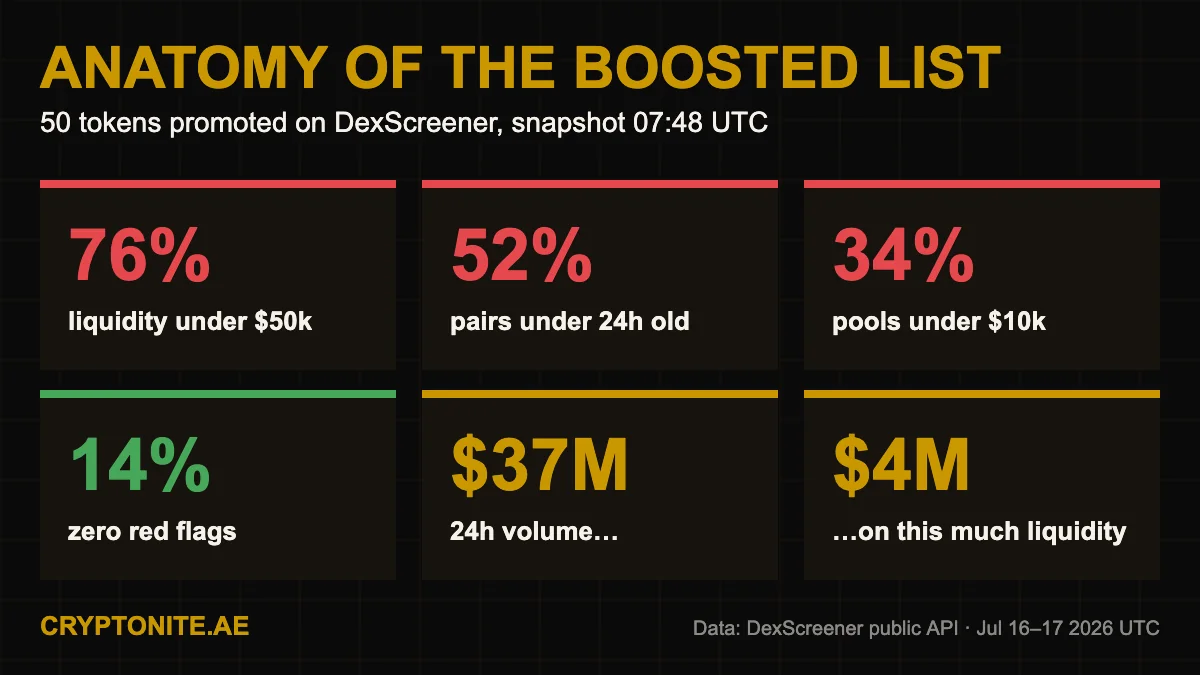
The Numbers: What 30 Scans of the Boost List Revealed
At the 07:48 UTC snapshot, the 50 DexScreener boosted tokens shared roughly $3.98 million in combined liquidity against $37 million in 24-hour volume — the whole promoted market turning its entire pool depth over nine times a day.
- 76% (38 of 50) had less than $50,000 in liquidity.
- 34% (17 of 50) sat on pools under $10,000 — small enough that even a modest exit moves the price against you.
- 52% (26 of 50) were trading pairs less than 24 hours old — inside the window where most rug pulls occur.
- Six carried a wash-trading signature (24h volume at 50× their liquidity or more).
- Only 7 of 50 — 14% — carried zero red flags.
Five of the DexScreener boosted tokens printed gains of +100% to +1,100% on pools holding zero dollars of liquidity — phantom charts with no market behind them, where the displayed price is unfalsifiable because nothing can actually be sold.
Twelve Rug Pulls in Twelve Hours, Logged as They Happened
Twelve of the DexScreener boosted tokens we tracked completed a rug or drain during the watch. A rug pull or liquidity drain, for this report, means a pool losing 30%+ of its liquidity while price collapsed. Twelve completed during the watch:
| Token | Chain | What the screener recorded |
|---|---|---|
| RWA | Solana | −93% in one hour on a $3k pool |
| CASHBULL | Solana | Four full refill–pump–drain cycles (detailed below) |
| 🚀 (rocket) | Solana | Launched, pumped and drained inside 40 minutes; −89% |
| DIP | Robinhood | 2h-old launch, parabolic, then −69% with pool −37% |
| PUMPVERSITY | Solana | +105% pump, then −96%; pool drained to $5k; wash-trade flag; 510 paid boosts |
| bul | Solana | Waited out its 24h “rug window,” then drained: pool $24k → $3k, −98% |
| COBIE | Base | 269-day-old token freshly boosted: +192% pump, 46% liquidity exit, −76% dump — inside one hour |
| WEN | Robinhood | Ran +459% at three hours old, then −73% as the pool fell under $10k |
| Toly | Solana | +338% run at launch, then pool −64% with volume at 93× liquidity |
| CASHGOAT | Solana | Pool halved, then halved again: $35k → $4k; −95% |
| HOMIE | Solana | −71% in 24h with pool draining a third in one scan |
| RIBBIT | Robinhood | A month-old, initially flag-free token: pool −37%, price −62% overnight |
The pattern was near-perfect: not one token under $50k liquidity that printed a triple-digit hourly candle kept its gains through the watch. Every single one either drained, dumped or vanished from the list.
CASHBULL: Anatomy of a Trap That Sprang Four Times
The single most instructive of the DexScreener boosted tokens was CASHBULL, a Solana pair carrying 500 paid boosts — among the highest on the platform.
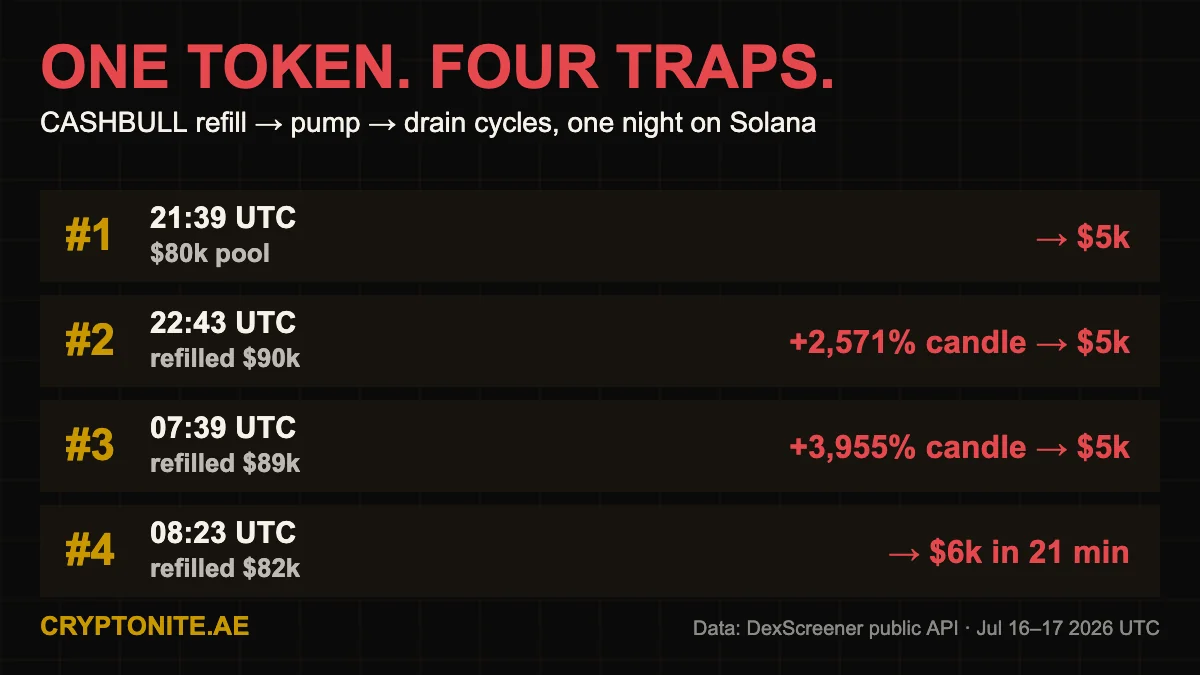
- 21:39 UTC: looks healthy — $80k pool, screener score 75. Within 90 minutes the pool is drained to $5k, price −84%.
- 22:43 UTC: pool refilled to $90k. A +2,571% one-hour candle prints. Drained back to $5k within about 20 minutes.
- 07:39 UTC: refilled to $89k, +3,955% candle — the biggest single move we recorded all night. Drained to $5k by 08:01.
- 08:23 UTC: refilled to $82k, risk flags clear, score jumps back to 70. Drained to $6k by 08:44.
Each cycle sprang within roughly 20–25 minutes of the refill. On-chain data cannot prove intent, but a pair that refills its own liquidity, prints a four-digit percentage candle and empties again four times on a stopwatch is not an organic market. It is a machine for converting fresh buyers into exit liquidity — and it wore a 500-boost flame badge the entire time.
The Boost Paradox: The Most-Promoted DexScreener Boosted Tokens Died First
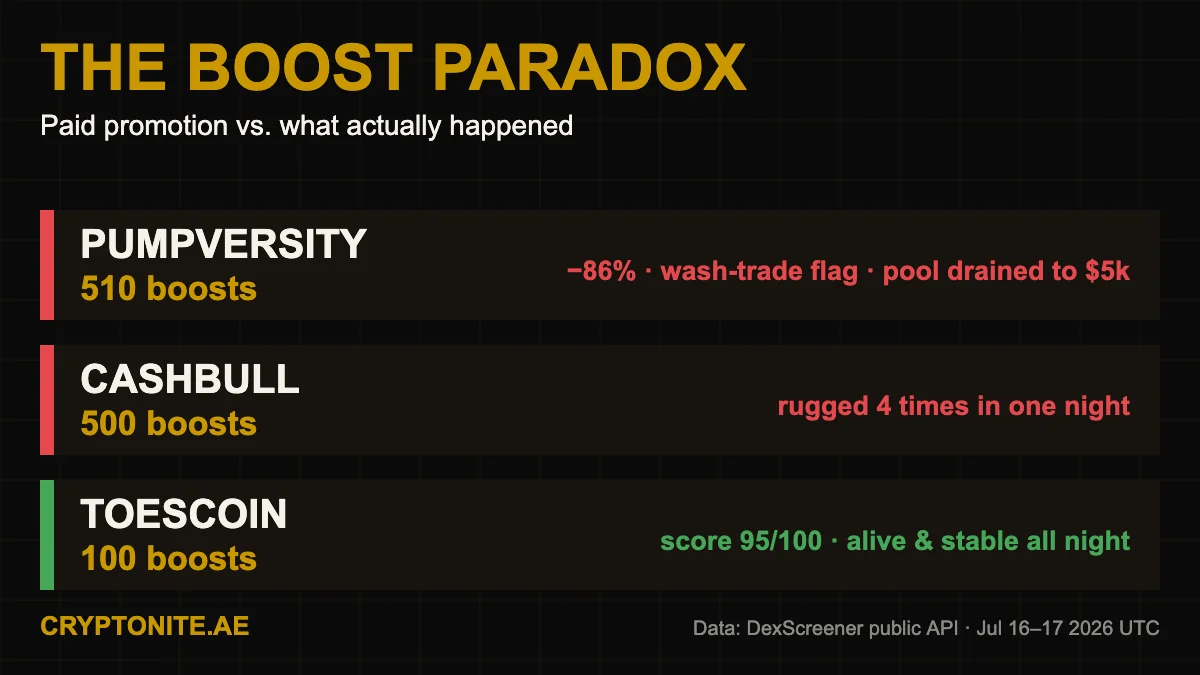
Rank every token by paid boost count and the correlation jumps out:
- PUMPVERSITY — 510 boosts: drained to a $5k pool, −86%, wash-trading flag.
- CASHBULL — 500 boosts: four rug cycles in one night.
- TOESCOIN — 100 boosts: score 95/100, $310k pool, two months old, price moving ±2% — alive, boring and stable all night.
Visibility on the boost list is paid for, and the parties paying the most were consistently the tokens that needed fresh exit liquidity most urgently. Treat the flame icon accordingly: it tells you marketing budget, not quality — and in this dataset the relationship between the two ran backwards.
Records From the Watch
Even by the standards of DexScreener boosted tokens, these extremes stood out:
- Fastest death: CEO (“Cat Executive Officer”) — already down 78% when the pair was eight minutes old.
- Biggest candle: CASHBULL, +3,955% in one hour, on a refilled trap pool.
- Most impossible volume: SHERK — 24-hour volume at 18,145 times its liquidity, price −100%.
- Fastest full lifecycle: WATER pumped +703% and disappeared from the boost list entirely within about 30 minutes.
What Survived — and Why It Was Boring
The DexScreener boosted tokens that ended the watch where they started shared three traits: pools above $100k, pair ages measured in weeks not hours, and charts that did nothing dramatic. Index held a $2 million pool — ten times anything else listed — and a 97/100 score. TOESCOIN, BYCOCKET, HBULL and KINDRA all kept deep pools and flag-free profiles through every scan. The survivors were, without exception, the least exciting tokens on the board.
How Readers Can Run the Same Checks
Before touching any DexScreener boosted tokens, run the same checks we did. Everything in this report used free, public tools, and the checks take under two minutes per token:
- Liquidity first: on any DexScreener pair page, check pool size before price. Under $50k, an exit at the displayed price is not guaranteed; under $10k it may be impossible.
- Age: pairs under 24 hours old sit in the statistical peak of the rug window — 52% of the promoted list qualified.
- Volume-to-liquidity ratio: 24h volume above roughly 20× the pool suggests manufactured activity; above 50× we treat it as a wash-trading signature.
- Contract scan: market data cannot see mint authority, hidden sell taxes or honeypot logic. Run the contract through honeypot.is or GoPlus Token Security before touching anything.
Regulators are moving in the same direction as this data. As we covered in our report on Japan’s crypto reclassification, insider-trading rules are now being extended to digital assets in major markets, and licensed-venue frameworks like the one behind Revolut’s VARA approval in the UAE exist precisely because the unregulated end of the market behaves the way this report documents.
What It Means
The promoted layer of the meme-coin market is not a discovery feed; it is an auction for attention in which the most motivated bidders are frequently the ones running extraction schemes. Twelve rugs in twelve hours is not a market anomaly — it was an ordinary Wednesday night for DexScreener boosted tokens. For UAE and GCC readers watching the meme-coin cycle from a jurisdiction that takes licensing seriously, the contrast is the story: the same industry contains both VARA-regulated venues and a boost list where a token can rug four times before breakfast wearing a paid promotion badge.
The data does not say every boosted token is a scam. It says the flame icon carries no information about safety — and that in at least one 12-hour sample, it correlated with the opposite.
FAQ
What are DexScreener boosted tokens?
They are tokens whose visibility on DexScreener has been paid for through the platform’s boost feature. Boosts buy placement and a flame icon; they are advertising, not a quality signal or an endorsement by DexScreener.
Are boosted tokens more likely to rug?
Among the DexScreener boosted tokens in our sample, the correlation was stark — though 12 hours cannot prove causation: the two most-boosted tokens on the list (500+ boosts each) were responsible for the worst outcomes recorded, while the steadiest performer carried one-fifth the boost spend.
How do I check a meme coin before buying?
Check liquidity depth and pair age on DexScreener, compare 24h volume to pool size, and scan the contract with honeypot.is or GoPlus for mint authority, sell taxes and honeypot logic. If liquidity is under $50k or the pair is under 24 hours old, the statistical base rates in this report apply.
What is a liquidity refill trap?
A pattern where a drained pool is deliberately refilled, a massive green candle is printed to attract buyers, and the pool is emptied again. CASHBULL ran this cycle four times in 11 hours during our watch.
Methodology & sources: all figures from DexScreener public API snapshots collected every 20 minutes, July 16 21:14 UTC – July 17 09:27 UTC, 2026, archived by Cryptonite. Contract-security references: honeypot.is, GoPlus Labs. This article is journalism and education, not financial advice; meme-coin trading carries a substantial risk of total loss.

1 thought on “DexScreener Boosted Tokens: Shocking 12-Hour Watch Logs 12 Rug Pulls and a 4-Cycle Trap”