Key Takeaways
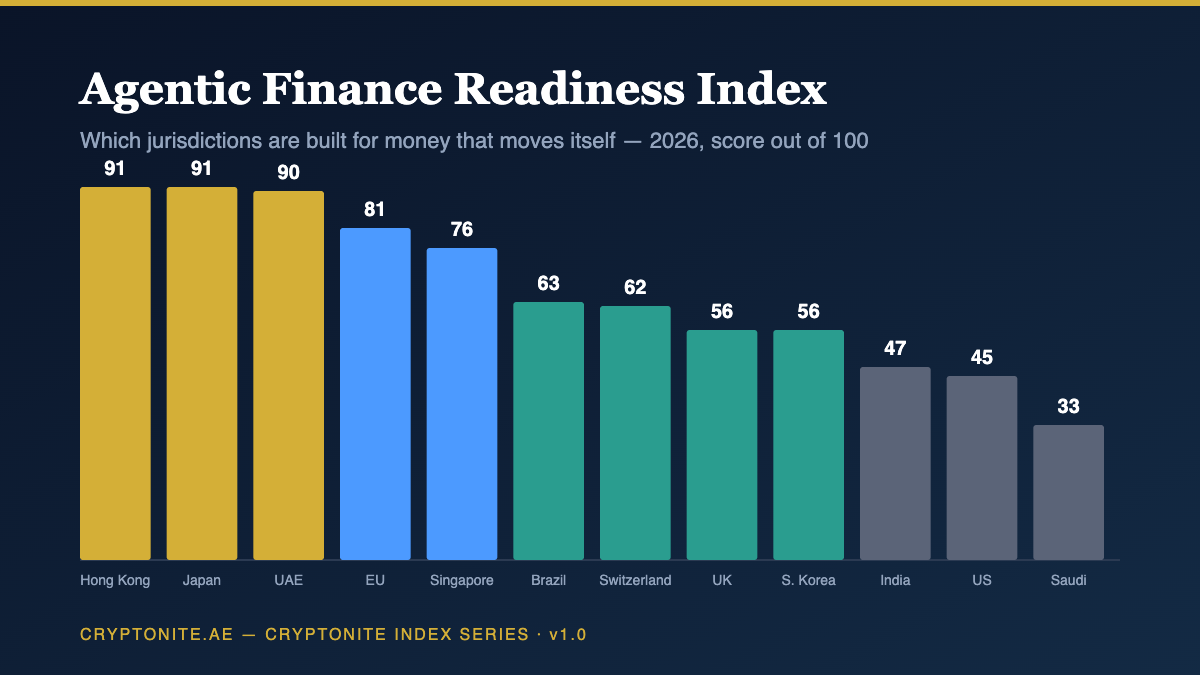
- Hong Kong and Japan lead at 91/100, with the UAE one point behind — all three combine licensed stablecoin issuance with working tokenization frameworks.
- The United States ranks 11th of 12 (45/100) despite having the largest crypto market. Its stablecoin law is passed but not yet applied, it has no federal service-provider regime, and it has no national digital identity for financial onboarding.
- Singapore is the only jurisdiction with a published framework for AI agents in finance — MAS SAFR, July 2026 — yet ranks 5th on infrastructure, because its stablecoin framework still has no statutory force.
- No jurisdiction anywhere has an in-force binding rule for AI agents initiating payments. Everything that exists is guidance, priorities papers or a discussion draft.
- Instant payments are no longer the differentiator — India and Brazil score full marks on rails while scoring near-bottom on regulated digital money.
Which country is most ready for AI agents that move money? On Cryptonite measures, Hong Kong and Japan tie at 91 out of 100, followed by the UAE at 90. Readiness is scored across five infrastructure pillars: regulated stablecoin rails, service-provider licensing, instant payments, digital identity and tokenization frameworks.
What this index measures
An AI agent that holds and spends money needs four things its owner cannot improvise: a settlement asset it can hold legally, a licensed venue to obtain and move it, rails that settle at machine speed, and a way to prove who authorised it. Add the ability to hold real assets rather than only currency and you have the full stack. This index scores jurisdictions on whether that stack exists in force — not whether it has been announced.
That distinction is the entire point. A great deal of agentic-finance commentary treats passed legislation and operating regimes as equivalent. They are not. A law with a 2027 commencement date does not let an agent transact in 2026.
Methodology
Five pillars, each scored out of 20, summed to 100. Scores reflect documented regulatory status as of 1 August 2026, with in-force-and-operating regimes scoring highest and announcements scoring lowest.
- Regulated stablecoin rails — is there an in-force authorisation regime for fiat-referenced stablecoins, and have licences actually been granted?
- Service-provider licensing — is there an operational licensing regime for crypto and digital-asset service providers, with licences issued?
- Instant payment infrastructure — does a live domestic real-time payment system exist, and is participation mandated or effectively universal?
- Digital identity — is there a national or federated digital identity usable for financial onboarding? This is the pillar that will carry Know Your Agent obligations.
- Tokenization framework — is there a regulatory pathway for tokenized securities or funds that is actually being used?
Scoring bands per pillar: 18-20 in force and operating at scale; 13-17 in force with limited deployment; 8-12 passed or finalised but not yet applied; 4-7 announced framework or consultation; 0-3 none identified.
The 2026 rankings
| Rank | Jurisdiction | Stablecoin rails | VASP licensing | Instant payments | Digital ID | Tokenization | Score /100 |
|---|---|---|---|---|---|---|---|
| 1 | Hong Kong | 20 | 17 | 18 | 17 | 19 | 91 |
| 2 | Japan | 20 | 18 | 16 | 17 | 20 | 91 |
| 3 | United Arab Emirates | 20 | 19 | 14 | 18 | 19 | 90 |
| 4 | European Union | 20 | 20 | 20 | 9 | 12 | 81 |
| 5 | Singapore | 6 | 18 | 18 | 20 | 14 | 76 |
| 6 | Brazil | 10 | 13 | 20 | 15 | 5 | 63 |
| 7 | Switzerland | 5 | 13 | 17 | 7 | 20 | 62 |
| 8 | United Kingdom | 8 | 8 | 18 | 8 | 14 | 56 |
| 9 | South Korea | 2 | 12 | 16 | 16 | 10 | 56 |
| 10 | India | 0 | 5 | 20 | 19 | 3 | 47 |
| 11 | United States | 10 | 8 | 11 | 3 | 13 | 45 |
| 12 | Saudi Arabia | 0 | 0 | 14 | 17 | 2 | 33 |
What the results actually show
The United States is not built for agentic finance yet
This is the finding most likely to surprise. The US has the deepest capital markets, the largest tokenized treasury products and the most AI companies — and ranks 11th. The reasons are structural rather than ideological: the GENIUS Act is law but does not take effect until January 2027 and no issuer has been licensed under it; market-structure legislation has cleared committee but not the Senate floor; FedNow participation is voluntary rather than universal; and there is no national digital identity a financial institution can use to verify a human principal, let alone their agent. American agentic finance is currently being built on infrastructure the state has not yet supplied.
Asia and the Gulf lead because they finished, not because they started early
Hong Kong, Japan and the UAE score highest for the same reason: each has moved from legislation to operation. Hong Kong granted its first stablecoin issuer licences in April 2026. Japan approved a yen stablecoin that is already used for real payroll. The UAE has multiple licensed dirham stablecoins live and a regulated secondary market for tokenized property. Announcements are common; issued licences are rare, and that is what the index rewards.
Payment rails are solved; regulated digital money is not
India and Brazil operate the two most impressive instant payment systems on earth and score 20/20 on that pillar — yet rank 10th and 6th overall. Fast rails without a legal settlement asset that software can hold do not produce agentic finance. Conversely Switzerland has a decade-old tokenization regime and no stablecoin licensing regime. The scarce resource is not speed. It is regulated digital money with a licensed issuer behind it.
Digital identity is the quiet chokepoint
The pillar with the widest spread is identity: Singapore scores 20, India 19, the United States 3. This matters more than it appears. Every serious proposal for governing AI agents — Know Your Agent, delegated authority, agent credentials — assumes a verifiable link between an agent and an accountable human. Jurisdictions without a national identity layer will have to build that link privately, slowly and inconsistently.
The agent governance frontier
Infrastructure readiness is one question. Whether a regulator has said anything about AI agents specifically is another — and the answer is almost nowhere.
| Jurisdiction | Agent-specific governance status |
|---|---|
| Brazil | None identified |
| European Union | EU AI Act (general only) |
| Hong Kong | None dedicated |
| India | RBI FREE-AI report (non-binding) |
| Japan | None dedicated |
| Saudi Arabia | None identified |
| Singapore | MAS SAFR framework (Jul 2026) |
| South Korea | None identified |
| Switzerland | None identified |
| United Arab Emirates | None dedicated |
| United Kingdom | FCA priorities paper (Mar 2026) |
| United States | AI AGENT Act (discussion draft) |
Singapore is furthest ahead: the Monetary Authority of Singapore published Safeguards for Agentic Finance at Runtime (SAFR v1.0) in July 2026, an industry-built framework for checking and logging each action an agent proposes before execution. It is a whitepaper, not a rule. The UK FCA has gone furthest in naming the legal problem — its 2026 payments priorities report asks whether rules requiring explicit customer consent, written for human decision-making, can accommodate agentic payments at all. In the US, Senator Warner released the AI AGENT Act as a discussion draft in June 2026, proposing a duty of loyalty for agent providers and an identity-verification protocol. The IMF published a framework note in April 2026 identifying the core tension: probabilistic AI behaviour meeting deterministic payment infrastructure.
The practical implication for builders is that agentic payments are currently governed by rules written for humans. Consent, authorisation, liability and dispute resolution all assume a person at a keyboard. That gap will close through supervisory guidance before it closes through legislation, which means the jurisdictions with active supervisory dialogue will set the de facto standard.
Why This Matters
Agentic finance will not deploy where the technology is best. It will deploy where an agent can legally hold a settlement asset, obtain it from a licensed venue, move it instantly, and be traced to an accountable human. On that test the map looks very different from the usual crypto rankings — Asia and the Gulf ahead, the United States behind, and identity infrastructure as the deciding variable almost nobody is discussing. For the vocabulary behind these concepts see our Agentic Finance Glossary; for the underlying records see our stablecoin, US, Europe, Asia and Gulf timelines.
Limitations and corrections
This is version 1.0 and we publish its weaknesses rather than hide them. Scores are Cryptonite assessments of documented regulatory status, not a statistical measure, and reasonable analysts would weight the pillars differently. Three specific caveats: Saudi Arabia sources conflict on whether any service-provider licensing exists and we scored the conservative reading; the exact number of Hong Kong stablecoin licensees should be confirmed against the HKMA register; and the United States digital identity score reflects a negative finding, which is inherently harder to evidence than a positive one. We update this index as regimes commence and will log material changes. Corrections are welcome via our contact page and handled under our corrections policy.
FAQ
What is agentic finance readiness?
The degree to which a jurisdiction supplies the infrastructure an AI agent needs to transact legally: a regulated settlement asset, licensed service providers, instant settlement rails, verifiable identity, and a tokenization pathway.
Why does the United States score so low?
Because the index measures what is in force. The US stablecoin regime is enacted but not yet effective, it has no federal service-provider licensing regime, instant payment participation is voluntary, and there is no national digital identity for financial verification.
Has any regulator approved AI agents making payments?
No jurisdiction has an in-force binding rule. Singapore has published a runtime safeguards framework, the UK FCA has flagged it as a live policy question, and a US discussion draft exists. Agent payments today operate under rules written for human consent.
How often is the index updated?
We revise it as regimes commence or licences are granted, and at minimum quarterly. Version 1.0 reflects status as of 1 August 2026.
This article is for informational purposes only and does not constitute financial, investment, or legal advice.
By Vaibhav Ali