Key Takeaways
- The first Forms 1099-DA arrived in February 2026, covering 2025 trades — gross proceeds only. If you do not report cost basis yourself, the IRS may effectively assume it is zero.
- Long-term capital-gains rates stay 0%, 15% and 20%, but the thresholds moved: the 0% band now reaches $49,450 (single) for tax year 2026.
- Universal pooled basis accounting is dead — basis must be tracked wallet by wallet since January 2025, and the one-time safe harbor has closed.
- Staking rewards remain taxable at receipt — but the Jarrett trial on September 29, 2026 could reshape that.
- The wash-sale rule still does not apply to crypto — and Congress is actively moving to close that window.
How are US crypto taxes changing in 2026? Exchanges now issue Form 1099-DA to you and the IRS, capital-gains rates hold at 0/15/20% with higher thresholds, cost basis must be tracked per wallet, staking is taxed at receipt, and the wash-sale rule still does not cover digital assets — for now.
The 1099-DA era has started — and it has a trap in it
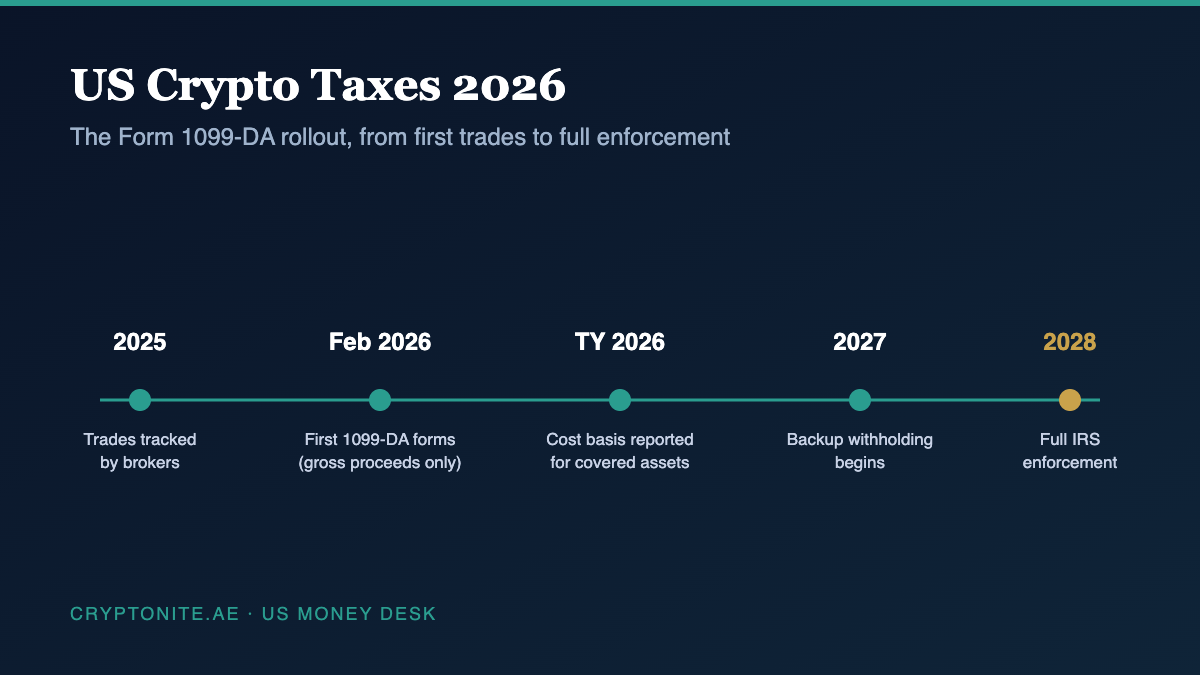
US crypto taxes 2026 will be remembered as the year reporting went institutional. Under the broker regulations finalized in 2024, custodial exchanges issued their first Forms 1099-DA by mid-February 2026, covering every sale made on or after January 1, 2025. The IRS now receives the same copy you do.
The trap: for tax year 2025, brokers only had to report gross proceeds — not what you paid. Cost-basis reporting begins with tax year 2026, and even then only for covered assets bought and sold in the same broker account. Practitioners expect the first matching cycle to generate automated notices that treat unreported basis as zero — turning a break-even trade into a paper gain. The defense is unglamorous: complete Form 8949 with your real basis, every line.
Relief has been extended in stages: backup withholding is delayed to 2027, and remaining transition relief runs out at the end of that year. From January 1, 2028, the regime is fully armed.
What do the 2026 crypto tax brackets look like?
Rates are unchanged; thresholds moved with inflation. Short-term gains (assets held a year or less) are taxed as ordinary income at 10–37%. Long-term gains get the preferential ladder:
| Long-term rate | Tax year 2025 (filed 2026), single | Tax year 2026 (filed 2027), single |
|---|---|---|
| 0% | Up to $48,350 | Up to $49,450 |
| 15% | $48,351 – $533,400 | $49,451 – $545,500 |
| 20% | Above $533,400 | Above $545,500 |
The overlooked planning lever is that 0% band: a household under the threshold can realize long-term crypto gains at a federal rate of zero — a legal reset of cost basis that many holders never use.
Per-wallet basis tracking is now mandatory
Since January 1, 2025, under Rev. Proc. 2024-28, basis must be tracked per wallet and per account. The old practice of pooling everything into one universal ledger is no longer permitted, and the one-time safe harbor for allocating legacy basis across wallets closed with the 2024 tax year. If you missed it, no formal IRS relief exists — practitioners advise documenting a good-faith allocation now rather than never. Every transfer between your own wallets now carries bookkeeping consequences, even though it is not a taxable event.
Staking and mining: taxed at receipt — but watch September 29
The standing rule (Rev. Rul. 2023-14) taxes staking rewards as ordinary income the moment you control them; mining income works the same way. A Tax Court memorandum this June (Paschall) reaffirmed receipt-based taxation, though on flawed stipulated facts from a self-represented taxpayer — it settles little.
The case that could actually move the law is Jarrett v. United States, heading to a bench trial on September 29, 2026. The Jarretts argue staking rewards are self-created property — taxable only when sold, like a crop at harvest. A taxpayer win would be the most consequential US crypto tax development in years. Until then: report at receipt.
The wash-sale window is still open — but closing
Because crypto is property rather than a security, the wash-sale rule still does not apply in 2026: you can sell at a loss, harvest the deduction, and repurchase immediately. Both the Senate bill from Sen. Lummis and the House Ways and Means drafts released in June 2026 would end this by extending wash-sale treatment to digital assets, and Congress renewed the push in late July. Mechanical same-second loss cycling also invites economic-substance challenges. Treat 2026 as the last predictable year of this strategy, not a permanent feature.
DeFi: the broker rule is dead, your obligations are not
Congress nullified the DeFi broker regulations in April 2025 via the Congressional Review Act, and the IRS is barred from issuing a substantially similar rule. That means decentralized protocols will not send you (or the IRS) a 1099-DA. It does not mean DeFi is a reporting-free zone: every swap, liquidity exit and reward remains self-reportable, with the same per-wallet basis rules — just without a broker paper trail to fall back on.
What Congress may change next
Seven draft bills at House Ways and Means (June 2026) sketch the next regime: a small de-minimis exemption for network fees, elective deferral of staking and mining income until sale, mark-to-market elections for traders, and the wash-sale extension. The broader Lummis package (S. 2207) proposes a $300 per-transaction de-minimis with a $5,000 annual cap. Nothing is enacted yet — and the CLARITY Act, for all its market-structure weight, contains no material tax provisions and remains stalled in the Senate as of this writing.
Why This Matters
For a decade, US crypto taxation ran on self-reporting and low visibility. The 1099-DA flips the information asymmetry: the IRS now sees gross proceeds first and asks questions later. The winners of this transition are mechanically boring — traders who kept per-wallet records, harvested losses while the window stayed open, and answered the Form 1040 digital-asset question accurately. The losers will be reconstructing 2025 basis from screenshots while a zero-basis notice accrues interest. Compliance has quietly become the highest-yield trade in crypto.
Key 2026 deadlines for crypto holders
- April 15, 2026 — 2025 federal return and payment due; Q1 2026 estimated payment
- June 15 / September 15, 2026 — Q2 and Q3 estimated payments (relevant for active traders)
- October 15, 2026 — extended filing deadline (payment was still due in April)
- January 15, 2027 — Q4 2026 estimated payment
Cryptonite context: UAE-based readers comparing regimes can see our UAE crypto tax guide — the contrast with a zero-personal-income-tax jurisdiction explains a growing share of the fund migration we track on the data desk. US ETF flows, covered on our US Money Desk, are one of the few crypto exposures where 1099 reporting has been routine for years.
FAQ
Do I owe taxes if I only bought and held crypto in 2025?
No. Buying with dollars and holding is not taxable, and you may answer No to the Form 1040 digital-asset question if that is all you did. Selling, swapping, spending, or earning crypto is what triggers tax.
What if my 1099-DA shows proceeds but no cost basis?
That is expected for tax year 2025 — brokers were only required to report gross proceeds. You must supply your own basis on Form 8949; otherwise the IRS may compute tax as if your basis were zero.
Does the wash-sale rule apply to crypto in 2026?
Not currently. Crypto is treated as property, so loss harvesting with immediate repurchase remains permitted — though pending legislation would extend the wash-sale rule to digital assets, and aggressive same-day cycling carries economic-substance risk.
How are staking rewards taxed in 2026?
As ordinary income at fair market value when you gain control of them, per Rev. Rul. 2023-14. The Jarrett trial in September 2026 challenges this position; any change would come through the courts or new IRS guidance.
This article is for informational purposes only and does not constitute financial, investment, or legal advice.
By Vaibhav Ali