Last updated: 25 July 2026. This guide is general information, not tax, legal or financial advice. Rules change and depend on your circumstances — confirm your position with the UAE Federal Tax Authority or a qualified advisor.
The UAE is widely described as a “zero-tax” haven for crypto — and for most individual investors, that’s broadly true. But the full picture has nuance: corporate tax, VAT on certain services, and incoming international reporting all matter depending on what you’re actually doing. Here’s how UAE crypto taxation works in 2026. For who’s licensed to operate here, see our VARA-licensed VASP tracker and VASP licence guide.
Individuals: no personal income or capital gains tax
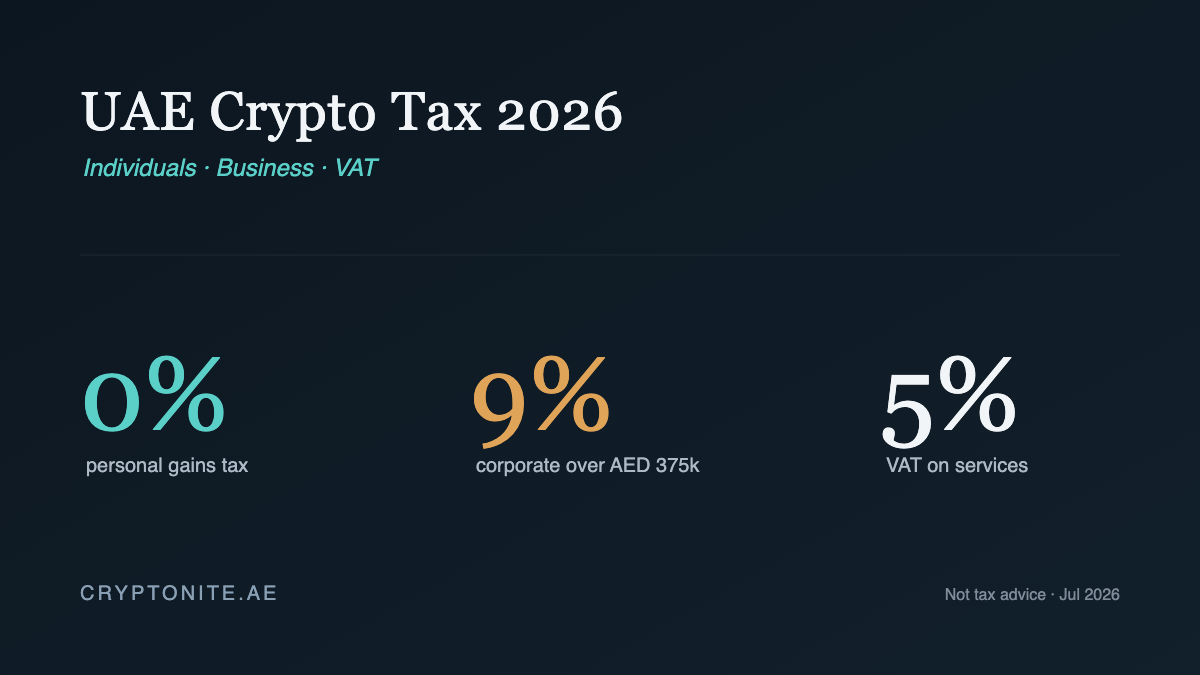
The UAE levies no personal income tax and no capital gains tax. For an individual investing personally — buying, holding and selling crypto — profits are generally not taxed, whether from spot trading, derivatives, or long-term holding. There is no personal crypto tax return to file.
The key word is personally. The moment your activity looks less like personal investing and more like a business — scale, regularity, staff, marketing, acting for others — the Federal Tax Authority may treat it differently (see below).
Businesses: 9% corporate tax above AED 375,000
The UAE introduced a 9% federal corporate tax on business profits exceeding AED 375,000 per year (profits below that are taxed at 0%). If crypto is a company’s primary or incidental business activity — trading desks, mining operations, staking-as-a-service, brokerage, or running an exchange — those profits fall within the corporate tax net.
- Personal investor → generally no tax
- Crypto business (mainland) → 9% on taxable profit over AED 375,000
- Free-zone crypto business → potentially 0% on qualifying income (see below)
Free zones: potential 0% on qualifying income
A “Qualifying Free Zone Person” (in zones such as DMCC) can access a 0% corporate tax rate on qualifying income, provided it meets substance, audit and qualifying-activity conditions. This is not automatic and non-qualifying income is still taxed at 9% — the criteria are technical and worth professional review before relying on them.
VAT: virtual-asset transfers exempt, services still 5%
The UAE Federal Tax Authority confirmed that transferring and converting virtual assets is exempt from the 5% VAT — a treatment applied retroactively to January 2018. However, related services — custody, wallet management, and many platform service fees — generally remain subject to 5% VAT in the normal way. The exemption covers the asset movement, not every service around it.
What’s coming: CARF and cross-border reporting
“Tax-free” does not mean “invisible.” The UAE signed the OECD’s Crypto-Asset Reporting Framework (CARF) in July 2025, with cross-border automatic exchange of crypto account information expected to begin around 2028. Individuals still owe tax in their country of tax residence; UAE residency and reporting rules are what determine your obligations.
Personal vs business at a glance
| Activity | Corporate tax | VAT |
|---|---|---|
| Individual buying/holding/selling | None | Transfers exempt |
| Mainland crypto company | 9% over AED 375k | 5% on taxable services |
| Qualifying free-zone company | 0% on qualifying income | 5% on taxable services |
| Custody / wallet / platform services | Per entity | Generally 5% |
Frequently asked questions
Is crypto tax-free in the UAE?
For individuals investing personally, yes — there is no personal income or capital gains tax on crypto profits. Crypto businesses can face 9% corporate tax on profits above AED 375,000, and some services carry 5% VAT.
Do I pay capital gains tax on crypto in Dubai?
No. The UAE does not levy capital gains tax on individuals, so personal crypto gains are not taxed. Note that you may still owe tax in another country if you are tax-resident there.
Does the 9% corporate tax apply to crypto trading?
If the trading is conducted as a business (a company, or activity of a business nature), profits over AED 375,000 are subject to 9% corporate tax. Purely personal investing is not.
Is there VAT on buying crypto in the UAE?
Transferring and converting virtual assets is VAT-exempt (retroactive to 2018). Services such as custody and wallet management generally remain subject to 5% VAT.
Related coverage
Cryptonite is independent of the projects it covers. This guide is general information and not tax, legal or financial advice. Tax treatment depends on your specific circumstances and residency, and rules change — always confirm with the UAE Federal Tax Authority or a qualified tax advisor. See our Editorial Policy.