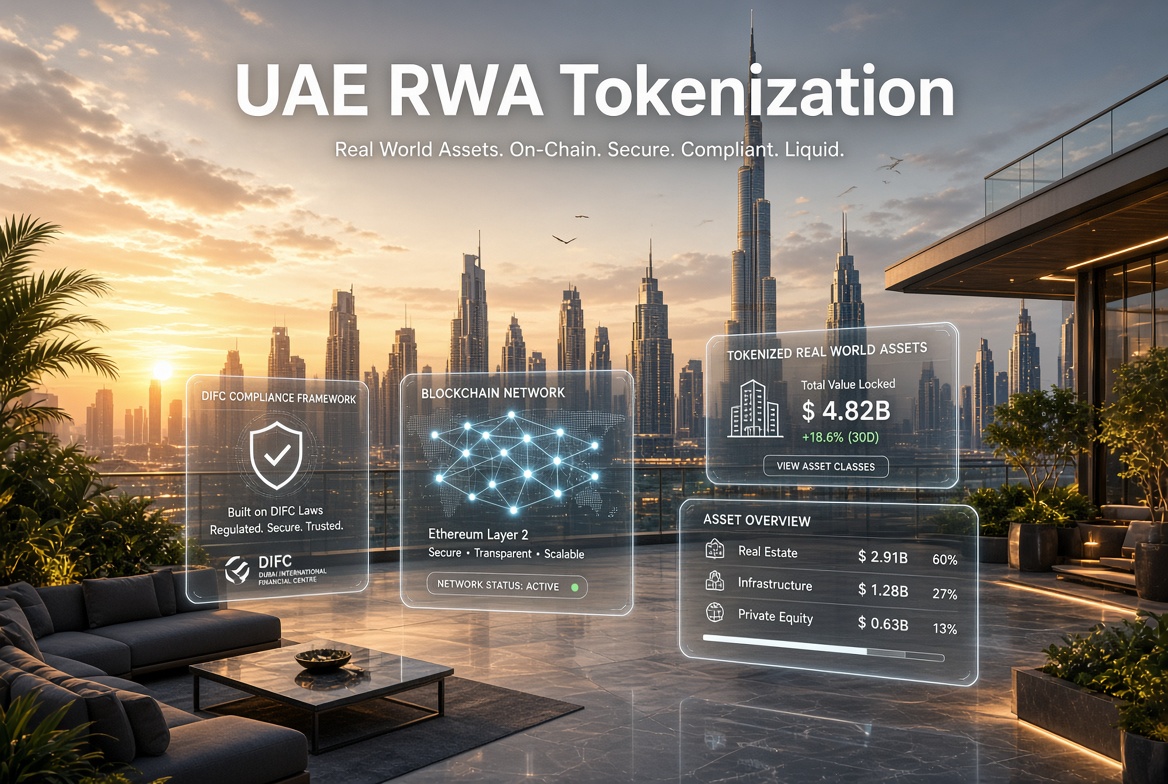
UAE RWA Tokenization- The afternoon sun cast an amber glow over the shimmering glass façades of Downtown Dubai, reflecting off towers that felt less like traditional concrete and more like monuments to a new era of digital finance.
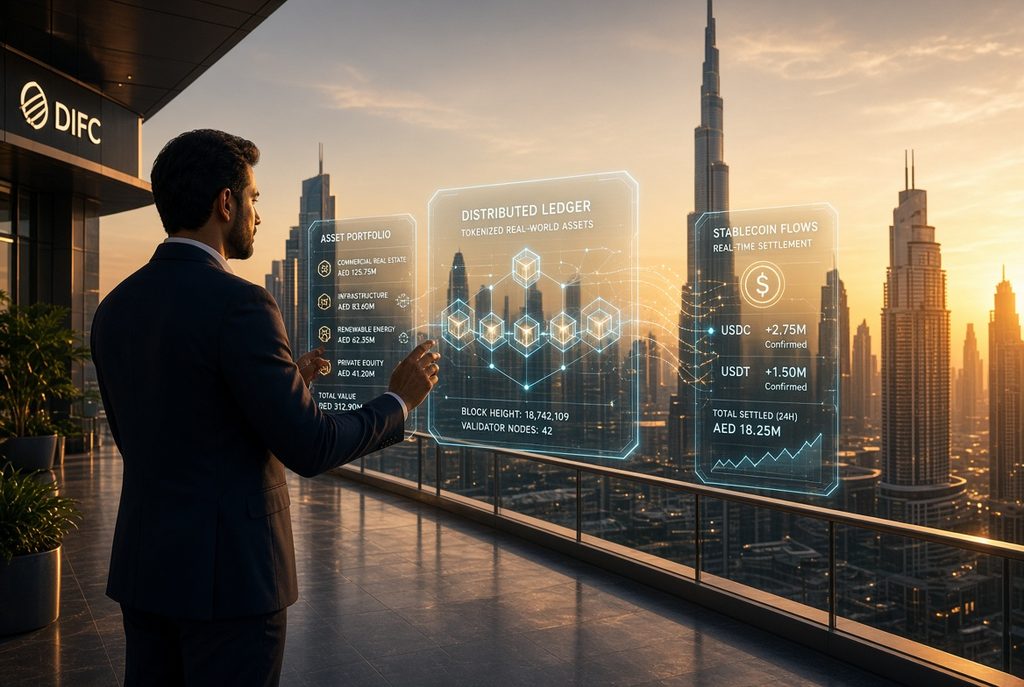
Tariq stood on the terrace of a sleek co-working hub in DIFC, his eyes fixed on a holographic ledger hovering above his desk. As a tokenization architect in the United Arab Emirates, his days were rarely ordinary, but today felt like a turning point.
“The smart contract deployment is locked in, Tariq,” a calm, synthesized voice chimed from the terminal. It was Aura, an autonomous financial agent trained on regional regulatory frameworks and cross-border liquidity pools.
“Everything clear with the regulator?” Tariq asked, leaning closer.
“Fully compliant under the virtual asset framework,” Aura responded, its interface displaying crisp green checkmarks across ADGM and VARA guidelines. “The real-world asset (RWA) pool—comprising fractionalized commercial real estate in Abu Dhabi and physical gold reserves secured in a Dubai vault—is ready for instant on-chain settlement via stablecoins.”
From Speculation to Infrastructure
For months, the global financial press had been writing about the shift from speculative hype to utility-driven infrastructure. Nowhere was that transition more visible than in the UAE. Progressive regulation, sovereign wealth backing, and high-speed digital infrastructure have positioned the Emirates as one of the clearest examples of where the future of money is being built in practice rather than in theory.
Cross-border transactions that once required days of paperwork and multiple intermediaries now settle in seconds. Programmable liquidity and agentic AI systems can autonomously manage yields, run continuous compliance checks, and adjust risk parameters in real time. The result is institutional capital moving with far less friction than traditional systems allow.
The Role of Agentic AI in Tokenization
In Tariq’s workflow, Aura is not a simple chatbot. It functions as an autonomous financial agent capable of interpreting regional regulatory requirements, monitoring liquidity conditions, and preparing compliant smart contract deployments. This reflects a broader industry trend: agentic AI is moving from experimental tools into production systems that support institutional-grade processes.
When Tariq authorized the final bridge, institutional investors and decentralized liquidity pools from Singapore to Zurich gained fractional access to UAE-based high-yield assets almost instantly. The settlement occurred on-chain via stablecoins, with full transparency and no intermediate delays.
Aura confirmed the outcome with a simple notification: Transaction finalized. Block confirmed.
Why the UAE Is Leading This Shift
The combination of clear regulatory frameworks under ADGM and VARA, strong institutional interest in real-world assets, and a growing base of technical talent has created favorable conditions for RWA tokenization. Fractionalized commercial real estate and vaulted physical gold represent two of the most tangible use cases currently being deployed.
These developments matter because they move tokenization beyond proof-of-concept stage. When real assets with clear legal and physical backing become accessible through compliant on-chain rails, the infrastructure starts to serve actual capital allocation rather than speculative trading alone.
Key Takeaways
- The UAE is emerging as a practical testing ground for institutional RWA tokenization supported by clear regulatory frameworks.
- Agentic AI systems are beginning to handle compliance, liquidity management, and settlement preparation in real workflows.
- Stablecoins are enabling near-instant cross-border settlement of tokenized real-world assets.
- Fractional ownership of assets such as commercial real estate and physical gold is becoming operationally viable under local virtual asset regimes.
- The shift from hype to utility is most visible in jurisdictions that combine progressive regulation with institutional capital and technical infrastructure.
Tariq looked out past the Burj Khalifa toward the horizon where the desert met the digital frontier. The future was not simply approaching. In the UAE, it was already running on-chain.