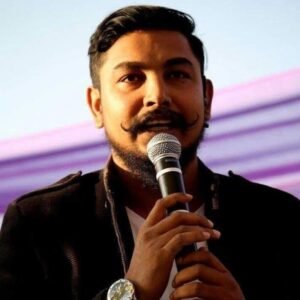
Innovation City Ras Al Khaimah – Every technology that remade the world arrived in costume. Electricity debuted as a light show. The internet looked like a toy for academics. On Aura 8 Episode 82, Vaibhavv Ali put the current costume on the table: AI is the engine. Gaming is the Trojan horse.
His guest was Paul Dawalibi, CEO of Innovation City Ras Al Khaimah — the rebranded, technology-first free zone that began life as RAK DAO (the RAK Digital Assets Oasis). Twenty-five years as a founder, hired-gun CEO, and VC across Silicon Valley, Canada, and the Gulf sit behind the pitch. The claim is not that RAK should clone Dubai. It is that RAK can do what Dubai’s cost base makes hard: put the whole team in one room.
Table of Contents
- The dual engine: gaming built the stack AI now runs on
- Why three billion players already accepted the future
- From RAK DAO to Innovation City
- Density of intensity — and why Dubai splits the org chart
- Hub comparison
- A free zone that sells outcomes, not licenses
- Rapid-fire: sovereign AI, events, robotics, humanity
- Key takeaways
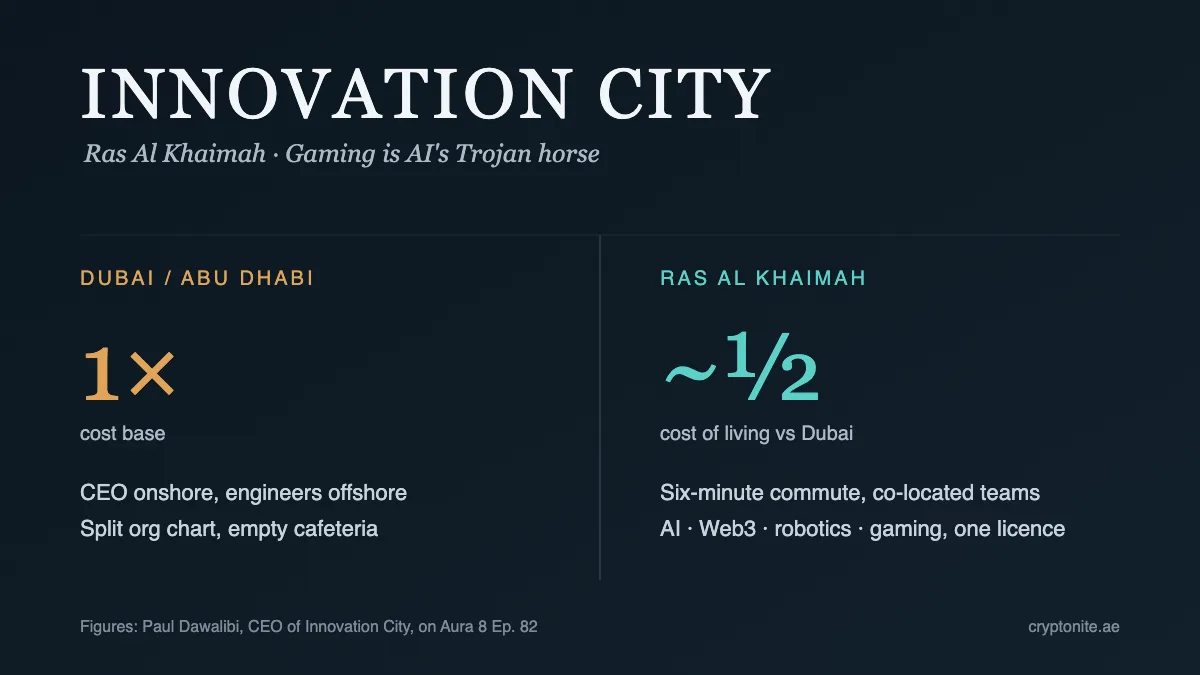
Dawalibi is building what he calls a Silicon Valley of the Middle East in the northern emirates — not by copying San Francisco, but by copying the Valley towns forty-five minutes outside it. Cost of living roughly half of Dubai. A six-minute commute. Co-located engineers instead of a CEO in DIFC and a backlog in another time zone. Gaming, in this telling, is not a vertical on the side of AI. It is how three billion people already live inside interactive systems, digital ownership, and — next — intelligent agents.
The dual engine: gaming built the stack AI now runs on
Headlines still treat games and models as separate industries. The hardware history does not.
| Gaming | Artificial intelligence | |
|---|---|---|
| Role | Compute and hardware engine | Creation and agent engine |
| What it funded | Massively parallel GPUs, frame-rate wars, 3D pipelines | Training and inference on that same silicon |
| What it returns | Intelligent NPCs, generated worlds, solo-studio production | Demand for more GPUs, more data centers, more interactive surfaces |
Before GPUs trained language models, they rendered games. Consumer demand for higher frame rates and denser 3D scenes is what paid NVIDIA and peers to invent the parallel machines modern AI sits on. The stack was not invented in a boardroom. It was subsidized by players.
The loop now runs the other way. Generative models collapse art, environment, and NPC design that used to require a studio bench. Content stops being the bottleneck reserved for incumbents. Independents ship worlds.
THE DUAL-ENGINE ECOSYSTEM

   GAMING  ──drove GPU parallel computing──►  ARTIFICIAL INTELLIGENCE
   (compute / HW)                              (creation / agents)
        ▲                                              │
        └── democratized assets, intelligent NPCs ─────┘

                    NEXT-GEN DIGITAL ECONOMY
Why three billion players already accepted the future
Ali’s line on the show is the one that should travel: gaming is not the fun corner of tech. Gaming is the delivery mechanism.
More than three billion people already inhabit interactive systems every day. They already treat virtual items as property. They already navigate software economies without reading a white paper. That is the onboarding layer Web3 spent a decade trying to force through documentation. Games did it as play.
Neither host claims to be digitally native. They watched Web 0 in the street, then Web 1, 2, 3 — and now whatever sits on top of models and stablecoins. The next cohort will not arrive through a deck. They will arrive through a world that talks back.
Cities that still try to photocopy Silicon Valley while ignoring that costume will keep building the wrong front door.
From RAK DAO to Innovation City Ras Al Khaimah
The free zone most of the UAE Web3 circuit knew as RAK DAO did not vanish. It widened.
Dawalibi’s reason for the pivot is customer-shaped. Crypto was the first beachhead. The companies walking in now do not live in one vertical. The same startup may run a ledger, an inference pipeline, a game client, and a robot in the same quarter. A license built only for tokens ages the day the stack converges.
Innovation City’s map is explicit: AI and machine learning, Web3, robotics and physical AI, gaming and spatial computing — one jurisdiction, one operating system.
INNOVATION CITY
         AI & ML ────────────┬──────────── Web3
                             │
                   CONVERGENT TECH INNOVATION
                             │
         Robotics & Physical AI      Gaming & Spatial Computing
Web3 is not the ex-girlfriend. “I believe that you never forget the girl who took you to the prom,” Dawalibi said. RAK DAO remains the DNA. He flagged work still aimed at that community, plus “big launches” this year and a signature conference targeted for 2027.
Density of intensity — and why Dubai splits the org chart
Dawalibi coined density of intensity for a reason Silicon Valley operators already feel in their bones: enough driven people in the same physical radius and the work changes. Ideas collide. Execution speeds up.
Dubai and Abu Dhabi, he was careful to say, are extraordinary. Dubai belongs on any serious top-ten cities list. What works against a builder cluster is the bill. Companies that relocate there typically import the CEO and a thin executive layer. Developers stay in India, Pakistan, Jordan, Syria — anywhere the burn rate still works. The org chart is split. The cafeteria is empty. You do not get Palo Alto. You get a holding company with Slack.
RAK’s cost of living, on his numbers, is roughly half of Dubai. That is the permission structure to move the engineers, not just the letterhead.
The geographic metaphor is the one that landed. Founders who “go west” in the United States rarely plant in San Francisco proper. They plant in Los Altos, Palo Alto, Cupertino, Mountain View — forty-five minutes from the noise. RAK is that town to Dubai’s city: an hour to an hour and a half from the meetings, outside the chaos, with a commute Dawalibi timed at six minutes even with Wynn-related roadworks. Without the cones, he joked, three.
Ali, who has run RAK DAO paper himself and hosted the team at India Blockchain Week in Bangalore, added the founder-math version: Dubai and Abu Dhabi are viable for people who can already afford them. Developers at the start of the curve need a cheaper northern door, with Dubai still a planned drive away.
Hub comparison
| Hub metric | Traditional metropolitan hubs | Innovation City (Ras Al Khaimah) |
|---|---|---|
| Operational overhead | High real estate and staffing | ~50% lower cost of living and setup |
| Team concentration | Executives onshore, engineers offshore | Co-located engineering and leadership |
| Friction and noise | Traffic, density, distraction | Six-minute commute, focused environment |
| Ecosystem design | Generic commercial licensing | AI, Web3, robotics, gaming, spatial compute |
| Analog | San Francisco | The Valley towns outside it |
A free zone that sells outcomes, not licenses
The product claim is cultural as much as legal. Dawalibi has sat in the founder chair. He argues that most free zones sell a certificate. Innovation City is supposed to sell support designed by someone who has already felt the pain points.
Regulation, in this model, has to attach to capability, not to last year’s narrative. Anchor a zone only to tokens, or only to AI, and the next pivot orphans the tenant. Convergence is the default stack now: ledger, model, interface, sometimes a machine.
The longer horizon is economic. As agents absorb routine cognition, value migrates to creation, entertainment, and experience. A zone that already houses gaming and spatial computing is underwriting the demand side of that shift, not only the data-center side.
Rapid-fire: sovereign AI, events, robotics, humanity
Ali closed with yes/no pressure. The useful answers were the hedged ones.
- Ban foreign-cloud AI for government-contract work? It depends. Sensitive data should stay in UAE sovereign facilities. Non-sensitive workloads do not need the same fence.
- Ship in your underwear and skip every conference? Probably beats the circuit — and still get off the couch. “Greatness is not achieved sitting in your underwear.” Business still happens with people.
- Will robotics and physical AI create more real jobs in RAK than Web3 tokens? Short term, no. Long term, yes. He would not name the near-term “something cool” on the robotics side.
- World-first AI-powered free zone — slogan or edge? Edge, he said: scale of a zone twenty times larger, with a fraction of the staff, if the agents work.
- By 2028, best Web3 events half the size and twice as useful? More useful, he hopes. Half the size, he does not.
What he wished had been asked: do not lose the humanity. Soft skills get more expensive as models get better at the rest. Also unprompted: a book is coming, and his CNBC show Game Changers returns with a wider brief — which means at least one RAK-to-Dubai drive a week.
Key takeaways
- Gaming funded the GPUs. AI is now paying them back with generated worlds and agent NPCs.
- Three billion players already live in the interface AI needs. They did not read the white paper.
- Innovation City Ras Al Khaimah is RAK DAO grown into a multi-stack free zone: AI, Web3, robotics, gaming.
- Density of intensity requires co-located teams. Dubai’s cost base usually forbids that. RAK’s, on his telling, does not.
- Treat RAK as Palo Alto to Dubai’s San Francisco — close enough for capital, quiet enough to ship.
- Fundamentals outlast the rotation from crypto to gaming to AI. Convergence is the stack. Human-to-human skill is the scarce layer.
FAQ: Innovation City Ras Al Khaimah
What is Innovation City Ras Al Khaimah?
Innovation City is the technology-focused free zone in Ras Al Khaimah, UAE, formerly known as RAK Digital Assets Oasis (RAK DAO). It licenses companies across AI and machine learning, Web3, robotics and physical AI, and gaming and spatial computing under one jurisdiction.
Why did RAK DAO rebrand as Innovation City?
According to CEO Paul Dawalibi on Aura 8 Episode 82, the companies applying no longer fit a single vertical. A startup may run a ledger, an inference pipeline and a game client at once, so a licence built only for tokens ages as the stack converges.
How does Ras Al Khaimah compare with Dubai for startups?
On the CEO’s own figures, RAK’s cost of living is roughly half of Dubai’s, the commute is about six minutes, and Dubai meetings are an hour to ninety minutes away. He positions RAK as the Palo Alto to Dubai’s San Francisco: close enough for capital, cheap enough to co-locate engineers.
Why does the episode call gaming AI’s Trojan horse?
Consumer demand for games funded the parallel GPUs that AI models now train on, and more than three billion players already live inside interactive economies with digital ownership. That installed base is the onboarding layer AI agents and Web3 have struggled to build through documentation.
This article is for informational purposes only and does not constitute financial, investment, or legal advice.